QUESTION IMAGE
Question
genetic diversity vs. soil salt concentration
use the information and your knowledge of science to answer the question.
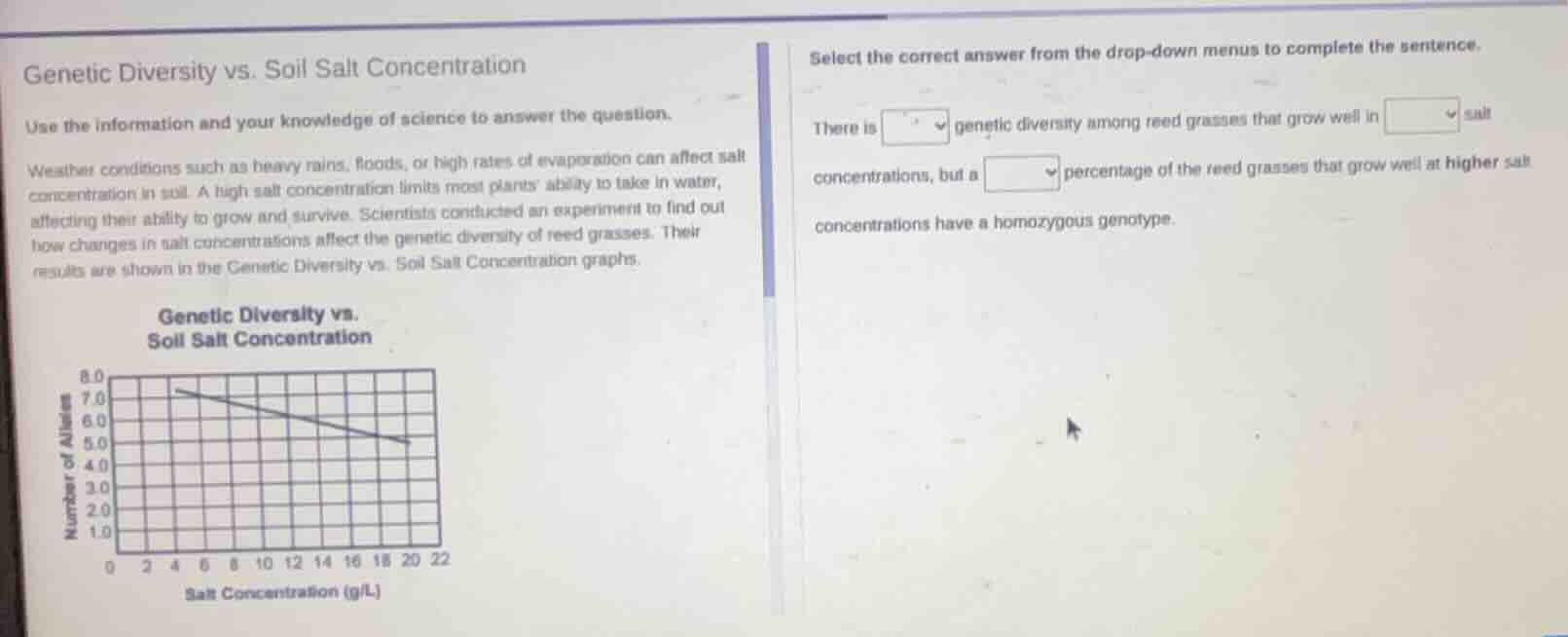
weather conditions such as heavy rains, floods, or high rates of evaporation can affect salt concentration in soil. a high salt concentration limits most plants ability to take in water, affecting their ability to grow and survive. scientists constructed an experiment to find out how changes in salt concentrations affect the genetic diversity of reed grasses. their results are shown in the genetic diversity vs. soil salt concentration graphs.
genetic diversity vs.
soil salt concentration
select the correct answer from the drop - down menus to complete the sentence.
there is genetic diversity among reed grasses that grow well in salt concentrations, but a percentage of the reed grasses that grow well at higher salt concentrations have a homozygous genotype.
- From the graph, as soil salt concentration (x-axis) increases, the number of alleles (a measure of genetic diversity, y-axis) decreases. So reed grasses growing well in higher salt concentrations have low genetic diversity.
- In environments with high selective pressure (like high salt), organisms with the adapted (homozygous) genotype are more likely to survive and reproduce. This leads to a high percentage of surviving plants having a homozygous genotype suited to the harsh conditions.

Snap & solve any problem in the app
Get step-by-step solutions on Sovi AI
Photo-based solutions with guided steps
Explore more problems and detailed explanations
There is low genetic diversity among reed grasses that grow well in higher salt concentrations, but a high percentage of the reed grasses that grow well at higher salt concentrations have a homozygous genotype.