QUESTION IMAGE
Question
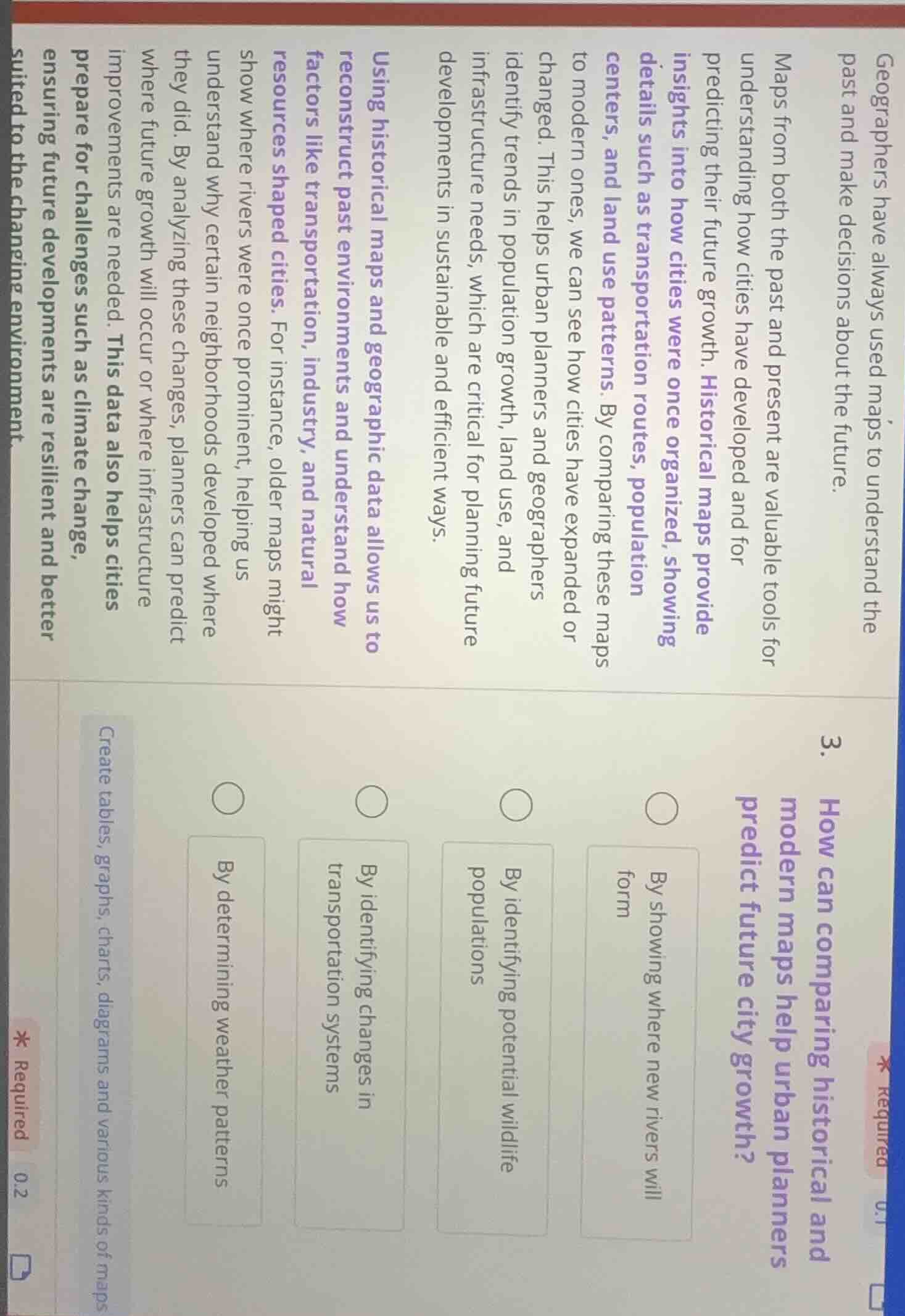
geographers have always used maps to understand the past and make decisions about the future.
maps from both the past and present are valuable tools for understanding how cities have developed and for predicting their future growth. historical maps provide insights into how cities were once organized, showing details such as transportation routes, population centers, and land use patterns. by comparing these maps to modern ones, we can see how cities have expanded or changed. this helps urban planners and geographers identify trends in population growth, land use, and infrastructure needs, which are critical for planning future developments in sustainable and efficient ways.
using historical maps and geographic data allows us to reconstruct past environments and understand how factors like transportation, industry, and natural resources shaped cities. for instance, older maps might show where rivers were once prominent, helping us understand why certain neighborhoods developed where they did. by analyzing these changes, planners can predict where future growth will occur or where infrastructure improvements are needed. this data also helps cities prepare for challenges such as climate change, ensuring future developments are resilient and better suited to the changing environment.
- *required
how can comparing historical and modern maps help urban planners predict future city growth?
○ by showing where new rivers will form
○ by identifying potential wildlife populations
○ by identifying changes in transportation systems
○ by determining weather patterns
- required
create tables, graphs, charts, diagrams and various kinds of maps
The passage states that comparing historical and modern maps lets planners identify trends in population growth, land use, and infrastructure needs to predict future growth. The other options are not supported: the text does not mention new rivers forming, wildlife, or weather patterns as uses for these map comparisons.

Snap & solve any problem in the app
Get step-by-step solutions on Sovi AI
Photo-based solutions with guided steps
Explore more problems and detailed explanations
None of the provided options correctly match the passage. However, based on the text, the correct reasoning is that comparing historical and modern maps helps identify trends in population growth, land use, and infrastructure needs to predict future city growth.
Note: The given multiple-choice options do not align with the content of the provided passage. The passage does not reference rivers forming, wildlife, weather patterns, or transportation system changes as methods for predicting future growth; instead, it focuses on population, land use, and infrastructure trends.