QUESTION IMAGE
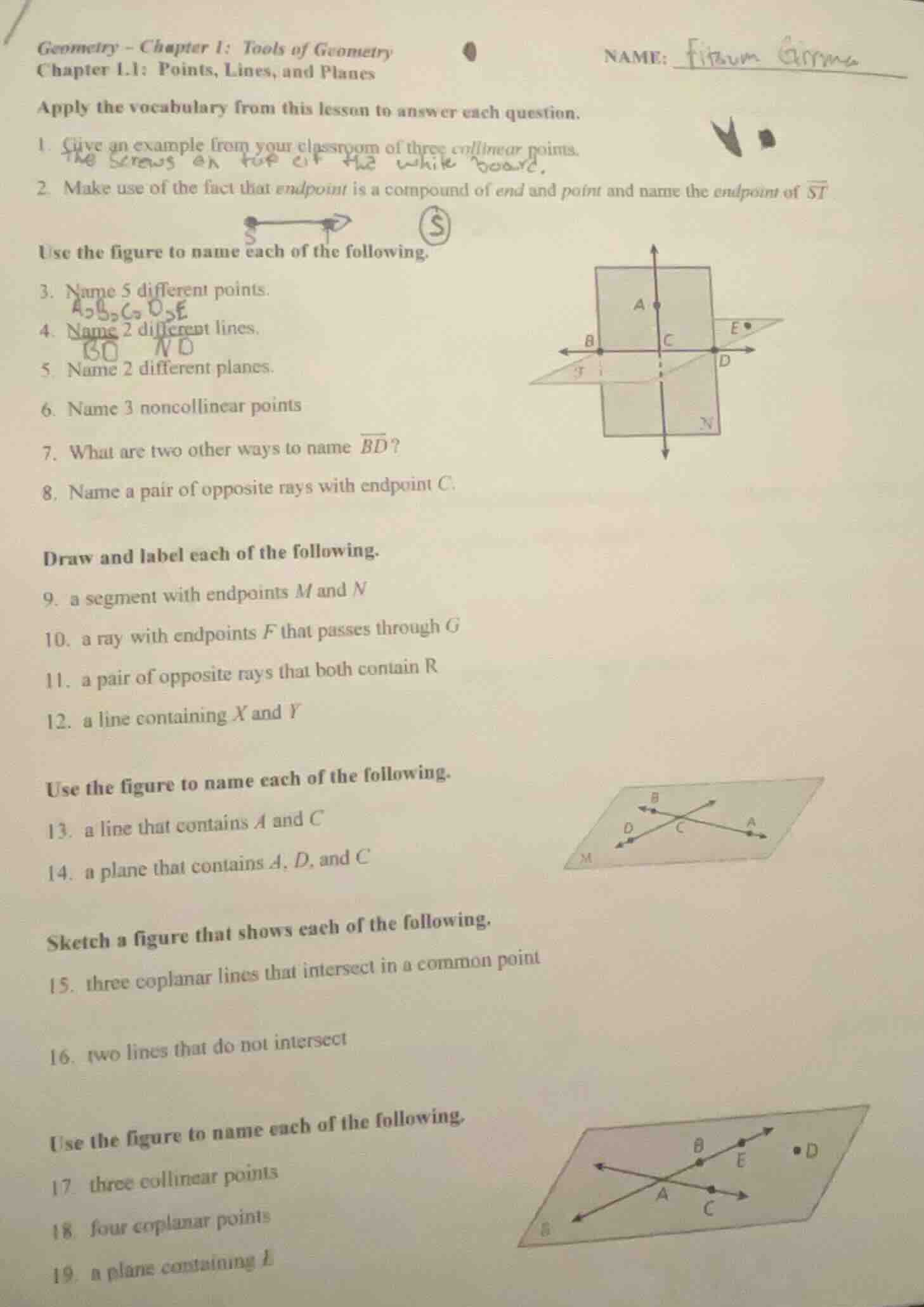
Question
geometry - chapter 1: tools of geometry
chapter 1.1: points, lines, and planes
name:
apply the vocabulary from this lesson to answer each question.
- give an example from your classroom of three collinear points.
- make use of the fact that endpoint is a compound of end and point and name the endpoint of \\(\overline{st}\\)
use the figure to name each of the following.
- name 5 different points.
- name 2 different lines.
- name 2 different planes.
- name 3 noncollinear points
- what are two other ways to name \\(\overline{bd}\\)?
- name a pair of opposite rays with endpoint c.
draw and label each of the following.
- a segment with endpoints m and n
- a ray with endpoints f that passes through g
- a pair of opposite rays that both contain r
- a line containing x and y
use the figure to name each of the following.
- a line that contains a and c
- a plane that contains a, d, and c
sketch a figure that shows each of the following.
- three coplanar lines that intersect in a common point
- two lines that do not intersect
use the figure to name each of the following.
- three collinear points
- four coplanar points
- a plane containing l
Brief Explanations
- Collinear points lie on the same line; classroom examples are common fixed points on a straight object.
- A segment $\overline{ST}$ has its first labeled point as the endpoint.
- Identify distinct labeled points in the first figure.
- Lines are defined by 2 collinear points in the first figure.
- Planes are flat surfaces labeled in the first figure.
- Noncollinear points do not lie on the same line in the first figure.
- A line can be named by any 2 points on it, in either order.
- Opposite rays share an endpoint and form a straight line from point $C$.
- A segment has two distinct endpoints connected by a straight line.
- A ray has an endpoint and extends infinitely through a second point.
- Opposite rays share endpoint $R$ and form a straight line.
- A line extends infinitely in both directions through two points.
- Identify the line containing points $A$ and $C$ in the second figure.
- The plane containing $A, D, C$ is the labeled flat surface in the second figure.
- Coplanar lines lie on the same flat surface and meet at one common point.
- Non-intersecting lines can be parallel (coplanar) or skew (noncoplanar).
- Collinear points lie on the same straight line in the third figure.
- Coplanar points lie on the same flat surface in the third figure.
- The plane containing $L$ is the labeled flat surface in the third figure.

Snap & solve any problem in the app
Get step-by-step solutions on Sovi AI
Photo-based solutions with guided steps
Explore more problems and detailed explanations
- Example: The three screw holes along the top edge of a whiteboard (any valid classroom collinear points work)
- $S$
- $A, B, C, D, E$
- $\overleftrightarrow{BD}, \overleftrightarrow{AN}$
- Plane $Y$, Plane $N$
- $A, B, E$
- $\overleftrightarrow{DB}, \overleftrightarrow{BC}$ (or $\overleftrightarrow{CD}$, since all are on the same line)
- $\overrightarrow{CB}$ and $\overrightarrow{CD}$
- (Draw a straight line segment with endpoints labeled $M$ and $N$)
- (Draw a ray with endpoint $F$, extending infinitely through a point labeled $G$, written as $\overrightarrow{FG}$)
- (Draw a straight line with endpoint $R$, and label opposite rays e.g., $\overrightarrow{RP}$ and $\overrightarrow{RQ}$ where $P-R-Q$ are collinear)
- (Draw a line extending infinitely in both directions through points labeled $X$ and $Y$, written as $\overleftrightarrow{XY}$)
- $\overleftrightarrow{AC}$ (or $\overleftrightarrow{AB}$, $\overleftrightarrow{AD}$ since all are on the same line)
- Plane $M$
- (Draw a flat plane with three lines all intersecting at a single common point)
- (Draw two parallel lines on a plane, or two skew lines on separate planes)
- $B, A, C$ (or $E, A, C$)
- $B, A, C, D$ (any four points on the labeled plane)
- Plane $L$ (the labeled plane containing point $L$)