QUESTION IMAGE
Question
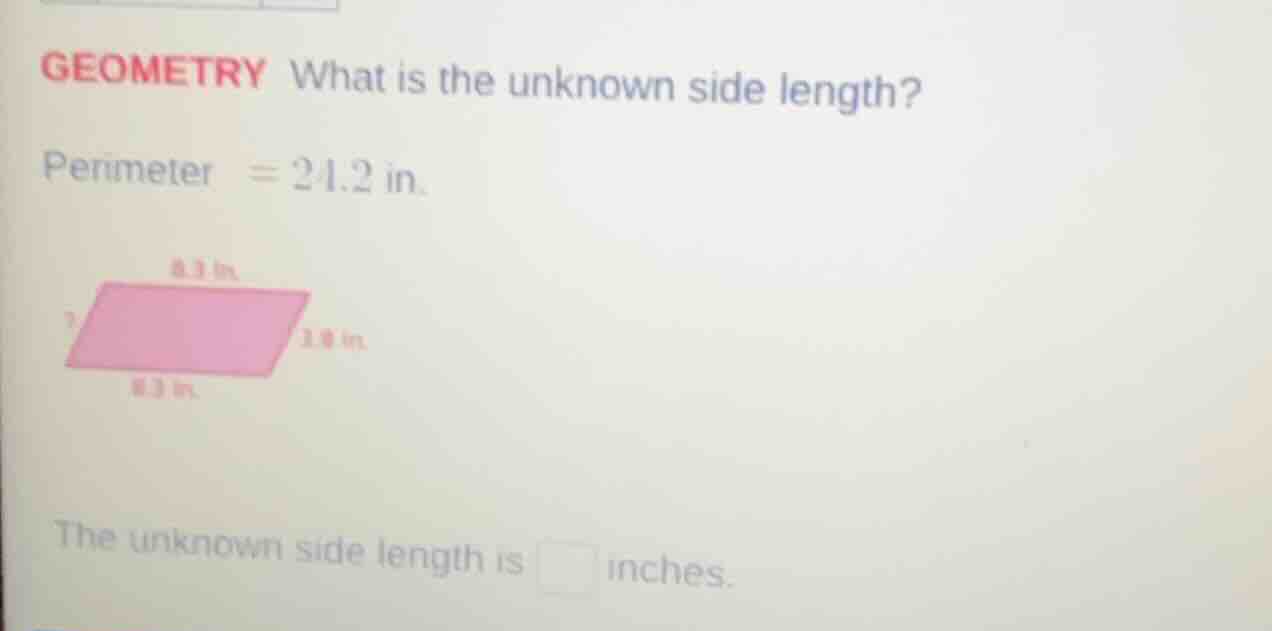
geometry what is the unknown side length? perimeter = 24.2 in. image of a parallelogram with two sides labeled 6.3 in, one side labeled 3.8 in, and one side unknown the unknown side length is \boxed{} inches.
Step1: Recall perimeter formula for parallelogram
A parallelogram has opposite sides equal. So perimeter \( P = 2(a + b) \), where \( a \) and \( b \) are adjacent sides. Let the unknown side be \( x \), known sides are \( 6.3 \) in and \( x \) (wait, no, the given sides: two sides are \( 6.3 \) in, and one is \( 3.8 \) in? Wait, the figure: top and bottom are \( 6.3 \) in, one side is \( 3.8 \) in, and the unknown is the other side (since opposite sides equal). So perimeter \( P = 2(6.3 + x) \)? Wait no, wait the given perimeter is \( 24.2 \) in. Wait, maybe the sides: two sides of length \( 6.3 \) and two sides of length \( x \)? Wait no, the figure shows top \( 6.3 \), bottom \( 6.3 \), one side \( 3.8 \)? Wait, maybe I misread. Wait, the problem: perimeter is \( 24.2 \) in. Let's denote the unknown side as \( x \). In a parallelogram, opposite sides are equal, so perimeter is \( 2\times(6.3 + x) \)? Wait no, if one side is \( 6.3 \), another is \( x \), then perimeter is \( 2(6.3 + x) \). Wait, but maybe the given side is \( 3.8 \)? Wait the image: the parallelogram has top \( 6.3 \) in, bottom \( 6.3 \) in, one side \( 3.8 \) in, and the unknown is the other side (so opposite to \( 3.8 \) is also \( 3.8 \)? No, that can't be. Wait, maybe the sides are \( 6.3 \), \( 6.3 \), \( x \), \( x \). Wait perimeter is sum of all sides: \( 6.3 + 6.3 + x + x = 24.2 \). Let's check: \( 6.3 + 6.3 = 12.6 \), so \( 12.6 + 2x = 24.2 \). Then \( 2x = 24.2 - 12.6 = 11.6 \), so \( x = 5.8 \)? Wait no, wait maybe the given side is \( 3.8 \). Wait, maybe the figure has sides \( 6.3 \), \( 3.8 \), \( 6.3 \), and \( x \). So perimeter is \( 6.3 + 3.8 + 6.3 + x = 24.2 \). Let's calculate that: \( 6.3 + 3.8 = 10.1 \), \( 10.1 + 6.3 = 16.4 \), so \( 16.4 + x = 24.2 \), so \( x = 24.2 - 16.4 = 7.8 \)? Wait, no, that doesn't make sense. Wait, maybe I misread the given side. Wait the problem: "Perimeter = 24.2 in. The figure: top 6.3 in, bottom 6.3 in, one side 3.8 in, unknown side? Wait, no, maybe the sides are \( 6.3 \), \( x \), \( 6.3 \), \( x \), and perimeter is \( 2(6.3 + x) = 24.2 \). Let's solve that: \( 6.3 + x = 24.2 / 2 = 12.1 \), so \( x = 12.1 - 6.3 = 5.8 \). Wait, but maybe the given side is \( 3.8 \). Wait, the user's image: maybe the side is \( 3.8 \) in. Wait, let's re-express. Let's denote:
Let the unknown side be \( x \). The perimeter of a parallelogram is \( 2 \times ( \text{length} + \text{width} ) \). Suppose length is \( 6.3 \) in, width is \( x \). Then \( 2(6.3 + x) = 24.2 \).
Step2: Solve for \( x \)
Divide both sides by 2: \( 6.3 + x = \frac{24.2}{2} = 12.1 \)
Subtract \( 6.3 \) from both sides: \( x = 12.1 - 6.3 = 5.8 \)
Wait, but maybe the other side is \( 3.8 \). Wait, maybe I misread the figure. Wait the user's image: the parallelogram has one side \( 3.8 \) in, top and bottom \( 6.3 \) in. So sides: \( 6.3 \), \( 3.8 \), \( 6.3 \), \( 3.8 \)? Then perimeter would be \( 6.3 + 3.8 + 6.3 + 3.8 = 6.3\times2 + 3.8\times2 = 12.6 + 7.6 = 20.2 \), which is not \( 24.2 \). So that's wrong. So the unknown side is not \( 3.8 \), but another side. So the correct approach: perimeter is sum of all sides. Let the unknown side be \( x \). So \( 6.3 + 6.3 + x + x = 24.2 \). So \( 12.6 + 2x = 24.2 \). Then \( 2x = 24.2 - 12.6 = 11.6 \). Then \( x = 11.6 / 2 = 5.8 \). Wait, but that gives \( x = 5.8 \). Wait, but maybe the given side is \( 3.8 \). Wait, maybe the figure has sides \( 6.3 \), \( 3.8 \), \( x \), \( x \)? No, that doesn't fit. Wait, perhaps the original problem has a typo, but based on the given perimeter and the two si…

Snap & solve any problem in the app
Get step-by-step solutions on Sovi AI
Photo-based solutions with guided steps
Explore more problems and detailed explanations
\( 5.8 \)