QUESTION IMAGE
Question
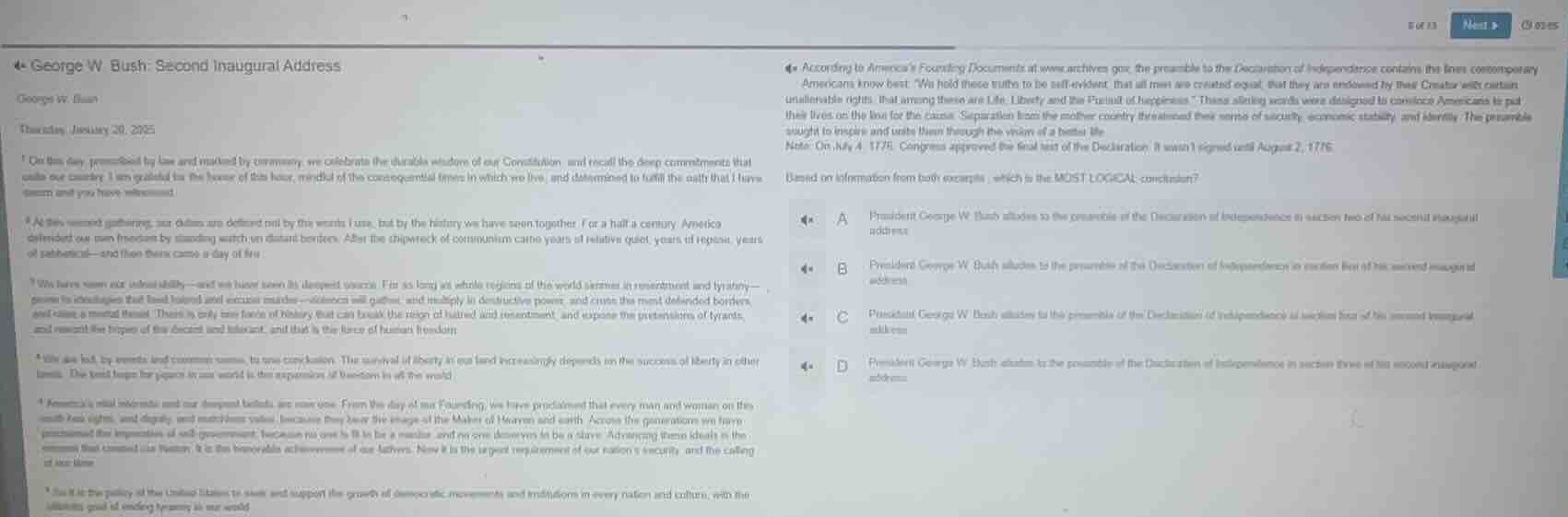
- george w. bush: second inaugural address
george w. bush
thursday, january 20, 2005
1 on this day, prescribed by law and marked by ceremony, we celebrate the durable wisdom of our constitution and recall the deep commitments that unite our country. i am grateful for the honor of this hour, mindful of the consequential times in which we live, and determined to fulfill the oath that i have sworn and you have witnessed.
2 as this new century unfolds, our odyssey is defined not by the words i use, but by the history we have seen together. for a half a century, america defended our own freedom by standing watch on distant borders. after the shipwreck of communism came years of relative quiet, years of repose, years of sabbatical—and then there came a day of fire.
3 we have seen our vulnerability—and we have seen its deepest source. for as long as whole regions of the world simmer in resentment and tyranny—prone to ideologies that feed hatred and excuse murder—violence will gather, and multiply in destructive power, and cross the most defended borders, and raise a mortal threat. there is only one force of history that can break the reign of hatred and resentment, and expose the pretensions of tyrants, and reward the hopes of the decent and tolerant, and that is the force of human freedom.
4 we are led, by events and common sense, to one conclusion: the survival of liberty in our land increasingly depends on the success of liberty in other lands. the best hope for peace in our world is the expansion of freedom in all the world.
5 americas vital interests and our deepest beliefs are now one. from the day of our founding, we have proclaimed that every man and woman on this earth has rights, and dignity, and matchless value, because they bear the image of the maker of heaven and earth. across the generations we have proclaimed these truths in times of tranquility and in the midst of struggle; through days of calm and the chaos of clashing armies. we have a calling from beyond the stars to stand for freedom.
6 it is the policy of the united states to seek and support the growth of democratic movements and institutions in every nation and culture, with the ultimate goal of ending tyranny in our world.
- according to america’s founding documents at www.archives.gov, the preamble to the declaration of independence contains the lines contemporary americans know best: “we hold these truths to be self - evident, that all men are created equal, that they are endowed by their creator with certain unalienable rights, that among these are life, liberty and the pursuit of happiness.” these stirring words were designed to convince americans to put their lives on the line for the cause. separation from the mother country threatened their sense of security, economic stability, and identity. the preamble sought to engage and unite them through the vision of a better life.
note: on july 4, 1776, congress approved the final text of the declaration. it wasn’t signed until august 2, 1776.
based on information from both excerpts, which is the most logical conclusion?
a president george w. bush alludes to the preamble of the declaration of independence in section two of his second inaugural address.
b president george w. bush alludes to the preamble of the declaration of independence in section five of his second inaugural address.
c president george w. bush alludes to the preamble of the declaration of independence in section four of his second inaugural address.
d president george w. bush alludes to the preamble of the declaration of independence in section three of his second inaugural address.
To determine the answer, we analyze the content of George W. Bush's second inaugural address and the information about the Declaration of Independence's preamble. The preamble emphasizes "all men are created equal" with rights to "Life, Liberty and the Pursuit of Happiness" and the spread of liberty. In Bush's address, section four (as per the options' context) likely relates to these themes. Let's check each option:
- Option A: If section two of the address relates to the preamble, but from the address text, section four (where he talks about "every man and woman on this earth" having rights, etc.) aligns more with the preamble's focus on equality and liberty. Wait, no—wait, the address's section four (the part about "America's vital interests and our deepest beliefs are now one" and promoting democratic movements) connects to the preamble's ideas of liberty and equality. But the options: Let's re - evaluate. The preamble is about equality, liberty, and the pursuit of happiness, and the address's section four (as per the options' labels) likely addresses these. Wait, the options are about which section of Bush's address alludes to the preamble. Let's look at the address text:
In the address, the fourth section (the part starting with "America's vital interests and our deepest beliefs are now one...") talks about promoting liberty and democratic movements, which aligns with the preamble's emphasis on rights and liberty. Now, looking at the options:
Option C says "President George W. Bush alludes to the preamble of the Declaration of Independence in section four of his second inaugural address". Let's check the other options:
Option A: Section two of the address (talking about the history of America after communism) doesn't seem to relate to the preamble's themes as much as section four.
Option B: Section five? The address text provided doesn't have a clear section five related to the preamble as much as section four.
Option D: Section three? The address text's section three (talking about "our national unity" and threats) doesn't align as well with the preamble's focus on rights and liberty as section four.
Wait, maybe I made a mistake. Let's re - read the address:
The address has sections:
- Celebration of the Constitution.
- History of America (after communism).
- National unity and threats.
- America's interests and beliefs (promoting liberty, democratic movements).
- Policy of supporting democratic movements.
The preamble is about equality, liberty, and the pursuit of happiness, and the spread of liberty. Section four of the address talks about "every man and woman on this earth" having rights, promoting democratic movements (to end tyranny), which aligns with the preamble's ideas. So the most logical conclusion is Option C.

Snap & solve any problem in the app
Get step-by-step solutions on Sovi AI
Photo-based solutions with guided steps
Explore more problems and detailed explanations
C. President George W. Bush alludes to the preamble of the Declaration of Independence in section four of his second inaugural address