QUESTION IMAGE
Question
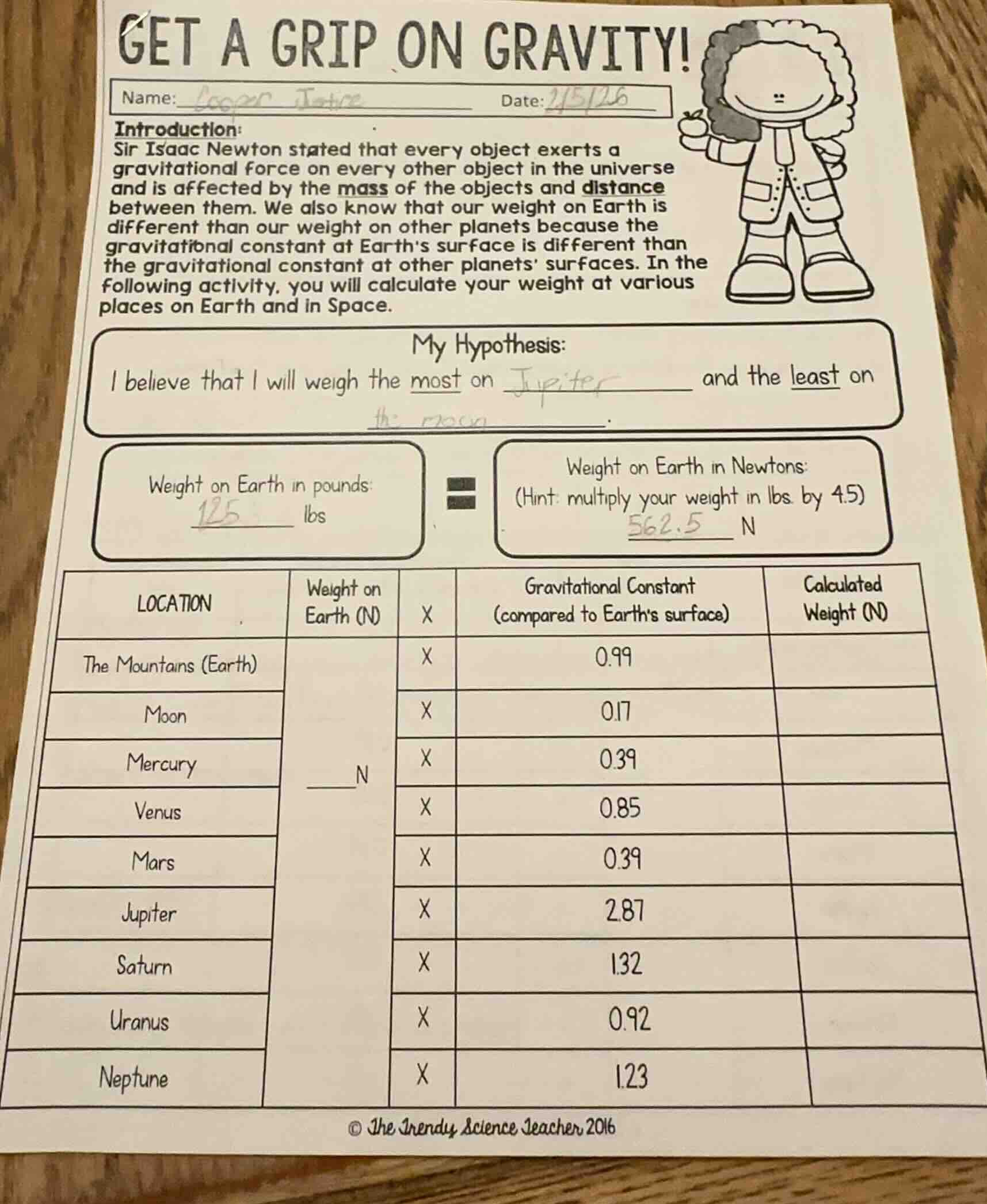
get a grip on gravity!
name: date:
introduction:
sir isaac newton stated that every object exerts a gravitational force on every other object in the universe and is affected by the mass of the objects and distance between them. we also know that our weight on earth is different than our weight on other planets because the gravitational constant at earths surface is different than the gravitational constant at other planets surfaces. in the following activity, you will calculate your weight at various places on earth and in space.
my hypothesis:
i believe that i will weigh the most on and the least on
weight on earth in pounds: lbs
weight on earth in newtons:
(hint: multiply your weight in lbs. by 4.5)
n
location | weight on earth (n) | × | gravitational constant (compared to earths surface) | calculated weight (n)
the mountains (earth) | | × | 0.99 |
moon | | × | 0.17 |
mercury | n | × | 0.39 |
venus | | × | 0.85 |
mars | | × | 0.39 |
jupiter | | × | 2.87 |
saturn | | × | 1.32 |
uranus | | × | 0.92 |
neptune | | × | 1.23 |
© the trendy science teacher 2016
To solve for the calculated weight at each location, we use the formula:
$\text{Calculated Weight (N)} = \text{Weight on Earth (N)} \times \text{Gravitational Constant}$
Step 1: Identify Weight on Earth (N)
From the worksheet, weight on Earth in Newtons is $562.5\ \text{N}$.
Step 2: Calculate Weight for Each Location
We multiply the Earth weight ($562.5\ \text{N}$) by the gravitational constant for each location:
- The Mountains (Earth):
$562.5 \times 0.99 = 556.875\ \text{N}$
- Moon:
$562.5 \times 0.17 = 95.625\ \text{N}$
- Mercury:
$562.5 \times 0.39 = 219.375\ \text{N}$
- Venus:
$562.5 \times 0.85 = 478.125\ \text{N}$
- Mars:
$562.5 \times 0.39 = 219.375\ \text{N}$
- Jupiter:
$562.5 \times 2.87 = 1614.375\ \text{N}$
- Saturn:
$562.5 \times 1.32 = 742.5\ \text{N}$
- Uranus:
$562.5 \times 0.92 = 517.5\ \text{N}$
- Neptune:
$562.5 \times 1.23 = 691.875\ \text{N}$
Filling the Table
| LOCATION | Weight on Earth (N) | × | Gravitational Constant | Calculated Weight (N) |
|---|---|---|---|---|
| Moon | $562.5$ | × | $0.17$ | $95.625$ |
| Mercury | $562.5$ | × | $0.39$ | $219.375$ |
| Venus | $562.5$ | × | $0.85$ | $478.125$ |
| Mars | $562.5$ | × | $0.39$ | $219.375$ |
| Jupiter | $562.5$ | × | $2.87$ | $1614.375$ |
| Saturn | $562.5$ | × | $1.32$ | $742.5$ |
| Uranus | $562.5$ | × | $0.92$ | $517.5$ |
| Neptune | $562.5$ | × | $1.23$ | $691.875$ |
(Note: The "Weight on Earth (N)" column is filled with $562.5$ for all rows, as it is constant.)

Snap & solve any problem in the app
Get step-by-step solutions on Sovi AI
Photo-based solutions with guided steps
Explore more problems and detailed explanations
To solve for the calculated weight at each location, we use the formula:
$\text{Calculated Weight (N)} = \text{Weight on Earth (N)} \times \text{Gravitational Constant}$
Step 1: Identify Weight on Earth (N)
From the worksheet, weight on Earth in Newtons is $562.5\ \text{N}$.
Step 2: Calculate Weight for Each Location
We multiply the Earth weight ($562.5\ \text{N}$) by the gravitational constant for each location:
- The Mountains (Earth):
$562.5 \times 0.99 = 556.875\ \text{N}$
- Moon:
$562.5 \times 0.17 = 95.625\ \text{N}$
- Mercury:
$562.5 \times 0.39 = 219.375\ \text{N}$
- Venus:
$562.5 \times 0.85 = 478.125\ \text{N}$
- Mars:
$562.5 \times 0.39 = 219.375\ \text{N}$
- Jupiter:
$562.5 \times 2.87 = 1614.375\ \text{N}$
- Saturn:
$562.5 \times 1.32 = 742.5\ \text{N}$
- Uranus:
$562.5 \times 0.92 = 517.5\ \text{N}$
- Neptune:
$562.5 \times 1.23 = 691.875\ \text{N}$
Filling the Table
| LOCATION | Weight on Earth (N) | × | Gravitational Constant | Calculated Weight (N) |
|---|---|---|---|---|
| Moon | $562.5$ | × | $0.17$ | $95.625$ |
| Mercury | $562.5$ | × | $0.39$ | $219.375$ |
| Venus | $562.5$ | × | $0.85$ | $478.125$ |
| Mars | $562.5$ | × | $0.39$ | $219.375$ |
| Jupiter | $562.5$ | × | $2.87$ | $1614.375$ |
| Saturn | $562.5$ | × | $1.32$ | $742.5$ |
| Uranus | $562.5$ | × | $0.92$ | $517.5$ |
| Neptune | $562.5$ | × | $1.23$ | $691.875$ |
(Note: The "Weight on Earth (N)" column is filled with $562.5$ for all rows, as it is constant.)