QUESTION IMAGE
Question
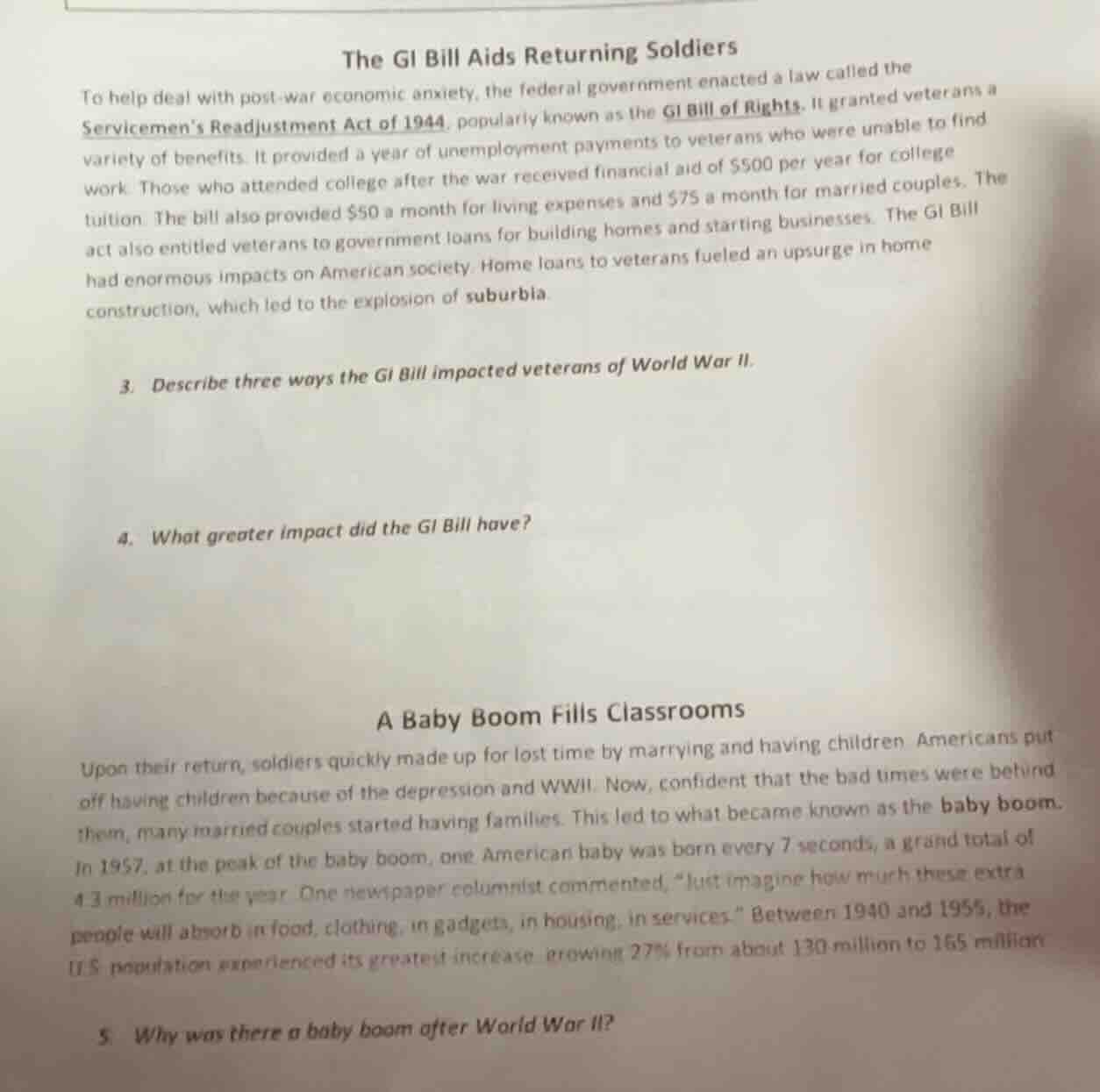
the gi bill aids returning soldiers
to help deal with post-war economic anxiety, the federal government enacted a law called the
servicemens readjustment act of 1944, popularly known as the gi bill of rights. it granted veterans a
variety of benefits. it provided a year of unemployment payments to veterans who were unable to find
work. those who attended college after the war received financial aid of $500 per year for college
tuition. the bill also provided $50 a month for living expenses and $75 a month for married couples. the
act also entitled veterans to government loans for building homes and starting businesses. the gi bill
had enormous impacts on american society. home loans to veterans fueled an upsurge in home
construction, which led to the explosion of suburbia.
- describe three ways the gi bill impacted veterans of world war ii.
- what greater impact did the gi bill have?
a baby boom fills classrooms
upon their return, soldiers quickly made up for lost time by marrying and having children. americans put
off having children because of the depression and wwii. now, confident that the bad times were behind
them, many married couples started having families. this led to what became known as the baby boom.
in 1957, at the peak of the baby boom, one american baby was born every 7 seconds, a grand total of
4.3 million for the year. one newspaper columnist commented, \just imagine how much these extra
people will absorb in food, clothing, in gadgets, in housing, in services.\ between 1940 and 1955, the
u.s. population experienced its greatest increase, growing 27% from about 130 million to 165 million
- why was there a baby boom after world war ii?
For question 3:
- It provided financial support for veterans to attend college, covering tuition and living expenses, helping them pursue higher education.
- It offered a year of unemployment payments to veterans who could not find work, easing post-war financial stress.
- It gave veterans access to government loans to build homes and start businesses, supporting their long-term financial stability and independence.
For question 4:
The GI Bill sparked a massive growth in home construction, which directly led to the rapid expansion of suburban areas (suburbia) across the United States, reshaping the country's residential and social landscape.
For question 5:
Americans had delayed having children during the Great Depression and World War II due to economic hardship and instability. After the war, with the end of the crisis and new economic security (supported by policies like the GI Bill), couples felt confident to start or expand their families, leading to the baby boom.

Snap & solve any problem in the app
Get step-by-step solutions on Sovi AI
Photo-based solutions with guided steps
Explore more problems and detailed explanations
3.
- Covered college tuition/living expenses for veterans.
- Provided 1 year of unemployment payments.
- Offered loans for homes and businesses.
- It fueled a surge in home construction, leading to the explosion of suburbia in the U.S.
- Americans had postponed having children during the Great Depression and WWII; post-war confidence in economic stability (aided by policies like the GI Bill) led couples to start families, causing the baby boom.