QUESTION IMAGE
Question
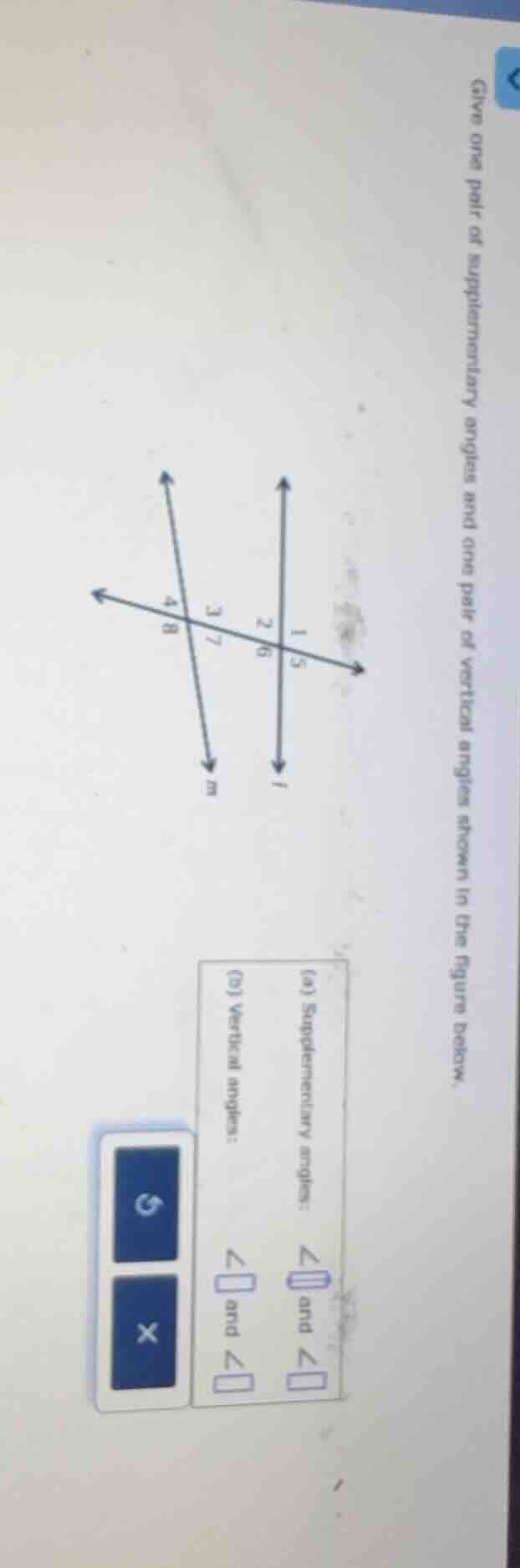
give one pair of supplementary angles and one pair of vertical angles shown in the figure below.
(a) supplementary angles: ∠square and ∠square
(b) vertical angles: ∠square and ∠square
(a) Supplementary Angles
Supplementary angles are two angles whose sum is \(180^\circ\). In the figure, adjacent angles on a straight line are supplementary. For example, \(\angle 1\) and \(\angle 2\) are adjacent and form a linear pair, so their sum is \(180^\circ\). Another example could be \(\angle 1\) and \(\angle 5\) (but \(\angle 1\) and \(\angle 2\) are more straightforward as adjacent on line \(l\) or the transversal). Let's take \(\angle 1\) and \(\angle 2\): they lie on a straight line, so their sum is \(180^\circ\), making them supplementary.
Vertical angles are opposite angles formed by the intersection of two lines. When two lines intersect, vertical angles are equal. For example, when line \(l\) and the transversal intersect, \(\angle 1\) and \(\angle 6\) are vertical angles? Wait, no, let's look at the labels. The lines are \(l\) (vertical arrow) and the transversal (horizontal arrow), and another line \(m\). Wait, the labels: \(\angle 1\), \(\angle 2\), \(\angle 5\), \(\angle 6\) are around line \(l\) and the transversal? Wait, maybe the intersection of the two lines (the transversal and line \(l\)): \(\angle 1\) and \(\angle 6\) are vertical? No, \(\angle 1\) and \(\angle 5\) are adjacent? Wait, maybe the intersection of the transversal and line \(m\): \(\angle 3\) and \(\angle 8\), or \(\angle 4\) and \(\angle 7\). Wait, vertical angles are opposite when two lines cross. So if we take the intersection of the transversal (horizontal) and line \(l\) (vertical), then \(\angle 1\) and \(\angle 6\) are vertical? No, \(\angle 1\) and \(\angle 5\) are adjacent, \(\angle 1\) and \(\angle 2\) are adjacent. Wait, maybe the intersection of the transversal and line \(m\): \(\angle 3\) and \(\angle 8\) are vertical, or \(\angle 4\) and \(\angle 7\). Alternatively, at the intersection of line \(l\) and the transversal, \(\angle 2\) and \(\angle 6\) are vertical? Wait, maybe the correct vertical angles are \(\angle 1\) and \(\angle 6\) no, let's recall: when two lines intersect, vertical angles are the non-adjacent ones. So if we have two intersecting lines, forming four angles: \(\angle A\), \(\angle B\), \(\angle C\), \(\angle D\) in order, then \(\angle A\) and \(\angle C\) are vertical, \(\angle B\) and \(\angle D\) are vertical. So in the figure, let's assume the transversal (horizontal) and line \(l\) (vertical) intersect, creating \(\angle 1\), \(\angle 2\), \(\angle 5\), \(\angle 6\). Then \(\angle 1\) and \(\angle 6\) are not vertical, \(\angle 1\) and \(\angle 5\) are adjacent. Wait, maybe the other intersection: transversal and line \(m\), creating \(\angle 3\), \(\angle 4\), \(\angle 7\), \(\angle 8\). Then \(\angle 3\) and \(\angle 8\) are vertical, \(\angle 4\) and \(\angle 7\) are vertical. So a valid pair is \(\angle 3\) and \(\angle 8\), or \(\angle 4\) and \(\angle 7\), or \(\angle 1\) and \(\angle 6\) (if \(\angle 1\) and \(\angle 6\) are opposite). Wait, maybe the problem's figure has \(\angle 1\) and \(\angle 5\) as adjacent, but no, let's check the standard. Vertical angles: \(\angle 2\) and \(\angle 6\) (if line \(l\) and transversal intersect, \(\angle 2\) and \(\angle 6\) are opposite), or \(\angle 1\) and \(\angle 5\) (no, \(\angle 1\) and \(\angle 5\) are same angle? Wait, maybe the labels are \(\angle 1\), \(\angle 2\) on line \(l\) above and below the transversal, \(\angle 5\), \(\angle 6\) below? No, maybe the correct vertical angles are \(\angle 2\) and \(\angle 6\), or \(\angle 3\) and \(\angle 8\). Let's take \(\angle 2\) and \(\angle 6\): they are opposite when line \(l\) and the transversal intersect, so they are vertical angles (equal in measure).

Snap & solve any problem in the app
Get step-by-step solutions on Sovi AI
Photo-based solutions with guided steps
Explore more problems and detailed explanations
One pair of supplementary angles: \(\boldsymbol{\angle 1}\) and \(\boldsymbol{\angle 2}\) (other valid pairs: \(\angle 2\) and \(\angle 6\), \(\angle 6\) and \(\angle 7\), \(\angle 7\) and \(\angle 8\), \(\angle 8\) and \(\angle 4\), \(\angle 4\) and \(\angle 3\), \(\angle 3\) and \(\angle 2\), etc.)