QUESTION IMAGE
Question
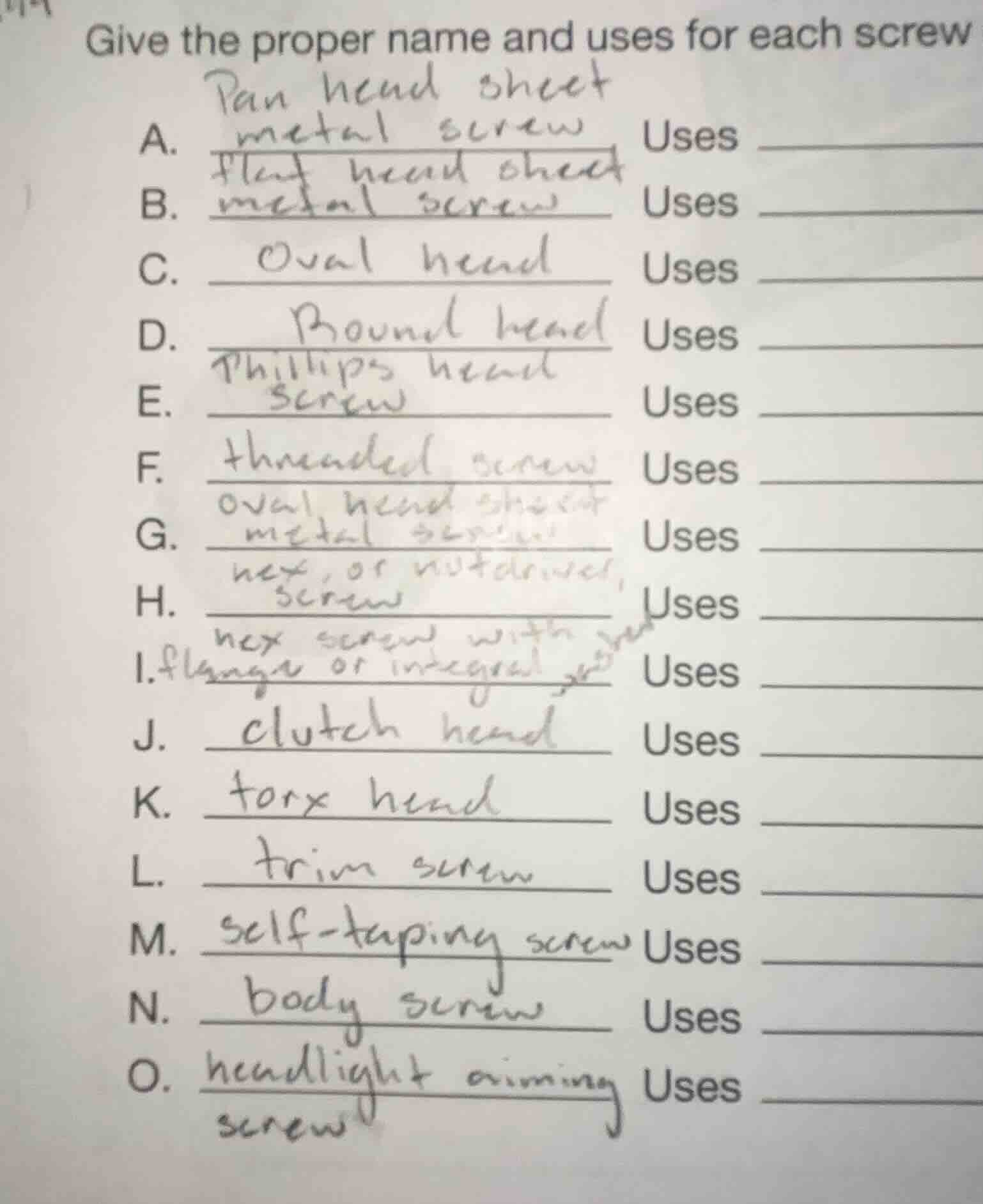
give the proper name and uses for each screw
a. pan head sheet metal screw uses ______
b. flat head sheet metal screw uses ______
c. oval head uses ______
d. round head uses ______
e. phillips head screw uses ______
f. threaded screw uses ______
g. oval head sheet metal screw uses ______
h. hex, or notdrivet, screw uses ______
i. hex screw with flange or integral uses ______
j. clutch head uses ______
k. torx head uses ______
l. trim screw uses ______
m. self - tapping screw uses ______
n. body screw uses ______
o. headlight aiming screw uses ______
To answer this, we analyze each screw type and its typical uses:
A. Pan Head Sheet Metal Screw
- Proper Name: Pan Head Sheet Metal Screw
- Uses: Used in sheet metal applications where a rounded, low - profile head is desired. Commonly in light - duty metal assemblies, electrical enclosures, or attaching metal components where a smooth, aesthetically pleasing head (that doesn't protrude sharply) is needed.
B. Flat Head Sheet Metal Screw
- Proper Name: Flat Head Sheet Metal Screw
- Uses: Ideal for applications where a flush - fitting head is required, such as in furniture making (where the head should sit below the surface), or in sheet metal work where the screw head needs to be recessed to prevent snags or for a smooth finish. Also used in drywall or woodworking when a flat - topped appearance is needed.
C. Oval Head Screw (General)
- Proper Name: Oval Head Screw
- Uses: Often used in woodworking and decorative applications. The oval - shaped head provides a more aesthetically pleasing look than a flat or pan head. It can be used to attach hardware (like hinges) to wood, or in cabinetry where appearance matters, and also in some light metal applications where a slightly raised, rounded head is acceptable.
D. Round Head Screw
- Proper Name: Round Head Screw
- Uses: Commonly used in woodworking, especially in applications where a classic, rounded head look is wanted (e.g., in antique - style furniture restoration). Also used in electrical work for attaching covers or plates, as the rounded head is less likely to catch on wires or other components.
E. Phillips Head Screw
- Proper Name: Phillips Head Screw
- Uses: Widely used in various industries (electronics, furniture, automotive, etc.). The cross - shaped (Phillips) drive allows for better torque transfer and reduces cam - out (the screw driver slipping out of the screw head). Used in assembling consumer electronics (like laptops, smartphones), furniture assembly kits, and automotive interior components.
F. Threaded Screw (General, e.g., Machine Screw)
- Proper Name: Threaded Screw (e.g., Machine Screw)
- Uses: Machine screws are used in metal - to - metal or metal - to - plastic assemblies where precise threading and a secure fit are needed. For example, in assembling small appliances, electronic devices (like circuit boards), or in industrial machinery where components need to be fastened with a screw that has uniform threading along its length.
G. Oval Head Sheet Metal Screw
- Proper Name: Oval Head Sheet Metal Screw
- Uses: Similar to oval head screws but specifically for sheet metal. Used in attaching sheet metal parts where a rounded, slightly raised head (oval - shaped) is desired, such as in automotive body panels (for non - structural, decorative, or light - duty fastening), or in HVAC ductwork where a smooth - looking, rounded head on sheet metal is preferred.
H. Hex (or Noted) Screw (e.g., Hex Head Screw)
- Proper Name: Hex Head Screw (if “hex” - related) or Noted Screw (if specific type is unclear, but likely Hex Head)
- Uses: Hex head screws are used in heavy - duty applications (automotive engines, industrial machinery, construction). The hexagonal head allows for easy use of wrenches or sockets to apply high torque, making them suitable for fastening large components, like in engine blocks, or in structural steel work.
I. Hex Screw with Flange or Integral Washer
- Proper Name: Hex Flange Screw (or Hex Screw with Integral Washer)
- Uses: Used in applicati…

Snap & solve any problem in the app
Get step-by-step solutions on Sovi AI
Photo-based solutions with guided steps
Explore more problems and detailed explanations
To answer this, we analyze each screw type and its typical uses:
A. Pan Head Sheet Metal Screw
- Proper Name: Pan Head Sheet Metal Screw
- Uses: Used in sheet metal applications where a rounded, low - profile head is desired. Commonly in light - duty metal assemblies, electrical enclosures, or attaching metal components where a smooth, aesthetically pleasing head (that doesn't protrude sharply) is needed.
B. Flat Head Sheet Metal Screw
- Proper Name: Flat Head Sheet Metal Screw
- Uses: Ideal for applications where a flush - fitting head is required, such as in furniture making (where the head should sit below the surface), or in sheet metal work where the screw head needs to be recessed to prevent snags or for a smooth finish. Also used in drywall or woodworking when a flat - topped appearance is needed.
C. Oval Head Screw (General)
- Proper Name: Oval Head Screw
- Uses: Often used in woodworking and decorative applications. The oval - shaped head provides a more aesthetically pleasing look than a flat or pan head. It can be used to attach hardware (like hinges) to wood, or in cabinetry where appearance matters, and also in some light metal applications where a slightly raised, rounded head is acceptable.
D. Round Head Screw
- Proper Name: Round Head Screw
- Uses: Commonly used in woodworking, especially in applications where a classic, rounded head look is wanted (e.g., in antique - style furniture restoration). Also used in electrical work for attaching covers or plates, as the rounded head is less likely to catch on wires or other components.
E. Phillips Head Screw
- Proper Name: Phillips Head Screw
- Uses: Widely used in various industries (electronics, furniture, automotive, etc.). The cross - shaped (Phillips) drive allows for better torque transfer and reduces cam - out (the screw driver slipping out of the screw head). Used in assembling consumer electronics (like laptops, smartphones), furniture assembly kits, and automotive interior components.
F. Threaded Screw (General, e.g., Machine Screw)
- Proper Name: Threaded Screw (e.g., Machine Screw)
- Uses: Machine screws are used in metal - to - metal or metal - to - plastic assemblies where precise threading and a secure fit are needed. For example, in assembling small appliances, electronic devices (like circuit boards), or in industrial machinery where components need to be fastened with a screw that has uniform threading along its length.
G. Oval Head Sheet Metal Screw
- Proper Name: Oval Head Sheet Metal Screw
- Uses: Similar to oval head screws but specifically for sheet metal. Used in attaching sheet metal parts where a rounded, slightly raised head (oval - shaped) is desired, such as in automotive body panels (for non - structural, decorative, or light - duty fastening), or in HVAC ductwork where a smooth - looking, rounded head on sheet metal is preferred.
H. Hex (or Noted) Screw (e.g., Hex Head Screw)
- Proper Name: Hex Head Screw (if “hex” - related) or Noted Screw (if specific type is unclear, but likely Hex Head)
- Uses: Hex head screws are used in heavy - duty applications (automotive engines, industrial machinery, construction). The hexagonal head allows for easy use of wrenches or sockets to apply high torque, making them suitable for fastening large components, like in engine blocks, or in structural steel work.
I. Hex Screw with Flange or Integral Washer
- Proper Name: Hex Flange Screw (or Hex Screw with Integral Washer)
- Uses: Used in applications where a built - in washer is needed to distribute the load and prevent the screw from pulling through the material. Common in automotive (e.g., attaching engine components, body panels), and industrial machinery (fastening parts that need a wide bearing surface to avoid damage to the fastened material).
J. Clutch Head Screw
- Proper Name: Clutch Head Screw
- Uses: Often used in security applications (e.g., in vending machines, public fixtures like park benches) because the clutch - style drive is less common and harder to remove without a special tool, thus deterring tampering. Also used in some automotive or industrial applications where security against unauthorized disassembly is needed.
K. Torx Head Screw
- Proper Name: Torx Head Screw
- Uses: Used in high - torque applications (automotive engines, aerospace, electronics). The star - shaped (Torx) drive provides excellent torque transfer and resists cam - out better than Phillips or slotted drives. Commonly found in modern cars (engine components, interior trim), and in high - end electronics (like server racks) where reliable fastening is crucial.
L. Trim Screw
- Proper Name: Trim Screw
- Uses: Specifically designed for automotive and furniture trim applications. Used to attach decorative or functional trim pieces (like moldings, door panels, or dashboard components in cars; or trim in cabinets/furniture). They often have a small, low - profile head to avoid detracting from the trim’s appearance.
M. Self - Tapping Screw
- Proper Name: Self - Tapping Screw
- Uses: Used in materials (metal, plastic, wood) where pre - drilling threads is not practical. For example, in sheet metal (attaching metal to metal without pre - tapped holes), in plastic enclosures (like in electronics), or in wood (for quick, temporary or permanent fastening without pre - drilling threads). They can create their own threads as they are driven in.
N. Body Screw (Automotive - related)
- Proper Name: Body Screw (Automotive Body Screw)
- Uses: Used in automotive bodywork, such as attaching fenders, bumpers, or body panels. These screws are designed to withstand the stresses of vehicle operation (vibration, temperature changes) and provide a secure fit for exterior and interior body components.
O. Headlight Aiming Screw
- Proper Name: Headlight Aiming Screw
- Uses: Specifically used in automotive headlight assemblies. These screws allow for the adjustment of the headlight’s angle (up/down, left/right) to ensure proper illumination of the road ahead. By turning these screws, the headlight’s position can be calibrated to meet safety and visibility standards.
(Note: For each, the “proper name” is refined based on standard terminology, and “uses” are based on industry - standard applications for each screw type.)