QUESTION IMAGE
Question
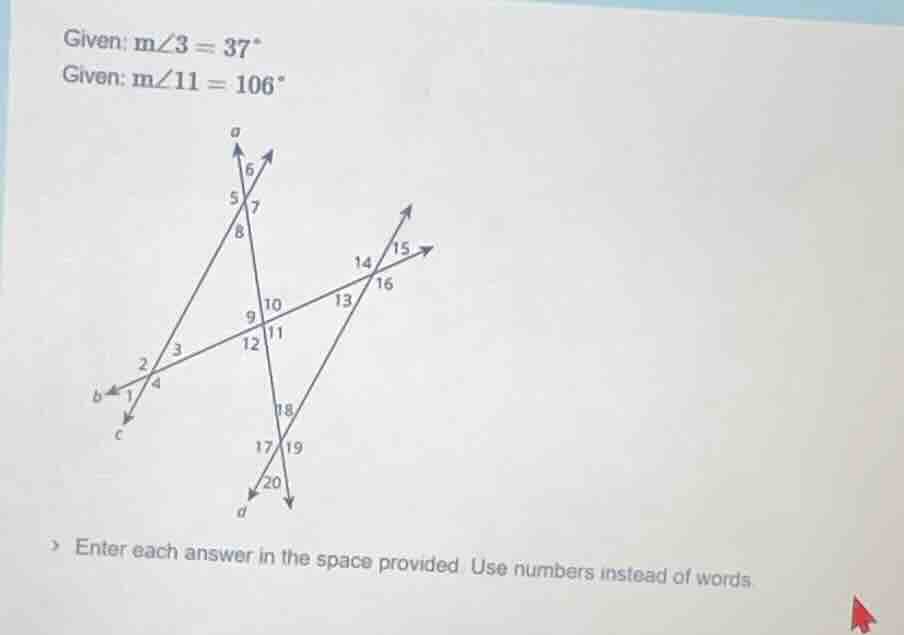
given: m∠3 = 37°
given: m∠11 = 106°
(image of angle diagram with labeled angles 1 - 20)
enter each answer in the space provided. use numbers instead of words.
Since the problem is not fully stated (e.g., what angle to find is not specified), we can't provide a solution yet. But if we assume we need to find angles like vertical angles, supplementary angles, or corresponding angles, here's how we could approach it:
Step 1: Identify the type of angle relationship
For example, if we want to find \( m\angle 1 \), since \( \angle 1 \) and \( \angle 3 \) are vertical angles? Wait, no, \( \angle 1 \) and \( \angle 3 \): let's check the lines. If lines \( b \) and the transversal: actually, \( \angle 1 \) and \( \angle 3 \) are adjacent? Wait, maybe \( \angle 1 \) and \( \angle 3 \) are vertical angles? Wait, no, vertical angles are opposite each other when two lines intersect. If we have two lines intersecting, forming \( \angle 1, \angle 2, \angle 3, \angle 4 \), then \( \angle 1 \) and \( \angle 3 \) would be vertical angles? Wait, no, \( \angle 1 \) and \( \angle 3 \): if the lines are \( b \) (with arrows) and the transversal, then \( \angle 1 \) and \( \angle 3 \) are vertical angles? Wait, no, vertical angles are equal. Wait, if \( m\angle 3 = 37^\circ \), then if \( \angle 1 \) is vertical to \( \angle 3 \), then \( m\angle 1 = 37^\circ \). But since the problem is not specified, we can't proceed.
Alternatively, if we want to find \( m\angle 12 \), since \( \angle 11 \) and \( \angle 12 \) are supplementary (they form a linear pair), so \( m\angle 12 = 180^\circ - m\angle 11 \). Given \( m\angle 11 = 106^\circ \), then \( m\angle 12 = 180 - 106 = 74^\circ \). But again, without knowing what angle to find, we can't give a definite answer.
Please specify which angle you need to find (e.g., \( m\angle 1 \), \( m\angle 12 \), \( m\angle 7 \), etc.), and we will provide the solution.

Snap & solve any problem in the app
Get step-by-step solutions on Sovi AI
Photo-based solutions with guided steps
Explore more problems and detailed explanations
Since the problem is not fully stated (e.g., what angle to find is not specified), we can't provide a solution yet. But if we assume we need to find angles like vertical angles, supplementary angles, or corresponding angles, here's how we could approach it:
Step 1: Identify the type of angle relationship
For example, if we want to find \( m\angle 1 \), since \( \angle 1 \) and \( \angle 3 \) are vertical angles? Wait, no, \( \angle 1 \) and \( \angle 3 \): let's check the lines. If lines \( b \) and the transversal: actually, \( \angle 1 \) and \( \angle 3 \) are adjacent? Wait, maybe \( \angle 1 \) and \( \angle 3 \) are vertical angles? Wait, no, vertical angles are opposite each other when two lines intersect. If we have two lines intersecting, forming \( \angle 1, \angle 2, \angle 3, \angle 4 \), then \( \angle 1 \) and \( \angle 3 \) would be vertical angles? Wait, no, \( \angle 1 \) and \( \angle 3 \): if the lines are \( b \) (with arrows) and the transversal, then \( \angle 1 \) and \( \angle 3 \) are vertical angles? Wait, no, vertical angles are equal. Wait, if \( m\angle 3 = 37^\circ \), then if \( \angle 1 \) is vertical to \( \angle 3 \), then \( m\angle 1 = 37^\circ \). But since the problem is not specified, we can't proceed.
Alternatively, if we want to find \( m\angle 12 \), since \( \angle 11 \) and \( \angle 12 \) are supplementary (they form a linear pair), so \( m\angle 12 = 180^\circ - m\angle 11 \). Given \( m\angle 11 = 106^\circ \), then \( m\angle 12 = 180 - 106 = 74^\circ \). But again, without knowing what angle to find, we can't give a definite answer.
Please specify which angle you need to find (e.g., \( m\angle 1 \), \( m\angle 12 \), \( m\angle 7 \), etc.), and we will provide the solution.