QUESTION IMAGE
Question
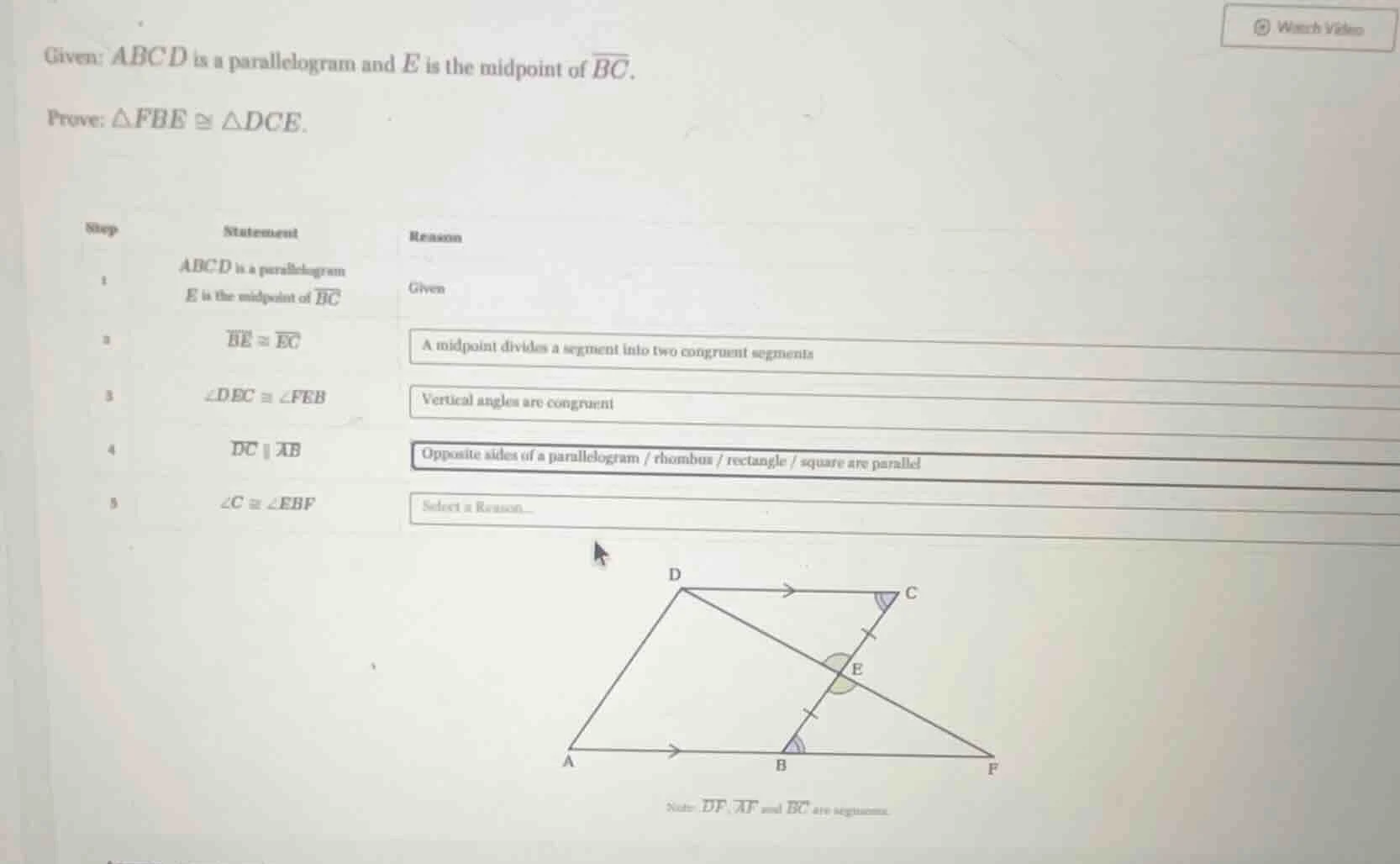
given: abcd is a parallelogram and e is the midpoint of \\(\overline{bc}\\).
prove: \\(\triangle fbe \cong \triangle dce\\).
step | statement | reason
1 | abcd is a parallelogram; e is the midpoint of \\(\overline{bc}\\) | given
2 | \\(\overline{be} \cong \overline{ec}\\) | a midpoint divides a segment into two congruent segments
3 | \\(\angle dec \cong \angle feb\\) | vertical angles are congruent
4 | \\(dc \parallel ab\\) | opposite sides of a parallelogram / rhombus / rectangle / square are parallel
5 | \\(\angle c \cong \angle ebf\\) | select a reason...
(note: df, af and bc are segments. there is a diagram of parallelogram abcd with e as midpoint of bc, and triangle fbe and dce with angles marked.)
Step1: Identify the relationship between lines and angles
Since \( DC \parallel AB \) (from step 4, opposite sides of a parallelogram are parallel) and \( BC \) is a transversal, \( \angle C \) and \( \angle EBF \) are alternate interior angles.
Step2: Recall the theorem for alternate interior angles
Alternate interior angles are congruent when two parallel lines are cut by a transversal. So the reason for \( \angle C \cong \angle EBF \) is "Alternate interior angles are congruent (when two parallel lines are cut by a transversal)".

Snap & solve any problem in the app
Get step-by-step solutions on Sovi AI
Photo-based solutions with guided steps
Explore more problems and detailed explanations
The reason for \( \angle C \cong \angle EBF \) is "Alternate interior angles are congruent (when two parallel lines are cut by a transversal)".