QUESTION IMAGE
Question
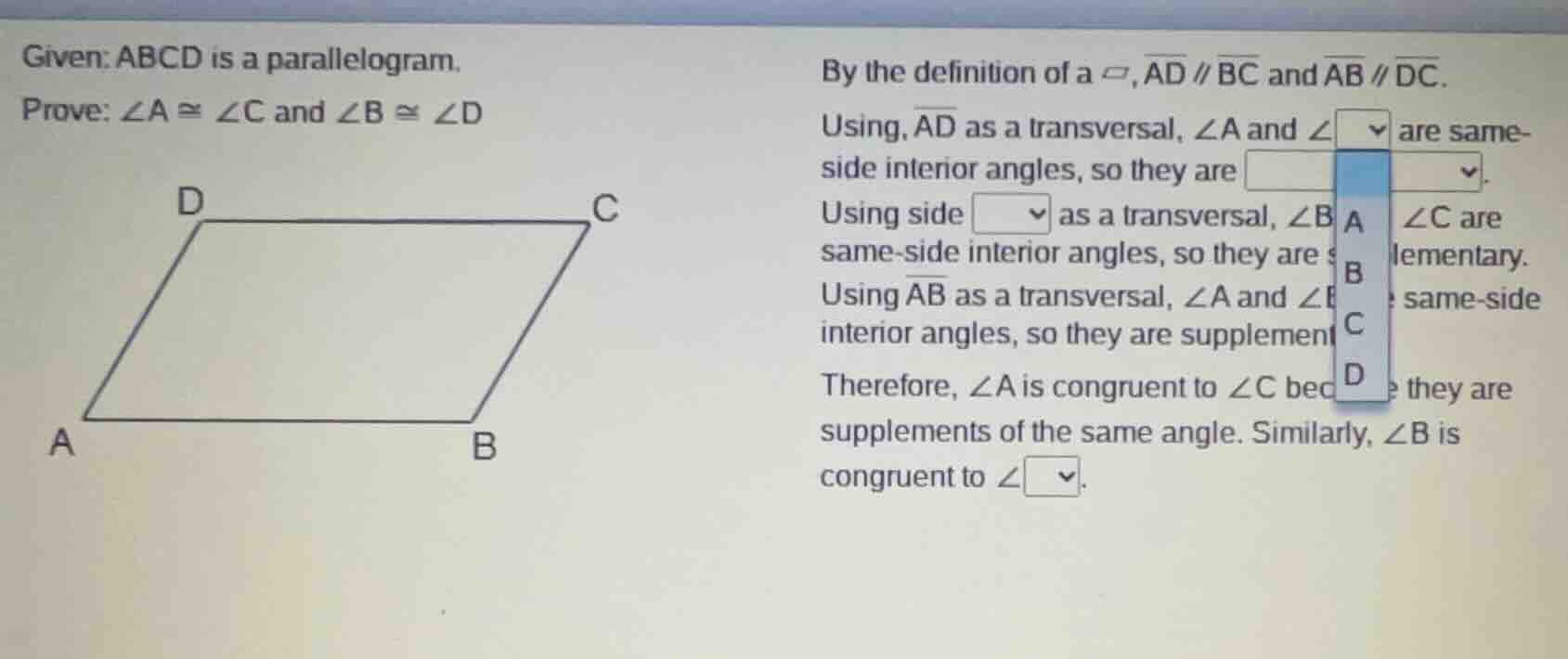
given: abcd is a parallelogram.
prove: ∠a ≅ ∠c and ∠b ≅ ∠d
by the definition of a ∥ogram, (overline{ad} parallel overline{bc}) and (overline{ab} parallel overline{dc}).
using, (overline{ad}) as a transversal, ∠a and ∠dropdown are same - side interior angles, so they are dropdown.
using side dropdown as a transversal, ∠b and ∠c are same - side interior angles, so they are supplementary.
using (overline{ab}) as a transversal, ∠a and ∠b are same - side interior angles, so they are supplementary.
therefore, ∠a is congruent to ∠c because they are supplements of the same angle. similarly, ∠b is congruent to ∠dropdown.
Step1: Analyze transversal \( \overline{AD} \)
When \( \overline{AD} \) is a transversal cutting \( \overline{AB} \parallel \overline{DC} \), the same - side interior angles with \( \angle A \) are \( \angle D \). By the property of parallel lines cut by a transversal, same - side interior angles are supplementary. So \( \angle A \) and \( \angle D \) are supplementary.
Step2: Analyze transversal for \( \angle B \) and \( \angle C \)
To find the transversal for \( \angle B \) and \( \angle C \), since \( \overline{AB}\parallel\overline{DC} \) and we are looking at angles \( \angle B \) and \( \angle C \), the transversal is \( \overline{BC} \). When \( \overline{BC} \) is a transversal cutting \( \overline{AB}\parallel\overline{DC} \), \( \angle B \) and \( \angle C \) are same - side interior angles and thus supplementary.
Step3: Analyze transversal \( \overline{AB} \)
When \( \overline{AB} \) is a transversal cutting \( \overline{AD}\parallel\overline{BC} \), \( \angle A \) and \( \angle B \) are same - side interior angles and are supplementary.
Step4: Prove \( \angle A\cong\angle C \) and \( \angle B\cong\angle D \)
We know that \( \angle A + \angle D=180^{\circ} \) and \( \angle C+\angle D = 180^{\circ} \) (from step 1 and the fact that \( \angle B+\angle C = 180^{\circ} \) and \( \angle A+\angle B=180^{\circ} \)). So \( \angle A \) and \( \angle C \) are both supplementary to \( \angle D \) (or \( \angle B \)), so \( \angle A\cong\angle C \) (supplements of the same angle are congruent). Similarly, \( \angle B \) and \( \angle D \) are both supplementary to \( \angle A \) (or \( \angle C \)), so \( \angle B\cong\angle D \).
For the first blank (angle with \( \angle A \) when transversal is \( \overline{AD} \)): The angle is \( \angle D \), so the option is D.
For the second blank (relationship of \( \angle A \) and \( \angle D \)): supplementary.
For the transversal of \( \angle B \) and \( \angle C \): The transversal is \( \overline{BC} \).
For the last blank (angle congruent to \( \angle B \)): The angle is \( \angle D \).

Snap & solve any problem in the app
Get step-by-step solutions on Sovi AI
Photo-based solutions with guided steps
Explore more problems and detailed explanations
First blank (angle): D. \( \angle D \)
Second blank (relationship): supplementary
Transversal for \( \angle B \) and \( \angle C \): \( \overline{BC} \)
Last blank (angle congruent to \( \angle B \)): D. \( \angle D \)