QUESTION IMAGE
Question
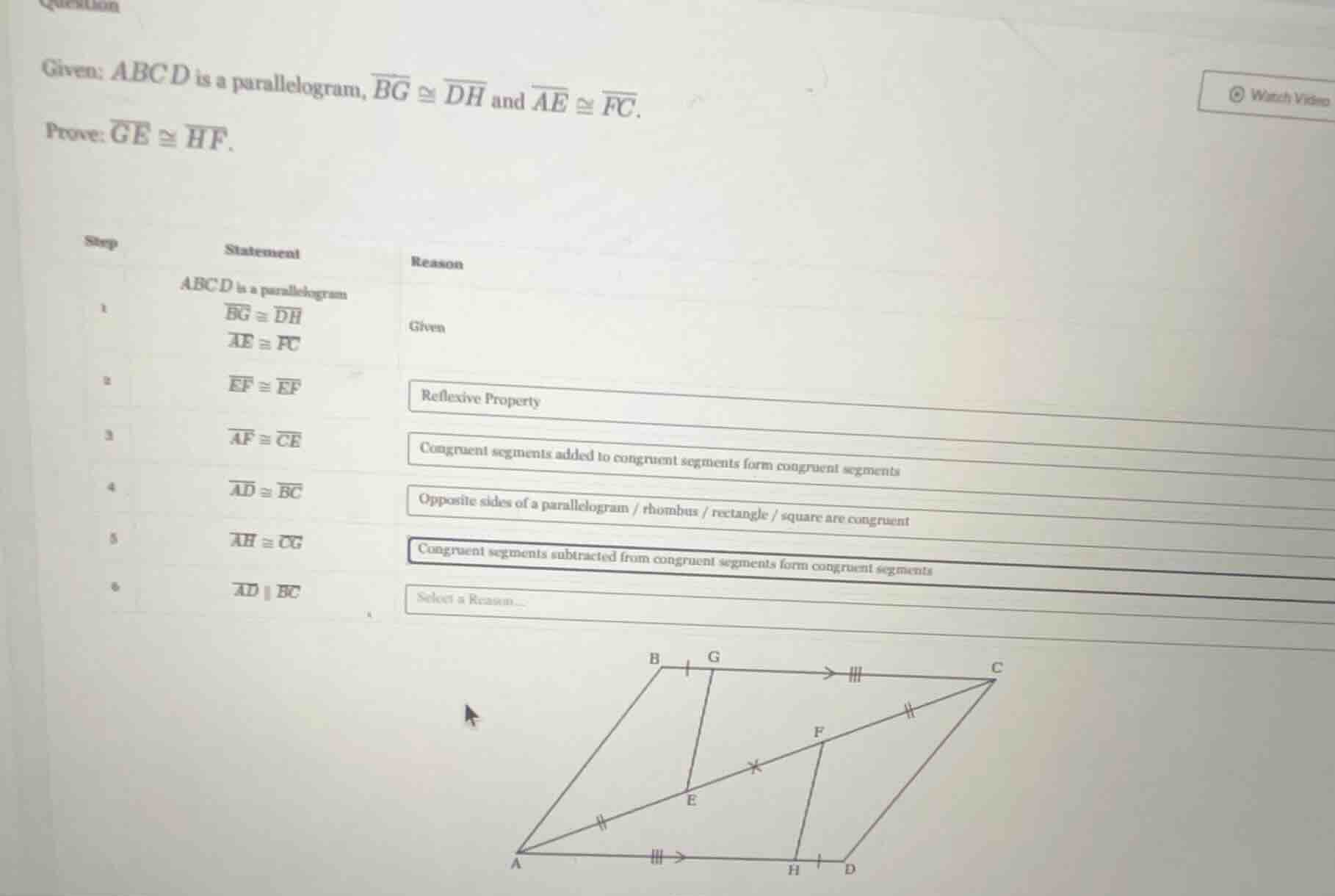
given: abcd is a parallelogram, \\(\overline{bg} \cong \overline{dh}\\) and \\(\overline{ae} \cong \overline{fc}\\).
prove: \\(\overline{ge} \cong \overline{hf}\\).
step | statement | reason
1 | abcd is a parallelogram; \\(\overline{bg} \cong \overline{dh}\\); \\(\overline{ae} \cong \overline{fc}\\) | given
2 | \\(\overline{ef} \cong \overline{ef}\\) | reflexive property
3 | \\(\overline{af} \cong \overline{ce}\\) | congruent segments added to congruent segments form congruent segments
4 | \\(\overline{ad} \cong \overline{bc}\\) | opposite sides of a parallelogram / rhombus / rectangle / square are congruent
5 | \\(\overline{ah} \cong \overline{cg}\\) | congruent segments subtracted from congruent segments form congruent segments
6 | \\(\overline{ad} \parallel \overline{bc}\\) | select a reason...
Step1: Recall parallelogram properties
In a parallelogram, opposite sides are parallel. So for parallelogram \(ABCD\), \(AD \parallel BC\) because it's a property of parallelograms (opposite sides of a parallelogram are parallel).
Step2: Use congruent segments for triangles
We know \( \overline{BG} \cong \overline{DH} \), \( \overline{AE} \cong \overline{FC} \), and from parallelogram properties \( \overline{AD} \cong \overline{BC} \), \( \overline{AD} \parallel \overline{BC} \). Also, \( \overline{AF} \cong \overline{CE} \) (from step 3) and \( \overline{AH} \cong \overline{CG} \) (from step 5). Now, to prove \( \overline{GE} \cong \overline{HF} \), we can show triangles \(GE C\) and \(HF A\) (or other relevant triangles) are congruent. But first, confirming \(AD \parallel BC\) is part of the parallelogram's opposite sides parallel property.
Step3: Prove triangle congruence (SAS or SSS)
Since \( \overline{AE} \cong \overline{FC} \), \( \overline{AH} \cong \overline{CG} \), and \( \angle EAH \cong \angle FCG \) (because \(AD \parallel BC\), alternate interior angles are congruent), by SAS congruence, triangles \(EAH\) and \(FCG\) might be congruent, but more directly, for \(GE\) and \(HF\), consider quadrilateral or triangles. Alternatively, since \(ABCD\) is a parallelogram, \(AB \parallel CD\) and \(AB \cong CD\), but with \(BG \cong DH\) and \(AE \cong FC\), we can show \(GE\) and \(HF\) are sides of congruent triangles. Let's use the given steps: we have \( \overline{AF} \cong \overline{CE} \), \( \overline{AH} \cong \overline{CG} \), and \( \angle FAH \cong \angle ECG \) (because \(AD \parallel BC\), alternate interior angles). So by SAS, \( \triangle FAH \cong \triangle ECG \), which would imply \( \overline{HF} \cong \overline{GE} \) (corresponding parts of congruent triangles are congruent).

Snap & solve any problem in the app
Get step-by-step solutions on Sovi AI
Photo-based solutions with guided steps
Explore more problems and detailed explanations
To prove \( \overline{GE} \cong \overline{HF} \), we use properties of parallelograms (opposite sides parallel and congruent) and congruent segment addition/subtraction, then triangle congruence (SAS) to show corresponding sides \( \overline{GE} \) and \( \overline{HF} \) are congruent. The key steps involve recognizing parallelogram side parallelism (\(AD \parallel BC\)) and using congruent segments to establish triangle congruence, leading to \( \overline{GE} \cong \overline{HF} \).