QUESTION IMAGE
Question
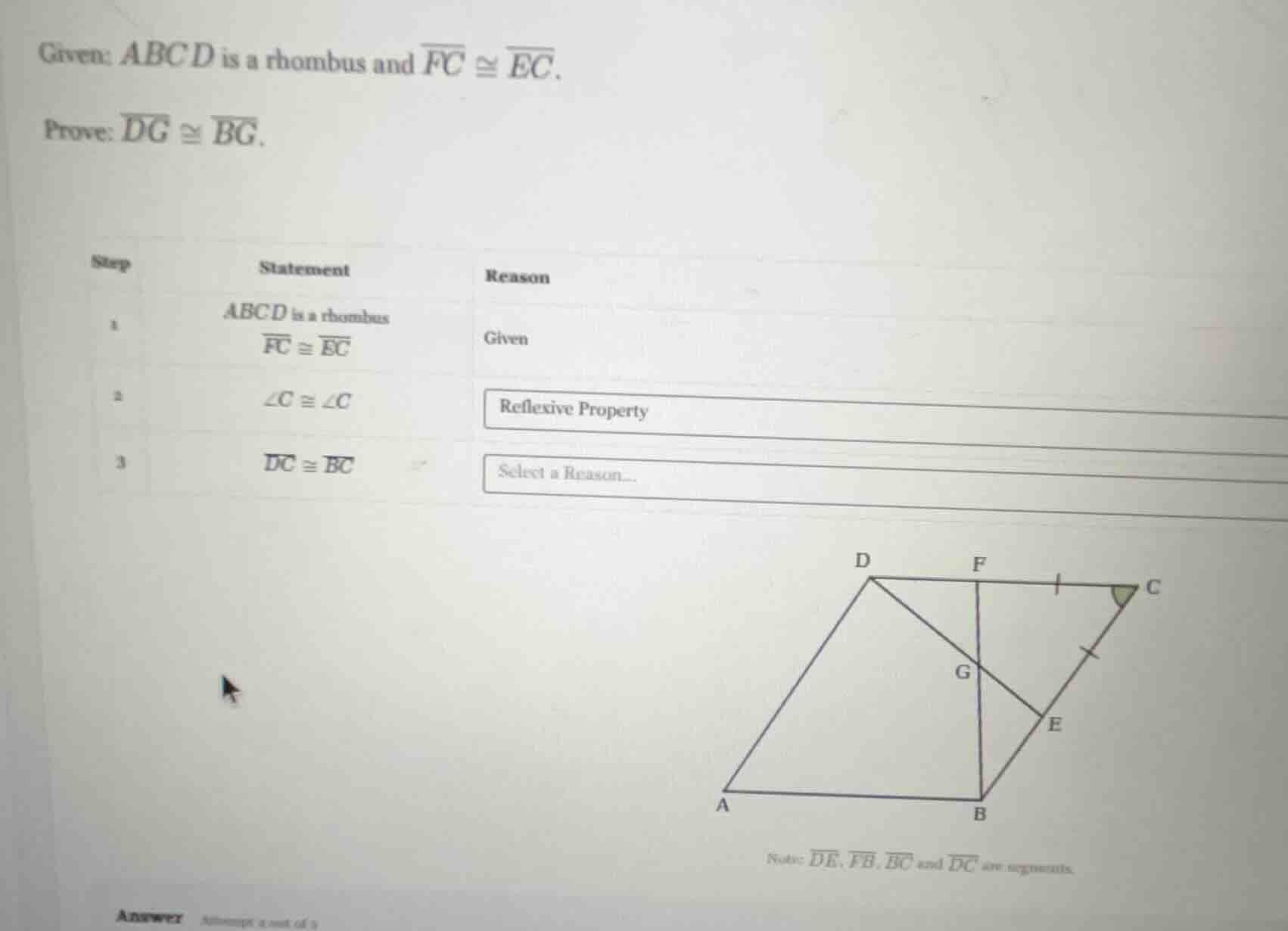
given: abcd is a rhombus and \\(\overline{fc} \cong \overline{ec}\\). prove: \\(\overline{dg} \cong \overline{bg}\\). step statement reason 1 abcd is a rhombus \\(\overline{fc} \cong \overline{ec}\\) given 2 \\(\angle c \cong \angle c\\) reflexive property 3 \\(\overline{dc} \cong \overline{bc}\\) select a reason... note: \\(\overline{de}\\), \\(\overline{fb}\\), \\(\overline{bc}\\) and \\(\overline{dc}\\) are segments. answer attempt 1 out of 3
Step1: Recall rhombus properties
In a rhombus, all sides are congruent. So, for rhombus \(ABCD\), \(DC = BC\) (or \(\overline{DC}\cong\overline{BC}\)) because of the definition of a rhombus (all sides of a rhombus are equal in length).

Snap & solve any problem in the app
Get step-by-step solutions on Sovi AI
Photo-based solutions with guided steps
Explore more problems and detailed explanations
The reason for \(\overline{DC}\cong\overline{BC}\) is "All sides of a rhombus are congruent" (or "Definition of a rhombus: sides are equal").