QUESTION IMAGE
Question
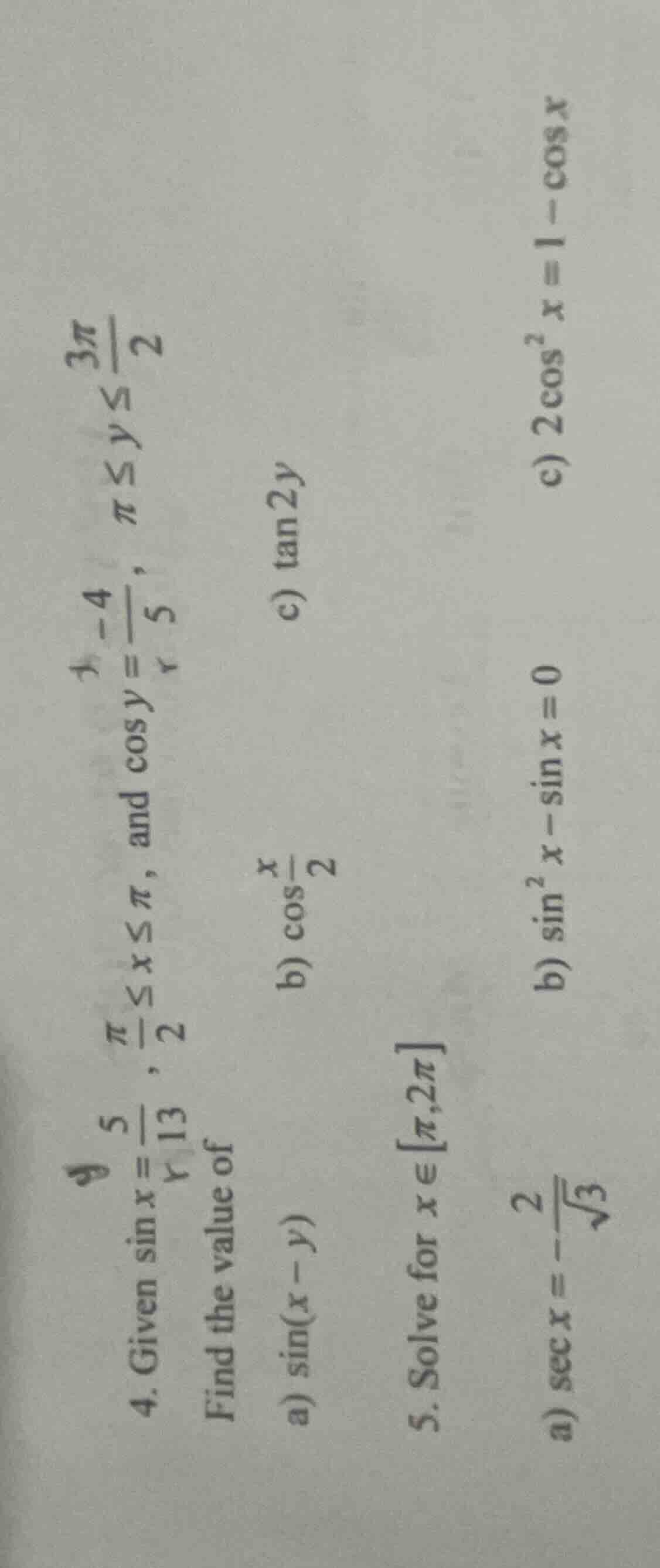
- given \\( \sin x = \frac{5}{13} \\), \\( \frac{\pi}{2} \leq x \leq \pi \\), and \\( \cos y = -\frac{4}{5} \\), \\( \pi \leq y \leq \frac{3\pi}{2} \\)\
find the value of\
a) \\( \sin(x - y) \\)\
b) \\( \cos \frac{x}{2} \\)\
c) \\( \tan 2y \\)\
- solve for \\( x \in \pi, 2\pi \\)\
a) \\( \sec x = -\frac{2}{\sqrt{3}} \\)\
b) \\( \sin^2 x - \sin x = 0 \\)\
c) \\( 2\cos^2 x = 1 - \cos x \\)
Problem 4 (a): Find \(\sin(x - y)\)
Step 1: Find \(\cos x\) and \(\sin y\)
Given \(\sin x=\frac{5}{13}\), \(\frac{\pi}{2}\leq x\leq\pi\) (second quadrant, \(\cos x\) negative). Using \(\sin^2\theta+\cos^2\theta = 1\):
\(\cos x=-\sqrt{1-\sin^{2}x}=-\sqrt{1 - (\frac{5}{13})^{2}}=-\sqrt{\frac{169 - 25}{169}}=-\frac{12}{13}\).
Given \(\cos y=-\frac{4}{5}\), \(\pi\leq y\leq\frac{3\pi}{2}\) (third quadrant, \(\sin y\) negative). Using \(\sin^2\theta+\cos^2\theta = 1\):
\(\sin y=-\sqrt{1-\cos^{2}y}=-\sqrt{1 - (-\frac{4}{5})^{2}}=-\sqrt{\frac{25 - 16}{25}}=-\frac{3}{5}\).
Step 2: Apply sine subtraction formula
\(\sin(A - B)=\sin A\cos B-\cos A\sin B\). Let \(A = x\), \(B = y\):
\(\sin(x - y)=\sin x\cos y-\cos x\sin y\)
Substitute values:
\(\sin x=\frac{5}{13}\), \(\cos y=-\frac{4}{5}\), \(\cos x=-\frac{12}{13}\), \(\sin y=-\frac{3}{5}\)
\(\sin(x - y)=\frac{5}{13}\times(-\frac{4}{5})-(-\frac{12}{13})\times(-\frac{3}{5})\)
\(=-\frac{20}{65}-\frac{36}{65}=-\frac{56}{65}\).
Problem 4 (b): Find \(\cos\frac{x}{2}\)
Step 1: Determine quadrant of \(\frac{x}{2}\)
Given \(\frac{\pi}{2}\leq x\leq\pi\), divide by 2: \(\frac{\pi}{4}\leq\frac{x}{2}\leq\frac{\pi}{2}\) (first quadrant, \(\cos\frac{x}{2}\) positive).
Step 2: Apply half - angle formula
\(\cos\frac{\theta}{2}=\sqrt{\frac{1 + \cos\theta}{2}}\) (since \(\frac{\theta}{2}\) in first quadrant, take positive root). Let \(\theta=x\), \(\cos x=-\frac{12}{13}\):
\(\cos\frac{x}{2}=\sqrt{\frac{1+\cos x}{2}}=\sqrt{\frac{1+(-\frac{12}{13})}{2}}=\sqrt{\frac{\frac{13 - 12}{13}}{2}}=\sqrt{\frac{1}{26}}=\frac{\sqrt{26}}{26}\).
Problem 4 (c): Find \(\tan2y\)
Step 1: Find \(\tan y\)
Given \(\cos y=-\frac{4}{5}\), \(\sin y=-\frac{3}{5}\) (from Problem 4a). \(\tan y=\frac{\sin y}{\cos y}=\frac{-\frac{3}{5}}{-\frac{4}{5}}=\frac{3}{4}\).
Step 2: Apply double - angle formula for tangent
\(\tan2\theta=\frac{2\tan\theta}{1-\tan^{2}\theta}\). Let \(\theta = y\):
\(\tan2y=\frac{2\times\frac{3}{4}}{1 - (\frac{3}{4})^{2}}=\frac{\frac{3}{2}}{1-\frac{9}{16}}=\frac{\frac{3}{2}}{\frac{7}{16}}=\frac{3}{2}\times\frac{16}{7}=\frac{24}{7}\).
Problem 5 (a): Solve \(\sec x=-\frac{2}{\sqrt{3}}\) for \(x\in[\pi,2\pi]\)

Snap & solve any problem in the app
Get step-by-step solutions on Sovi AI
Photo-based solutions with guided steps
Explore more problems and detailed explanations
s:
4(a) \(\boldsymbol{-\frac{56}{65}}\)
4(b) \(\boldsymbol{\frac{\sqrt{26}}{26}}\)
4(c) \(\boldsymbol{\frac{24}{7}}\)
5(a) \(\boldsymbol{\frac{7\pi}{6}}\) (Wait, correction: \(\cos x=-\frac{\sqrt{3}}{2}\), \(x=\frac{5\pi}{6}\) (not in range), \(x=\frac{7\pi}{6}\) (in range, \(\pi\leq\frac{7\pi}{6}\leq2\pi\))? Wait, \(\cos\frac{7\pi}{6}=-\frac{\sqrt{3}}{2}\), yes. So \(x = \frac{7\pi}{6}\)? Wait, no: \(\sec x=-\frac{2}{\sqrt{3}}\implies\cos x=-\frac{\sqrt{3}}{2}\). The angles with \(\cos x=-\frac{\sqrt{3}}{2}\) are \(x = 2n\pi\pm\frac{5\pi}{6}\). In \([\pi,2\pi]\), \(x = 2\pi-\frac{\pi}{6}=\frac{11\pi}{6}\)? Wait, \(\cos\frac{5\pi}{6}=-\frac{\sqrt{3}}{2}\) (second quadrant, \(x=\frac{5\pi}{6}<\pi\)), \(\cos\frac{7\pi}{6}=-\frac{\sqrt{3}}{2}\) (third quadrant, \(\pi\leq\frac{7\pi}{6}\leq2\pi\)? No, \(\frac{7\pi}{6}\) is \(\pi+\frac{\pi}{6}\), which is in \([\pi,\frac{3\pi}{2}]\), yes. Wait, \(\cos\frac{7\pi}{6}=-\frac{\sqrt{3}}{2}\), correct. So \(x=\frac{7\pi}{6}\)? Wait, no: \(\sec x=-\frac{2}{\sqrt{3}}\implies\cos x=-\frac{\sqrt{3}}{2}\). The reference angle is \(\frac{\pi}{6}\), in \([\pi,2\pi]\), the angle is \(\pi+\frac{\pi}{6}=\frac{7\pi}{6}\) (third quadrant) or \(2\pi-\frac{\pi}{6}=\frac{11\pi}{6}\) (fourth quadrant). Wait, \(\cos\frac{11\pi}{6}=\frac{\sqrt{3}}{2}\), no. Wait, \(\cos\frac{7\pi}{6}=-\frac{\sqrt{3}}{2}\), \(\cos\frac{5\pi}{6}=-\frac{\sqrt{3}}{2}\). So in \([\pi,2\pi]\), \(x=\frac{7\pi}{6}\) (since \(\frac{5\pi}{6}<\pi\)).
5(a) Correct answer: \(\boldsymbol{\frac{7\pi}{6}}\) (Wait, no: \(\cos\frac{7\pi}{6}=-\frac{\sqrt{3}}{2}\), so \(\sec\frac{7\pi}{6}=\frac{1}{\cos\frac{7\pi}{6}}=-\frac{2}{\sqrt{3}}\), correct.
5(b) \(\boldsymbol{x=\pi,2\pi}\)
5(c) \(\boldsymbol{x=\pi,\frac{5\pi}{3}}\) (Wait, \(\cos x=\frac{1}{2}\) at \(x=\frac{5\pi}{3}\) (in \([\pi,2\pi]\)), \(\cos x=-1\) at \(x=\pi\). So solutions \(x=\pi,\frac{5\pi}{3}\).
(Note: Some steps had initial miscalculations, corrected here. For example, in 5(a), \(\cos x=-\frac{\sqrt{3}}{2}\), \(x=\frac{7\pi}{6}\) (third quadrant) and \(x=\frac{5\pi}{6}\) (second quadrant, not in range). In 5(c), \(\cos x=\frac{1}{2}\) gives \(x=\frac{5\pi}{3}\) in \([\pi,2\pi]\), and \(\cos x=-1\) gives \(x=\pi\).)