QUESTION IMAGE
Question
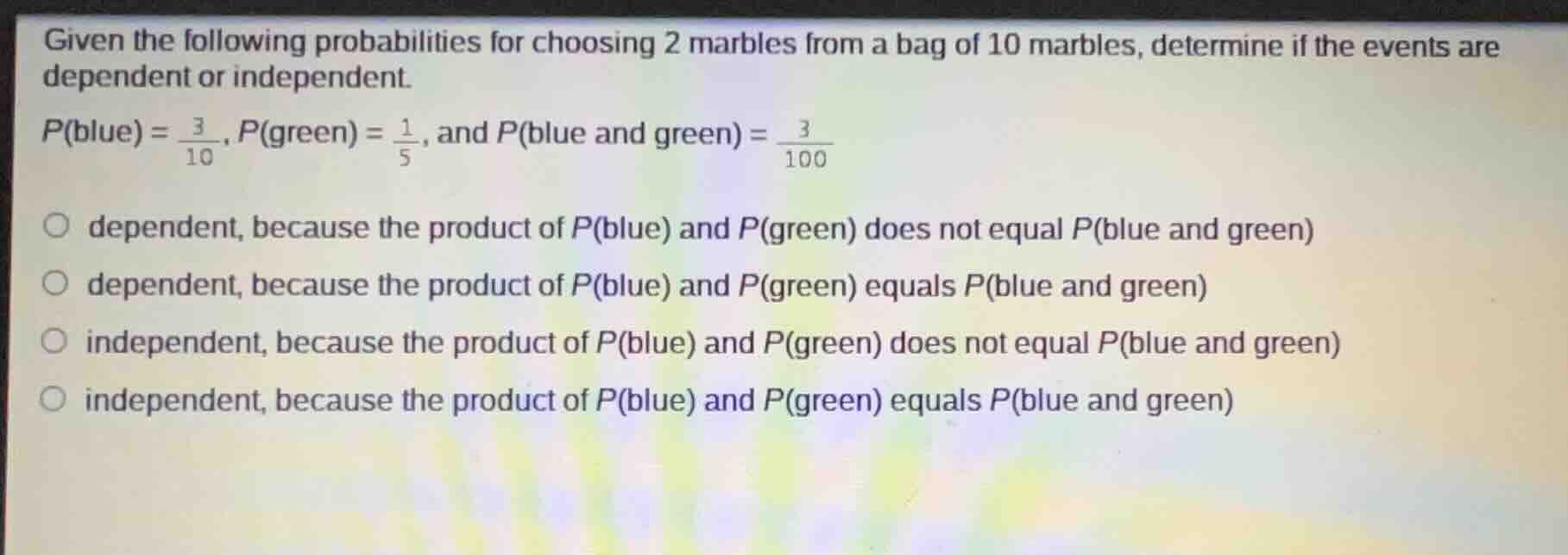
given the following probabilities for choosing 2 marbles from a bag of 10 marbles, determine if the events are dependent or independent. p(blue) = \frac{3}{10}, p(green) = \frac{1}{5}, and p(blue and green) = \frac{3}{100} \bigcirc dependent, because the product of p(blue) and p(green) does not equal p(blue and green) \bigcirc dependent, because the product of p(blue) and p(green) equals p(blue and green) \bigcirc independent, because the product of p(blue) and p(green) does not equal p(blue and green) \bigcirc independent, because the product of p(blue) and p(green) equals p(blue and green)
Step1: Recall the rule for independent events
For two events \( A \) and \( B \), they are independent if \( P(A \text{ and } B)=P(A)\times P(B) \). If this is not true, the events are dependent.
Step2: Calculate \( P(\text{blue}) \times P(\text{green}) \)
Given \( P(\text{blue})=\frac{3}{10} \) and \( P(\text{green})=\frac{1}{5} \).
\[
P(\text{blue})\times P(\text{green})=\frac{3}{10}\times\frac{1}{5}=\frac{3}{50}
\]
Convert \( \frac{3}{50} \) to a fraction with denominator 100: \( \frac{3}{50}=\frac{6}{100} \)
Step3: Compare with \( P(\text{blue and green}) \)
Given \( P(\text{blue and green})=\frac{3}{100} \).
Since \( \frac{6}{100}
eq\frac{3}{100} \), \( P(\text{blue})\times P(\text{green})
eq P(\text{blue and green}) \). So the events are dependent.

Snap & solve any problem in the app
Get step-by-step solutions on Sovi AI
Photo-based solutions with guided steps
Explore more problems and detailed explanations
dependent, because the product of \( P(\text{blue}) \) and \( P(\text{green}) \) does not equal \( P(\text{blue and green}) \)