QUESTION IMAGE
Question
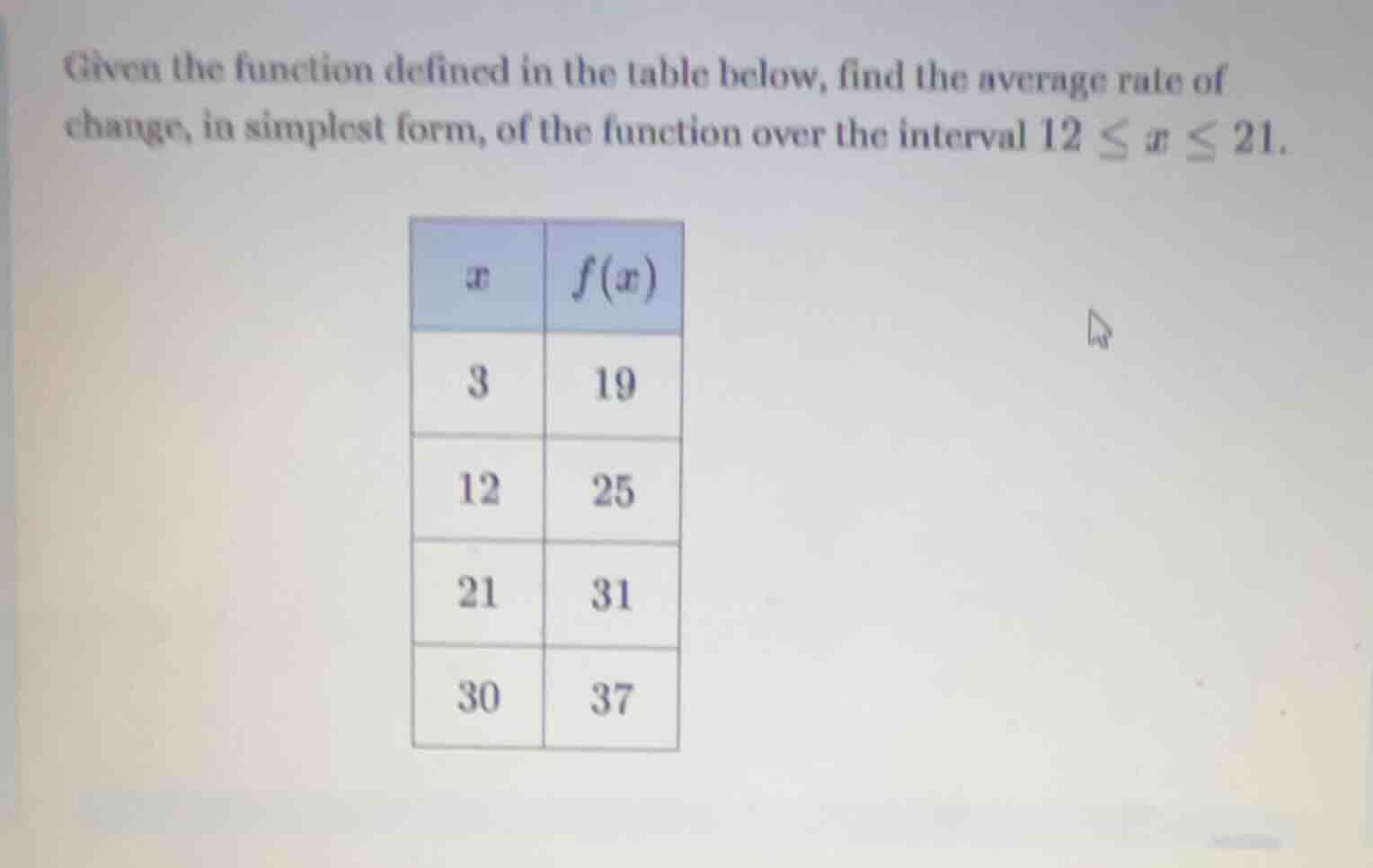
given the function defined in the table below, find the average rate of change, in simplest form, of the function over the interval 12 ≤ x ≤ 21.
| x | f(x) |
|---|---|
| 12 | 25 |
| 21 | 31 |
| 30 | 37 |
Step1: Recall the formula for average rate of change
The average rate of change of a function \( f(x) \) over the interval \( [a, b] \) is given by \( \frac{f(b) - f(a)}{b - a} \). Here, \( a = 12 \), \( b = 21 \), so we need to find \( f(21) \) and \( f(12) \) from the table.
Step2: Identify \( f(12) \) and \( f(21) \)
From the table, when \( x = 12 \), \( f(12) = 25 \), and when \( x = 21 \), \( f(21) = 31 \).
Step3: Substitute into the formula
Substitute \( a = 12 \), \( b = 21 \), \( f(a) = 25 \), and \( f(b) = 31 \) into the formula: \( \frac{f(21) - f(12)}{21 - 12} = \frac{31 - 25}{21 - 12} \).
Step4: Simplify the expression
First, calculate the numerator: \( 31 - 25 = 6 \). Then, calculate the denominator: \( 21 - 12 = 9 \). So the fraction is \( \frac{6}{9} \), which simplifies to \( \frac{2}{3} \) by dividing both the numerator and denominator by their greatest common divisor, which is 3.

Snap & solve any problem in the app
Get step-by-step solutions on Sovi AI
Photo-based solutions with guided steps
Explore more problems and detailed explanations
\( \frac{2}{3} \)