QUESTION IMAGE
Question
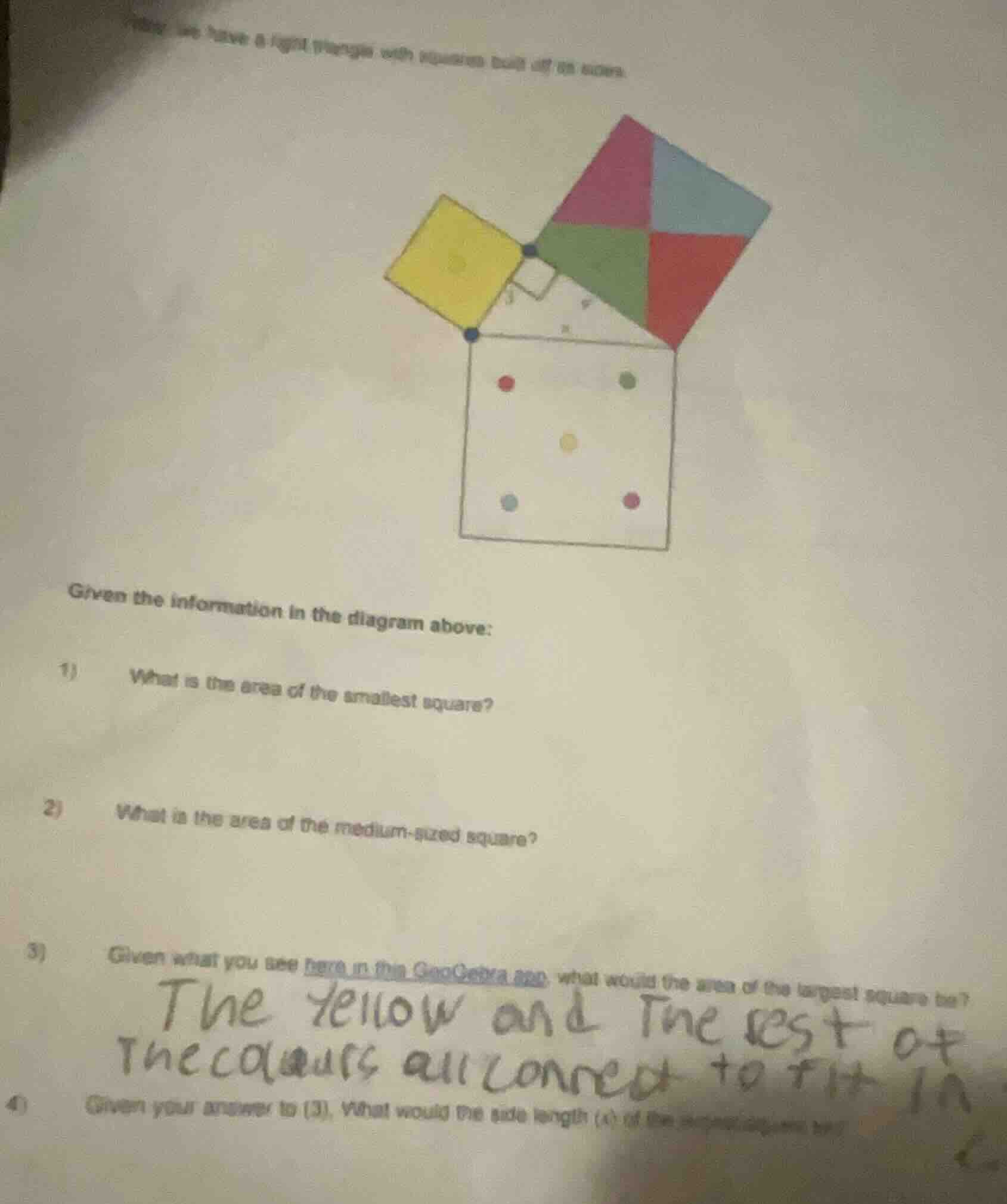
given the information in the diagram above:
- what is the area of the smallest square?
- what is the area of the medium - sized square?
- given what you see here in the geogebra app, what would the area of the largest square be? (handwritten note: the yellow and the rest of the colors all connect to fit in)
- given your answer to (3), what would the side length (c) of the largest square be?
1) What is the area of the smallest square?
Step1: Identify side length of smallest square
From the diagram, the side length of the smallest square (attached to the right - angled triangle with legs 3 and 4) is 3.
Step2: Calculate area of square
The formula for the area of a square is \(A = s^2\), where \(s\) is the side length. For \(s = 3\), we have \(A=3^2 = 9\).
Step1: Identify side length of medium - sized square
From the diagram, the side length of the medium - sized square (attached to the right - angled triangle with legs 3 and 4) is 4.
Step2: Calculate area of square
Using the formula for the area of a square \(A = s^2\), with \(s = 4\), we get \(A = 4^2=16\).
Step1: Recall the Pythagorean theorem for squares on sides of right - triangle
For a right - triangle, the sum of the areas of the squares on the two legs is equal to the area of the square on the hypotenuse. Let the area of the square on the first leg be \(A_1\), on the second leg be \(A_2\), and on the hypotenuse be \(A_3\). Then \(A_3=A_1 + A_2\).
Step2: Substitute the known areas
We know \(A_1 = 9\) (from part 1) and \(A_2 = 16\) (from part 2). So \(A_3=9 + 16=25\).

Snap & solve any problem in the app
Get step-by-step solutions on Sovi AI
Photo-based solutions with guided steps
Explore more problems and detailed explanations
9