QUESTION IMAGE
Question
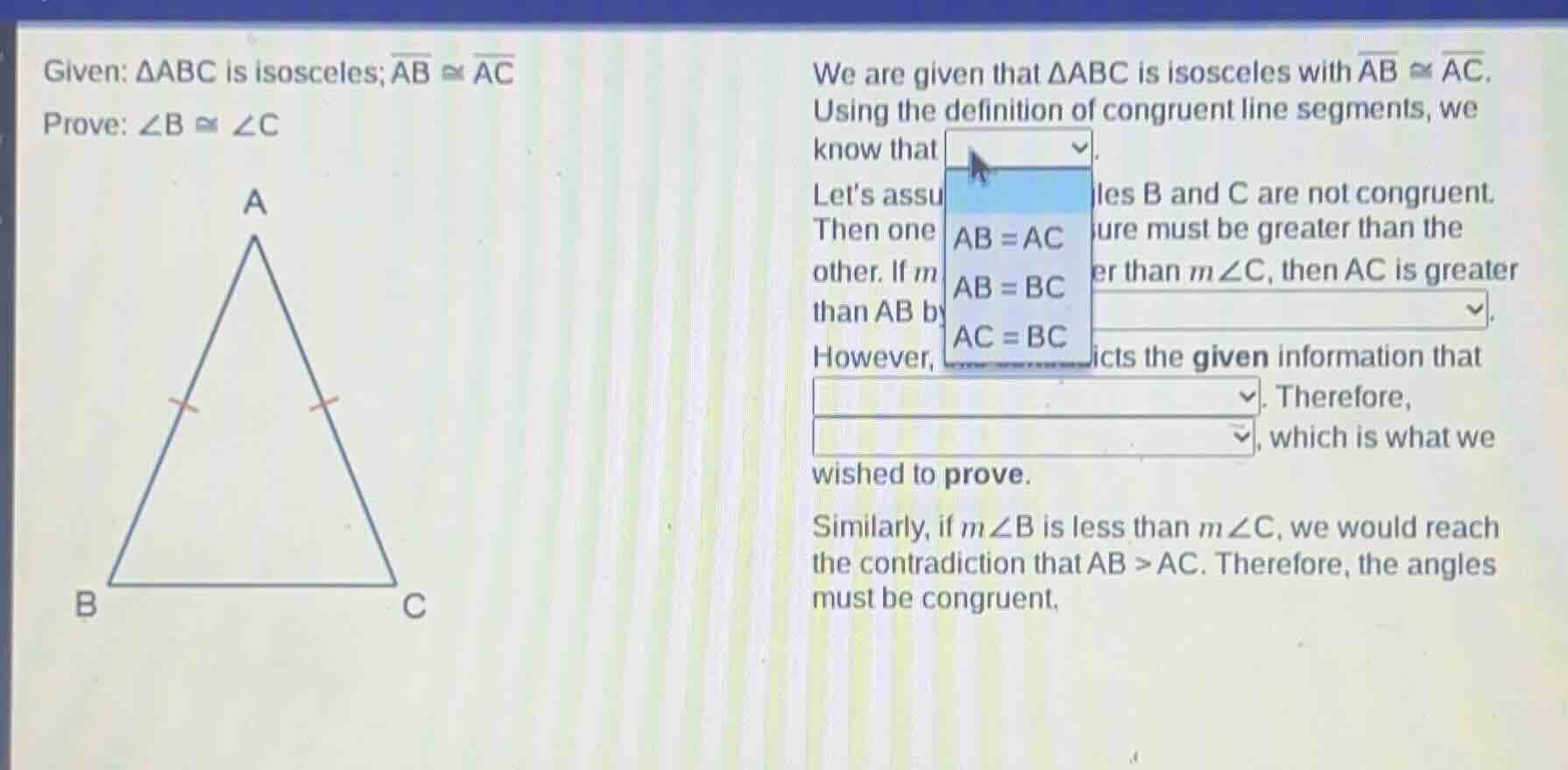
given: $\triangle abc$ is isosceles; $\overline{ab} \cong \overline{ac}$
prove: $\angle b \cong \angle c$
we are given that $\triangle abc$ is isosceles with $\overline{ab} \cong \overline{ac}$.
using the definition of congruent line segments, we
know that
lets assu les b and c are not congruent.
then one ure must be greater than the
other. if $m$ er than $m\angle c$, then $ac$ is greater
than $ab$ b
however, icts the given information that
. therefore,
, which is what we
wished to prove.
similarly, if $m\angle b$ is less than $m\angle c$, we would reach
the contradiction that $ab > ac$. therefore, the angles
must be congruent,
Step1: Recall congruent segments
By definition of congruent line segments, if \(\overline{AB} \cong \overline{AC}\), then \(AB = AC\).
Step2: Analyze angle - side relationship
The theorem used here is: In a triangle, if one angle has a greater measure than another angle, then the side opposite the greater angle is longer. So if \(m\angle B>m\angle C\), then \(AC > AB\) (by the "greater angle - longer side" theorem). But we know \(AB = AC\) from the congruence of \(\overline{AB}\) and \(\overline{AC}\), so this is a contradiction. Similarly, if \(m\angle B
For the first dropdown (using definition of congruent line segments): The correct option is \(AB = AC\) because congruent segments have equal length.
For the second dropdown (theorem used): The theorem is "If one angle of a triangle is larger than another angle, then the side opposite the larger angle is longer". So when we assume \(m\angle B>m\angle C\), we use this theorem to say \(AC > AB\).
For the third dropdown (contradiction): The contradiction is with the given \(AB = AC\) (from \(\overline{AB}\cong\overline{AC}\)).
For the fourth dropdown (conclusion): Since the assumption that \(\angle B\) and \(\angle C\) are not congruent leads to a contradiction, we conclude that \(\angle B\cong\angle C\).

Snap & solve any problem in the app
Get step-by-step solutions on Sovi AI
Photo-based solutions with guided steps
Explore more problems and detailed explanations
First dropdown: \(AB = AC\)
Second dropdown: (The theorem: If one angle of a triangle is larger than another angle, then the side opposite the larger angle is longer)
Third dropdown: \(AB = AC\)
Fourth dropdown: \(\angle B\cong\angle C\)