QUESTION IMAGE
Question
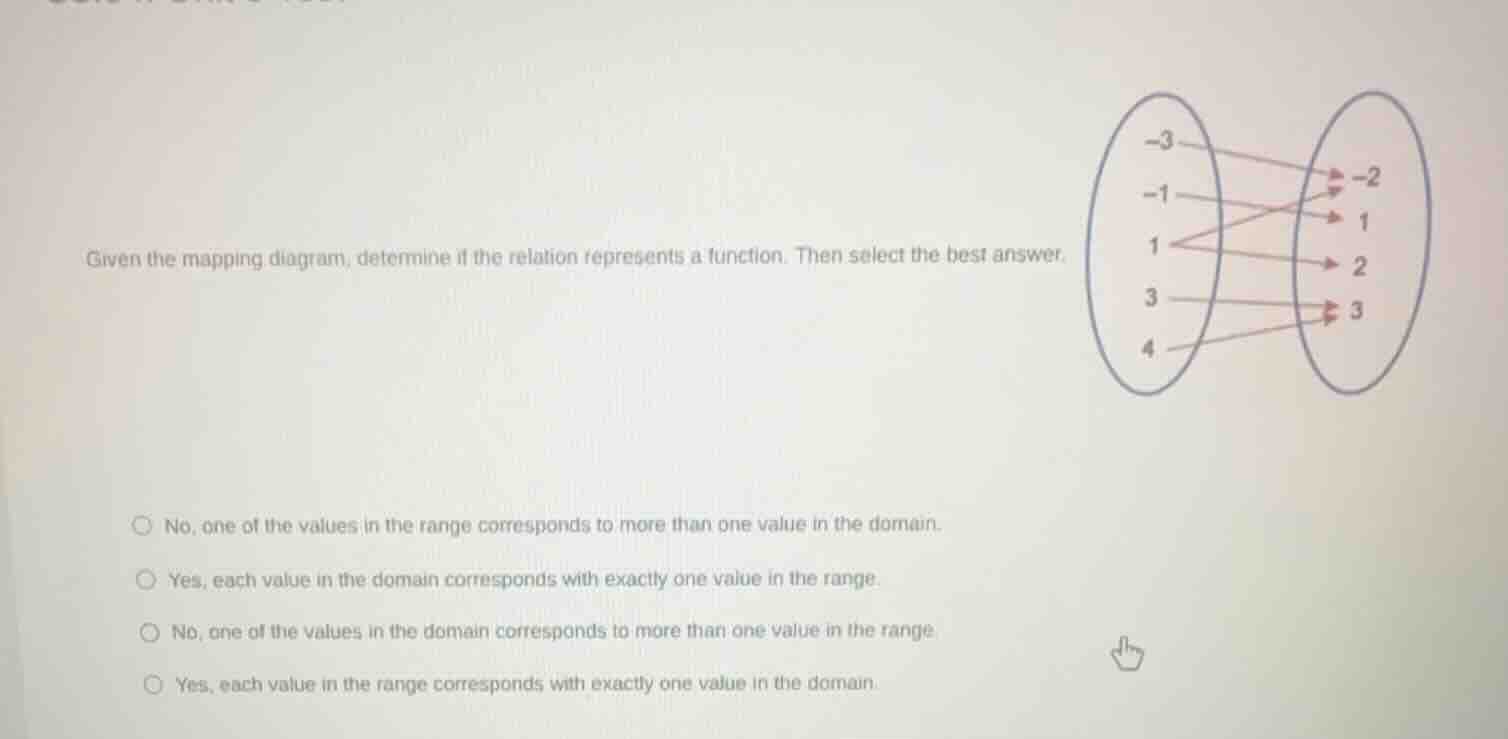
given the mapping diagram, determine if the relation represents a function. then select the best answer.
no, one of the values in the range corresponds to more than one value in the domain.
yes, each value in the domain corresponds with exactly one value in the range.
no, one of the values in the domain corresponds to more than one value in the range.
yes, each value in the range corresponds with exactly one value in the domain.
Step1: Recall function definition
A function is a relation where each element in the domain (left set) maps to exactly one element in the range (right set).
Step2: Analyze domain elements
- Domain element \(-3\): maps to \(-2\) (1 value).
- Domain element \(-1\): maps to \(-2\) and \(1\) (2 values? Wait, no, looking at the diagram: \(-1\) maps to \(-2\) and \(1\)? Wait, no, the left oval (domain) has \(-3, -1, 1, 3, 4\). Let's check each:
- \(-3\): maps to \(-2\) (1).
- \(-1\): maps to \(-2\) and \(1\)? Wait, no, the arrows: \(-1\) has two arrows? Wait, the diagram: \(-3\) to \(-2\), \(-1\) to \(-2\) and \(1\)? Wait, no, the left is domain (input), right is range (output). A function requires each input has at most one output.
- Wait, the domain element \(1\): looks like it maps to \(1\) and \(2\) (two outputs). Oh, right! The element \(1\) in the domain (left) has arrows to both \(1\) and \(2\) in the range (right). So \(1\) (domain) corresponds to more than one range value.
Step3: Evaluate options
- Option 1: Talks about range to domain, wrong direction.
- Option 2: Says each domain has exactly one range, but \(1\) has two, so wrong.
- Option 3: Says no, because a domain value (1) corresponds to more than one range value. Correct.
- Option 4: Talks about range to domain, wrong direction.

Snap & solve any problem in the app
Get step-by-step solutions on Sovi AI
Photo-based solutions with guided steps
Explore more problems and detailed explanations
No, one of the values in the domain corresponds to more than one value in the range. (The correct option is the third one: "No, one of the values in the domain corresponds to more than one value in the range.")