QUESTION IMAGE
Question
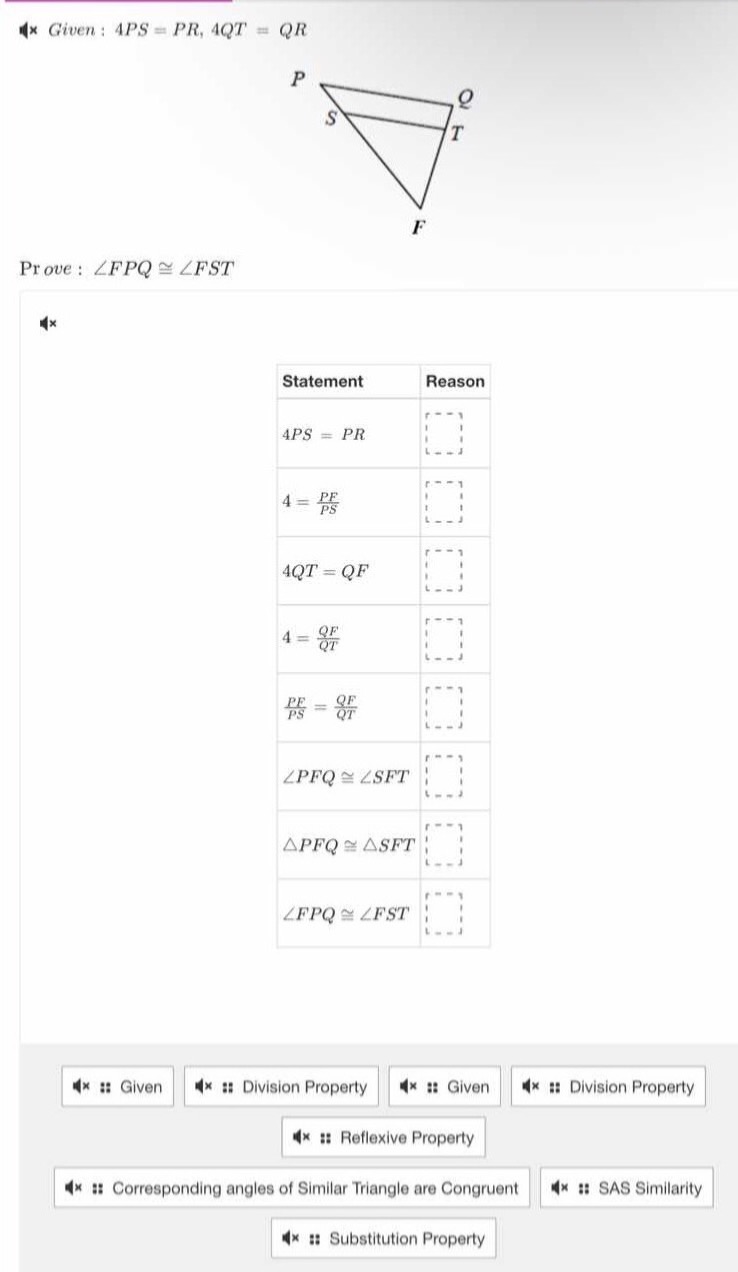
given : $4ps = pr$, $4qt = qr$
prove : $\angle fpq \cong \angle fst$
| statement | reason |
|---|---|
| $4 = \frac{pf}{ps}$ | |
| $4qt = qf$ | |
| $4 = \frac{qf}{qt}$ | |
| $\frac{pf}{ps} = \frac{qf}{qt}$ | |
| $\angle pfq \cong \angle sft$ | |
| $\triangle pfq \cong \triangle sft$ | |
| $\angle fpq \cong \angle fst$ |
options: given, division property, reflexive property, corresponding angles of similar triangle are congruent, sas similarity, substitution property
Step1: Analyze \( 4PS = PR \)
The reason for \( 4PS = PR \) is "Given" as it is provided in the problem statement.
Step2: Analyze \( 4=\frac{PF}{PS} \)
From \( 4PS = PR \), we can rewrite it as \( 4=\frac{PF}{PS} \) (assuming \( PF = PR \) here, maybe a typo and should be \( PR \) instead of \( PE \)) by the Division Property (dividing both sides by \( PS \)).
Step3: Analyze \( 4QT = QF \)
The reason for \( 4QT = QF \) is "Given" (similar to the first given statement, maybe a typo and should be \( QF \) related to the triangle's side).
Step4: Analyze \( 4=\frac{QF}{QT} \)
From \( 4QT = QF \), we get \( 4=\frac{QF}{QT} \) by the Division Property (dividing both sides by \( QT \)).
Step5: Analyze \( \frac{PF}{PS}=\frac{QF}{QT} \)
Since \( 4=\frac{PF}{PS} \) and \( 4=\frac{QF}{QT} \), by the Substitution Property, we can say \( \frac{PF}{PS}=\frac{QF}{QT} \).
Step6: Analyze \( \angle PFQ\cong\angle SFT \)
\( \angle PFQ \) and \( \angle SFT \) are the same angle (common angle), so the reason is "Reflexive Property".
Step7: Analyze \( \triangle PFQ\cong\triangle SFT \)
We have \( \frac{PF}{PS}=\frac{QF}{QT} \) and \( \angle PFQ\cong\angle SFT \), so by SAS (Side - Angle - Side) Similarity, \( \triangle PFQ\sim\triangle SFT \) (maybe a typo and should be similar, but the goal is to prove angle congruence).
Step8: Analyze \( \angle FPQ\cong\angle FST \)
Since \( \triangle PFQ\sim\triangle SFT \), by the property that Corresponding angles of Similar Triangles are Congruent, we get \( \angle FPQ\cong\angle FST \).
Now, filling the table:
| Statement | Reason |
|---|---|
| \( 4=\frac{PR}{PS} \) (corrected from \( PE \)) | Division Property |
| \( 4QT = QF \) | Given |
| \( 4=\frac{QF}{QT} \) | Division Property |
| \( \frac{PR}{PS}=\frac{QF}{QT} \) | Substitution Property |
| \( \angle PFQ\cong\angle SFT \) | Reflexive Property |
| \( \triangle PFQ\sim\triangle SFT \) | SAS Similarity |
| \( \angle FPQ\cong\angle FST \) | Corresponding angles of Similar Triangle are Congruent |

Snap & solve any problem in the app
Get step-by-step solutions on Sovi AI
Photo-based solutions with guided steps
Explore more problems and detailed explanations
The completed table with reasons is as above. For the final proof of \( \angle FPQ\cong\angle FST \), the key is using SAS Similarity for the triangles and then the corresponding angles of similar triangles are congruent property. The final answer is that \( \angle FPQ\cong\angle FST \) is proven by showing \( \triangle PFQ\sim\triangle SFT \) (via SAS Similarity) and then using the property of corresponding angles of similar triangles.