QUESTION IMAGE
Question
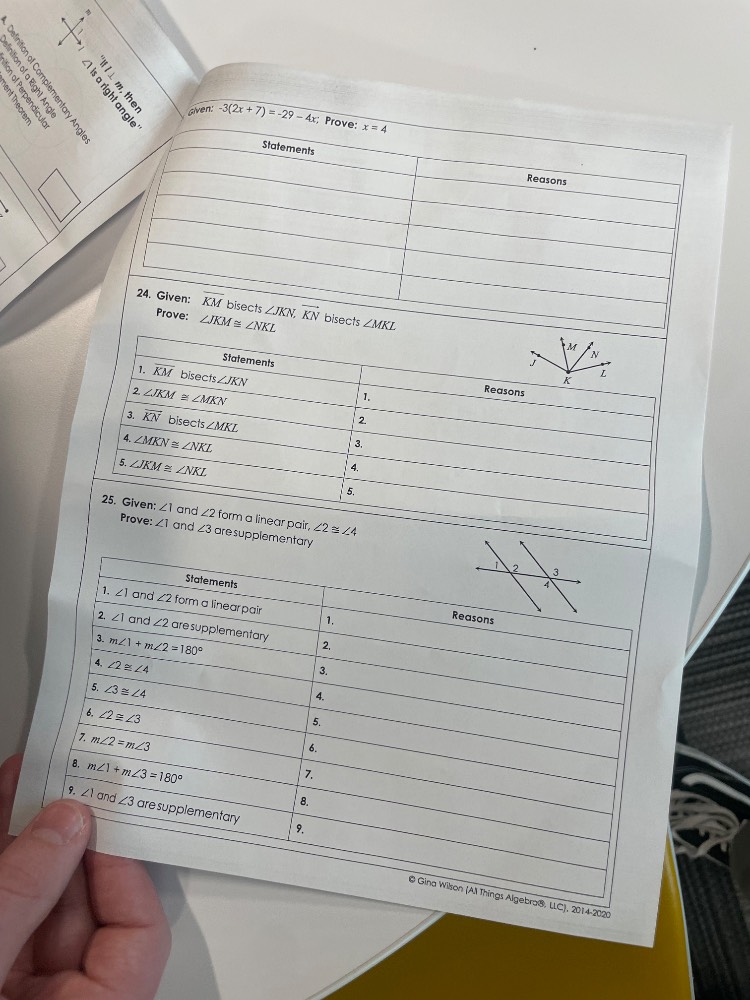
given: $-3(2x + 7) = -29 - 4x$; prove: $x = 4$
statements reasons
- given: $\overrightarrow{km}$ bisects $\angle jkn$, $\overrightarrow{kn}$ bisects $\angle mkl$
prove: $\angle jkm \cong \angle nkl$
statements reasons
- $\overrightarrow{km}$ bisects $\angle jkn$ 1.
- $\angle jkm \cong \angle mkn$ 2.
- $\overrightarrow{kn}$ bisects $\angle mkl$ 3.
- $\angle mkn \cong \angle nkl$ 4.
- $\angle jkm \cong \angle nkl$ 5.
- given: $\angle 1$ and $\angle 2$ form a linear pair, $\angle 2 \cong \angle 4$
prove: $\angle 1$ and $\angle 3$ are supplementary
statements reasons
- $\angle 1$ and $\angle 2$ form a linear pair 1.
- $\angle 1$ and $\angle 2$ are supplementary 2.
- $m\angle 1 + m\angle 2 = 180^\circ$ 3.
- $\angle 2 \cong \angle 4$ 4.
- $\angle 3 \cong \angle 4$ 5.
- $\angle 2 \cong \angle 3$ 6.
- $m\angle 2 = m\angle 3$ 7.
- $m\angle 1 + m\angle 3 = 180^\circ$ 8.
- $\angle 1$ and $\angle 3$ are supplementary 9.
© gina wilson (all things algebra®, llc), 2014-2020
Response
First Problem: Given: $-3(2x + 7) = -29 - 4x$; Prove: $x = 4$
Step1: Expand left-hand side
$-3(2x + 7) = -6x - 21$
Equation becomes: $-6x - 21 = -29 - 4x$
Step2: Add $6x$ to both sides
$-6x - 21 + 6x = -29 - 4x + 6x$
Simplify: $-21 = -29 + 2x$
Step3: Add 29 to both sides
$-21 + 29 = -29 + 2x + 29$
Simplify: $8 = 2x$
Step4: Divide by 2
$\frac{8}{2} = \frac{2x}{2}$
Simplify: $x = 4$
Brief Explanations
- The first statement is given directly in the problem.
- A bisector splits an angle into two congruent angles, so $\overrightarrow{KM}$ bisecting $\angle JKN$ creates two equal angles.
- The second bisector statement is given in the problem.
- A bisector splits an angle into two congruent angles, so $\overrightarrow{KN}$ bisecting $\angle MKL$ creates two equal angles.
- By the transitive property of congruence, if $\angle JKM \cong \angle MKN$ and $\angle MKN \cong \angle NKL$, then the two outer angles are congruent.
Brief Explanations
- The first statement is given directly in the problem.
- Linear pairs of angles are always supplementary by definition.
- Supplementary angles have a sum of $180^\circ$.
- The second congruence statement is given directly in the problem.
- $\angle 3$ and $\angle 4$ are vertical angles, which are congruent.
- By the transitive property, if $\angle 2 \cong \angle 4$ and $\angle 3 \cong \angle 4$, then $\angle 2 \cong \angle 3$.
- Congruent angles have equal measures.
- Substitute $m\angle 2$ with $m\angle 3$ in the supplementary angle sum.
- Angles with measures that add to $180^\circ$ are supplementary by definition.

Snap & solve any problem in the app
Get step-by-step solutions on Sovi AI
Photo-based solutions with guided steps
Explore more problems and detailed explanations
$x = 4$
---