QUESTION IMAGE
Question
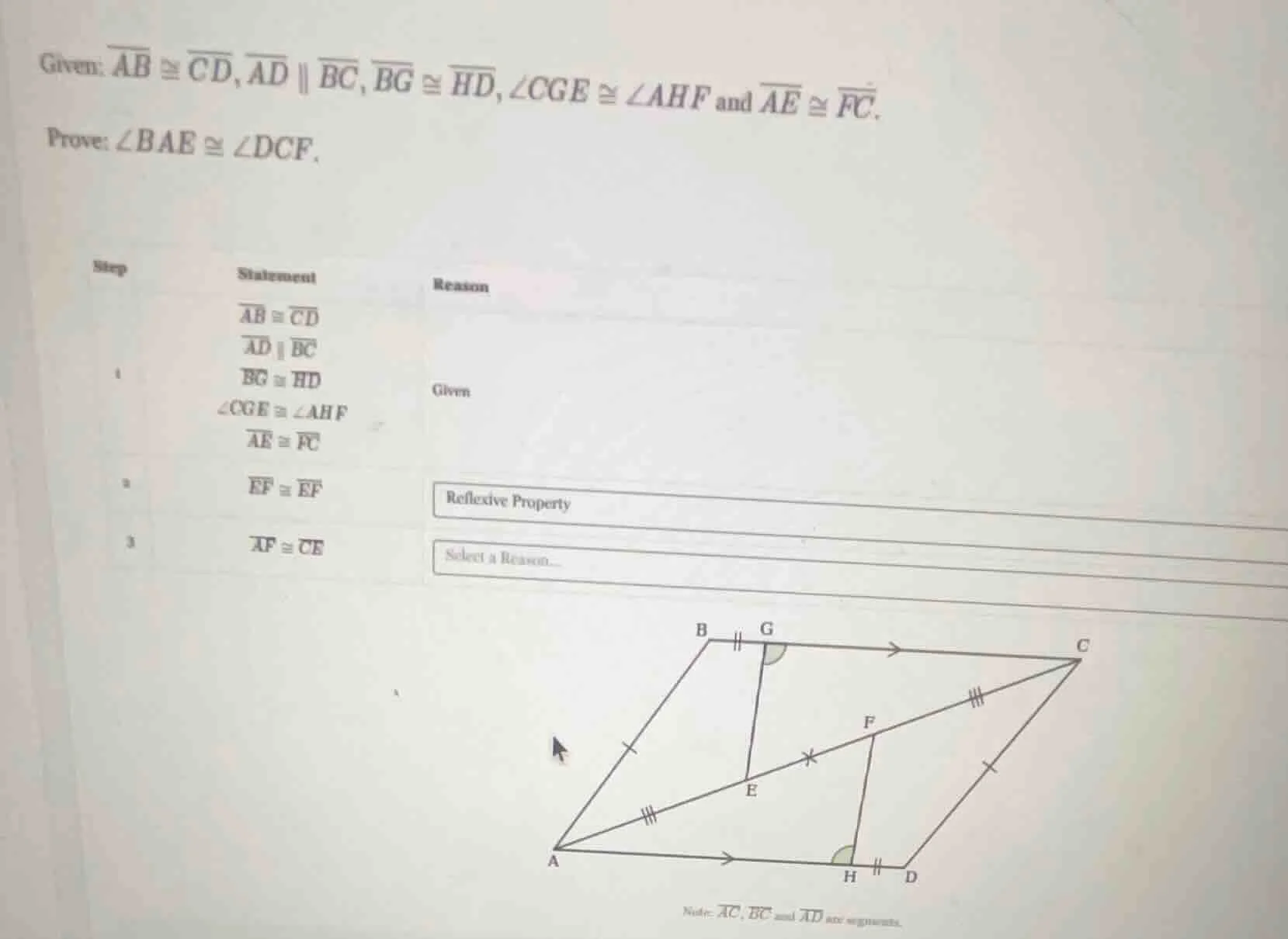
given: \\(\overline{ab} \cong \overline{cd}\\), \\(\overline{ad} \parallel \overline{bc}\\), \\(\overline{bg} \cong \overline{hd}\\), \\(\angle cge \cong \angle ahf\\) and \\(\overline{ae} \cong \overline{fc}\\).
prove: \\(\angle bae \cong \angle dcf\\).
step | statement | reason
--- | --- | ---
1 | \\(\overline{ab} \cong \overline{cd}\\) <br> \\(\overline{ad} \parallel \overline{bc}\\) <br> \\(\overline{bg} \cong \overline{hd}\\) <br> \\(\angle cge \cong \angle ahf\\) <br> \\(\overline{ae} \cong \overline{fc}\\) | given
2 | \\(\overline{ef} \cong \overline{ef}\\) | reflexive property
3 | \\(\overline{af} \cong \overline{ce}\\) | select a reason...
(note: there is a diagram of a quadrilateral with points a, b, c, d, e, f, g, h. \\(\overline{ac}\\), \\(\overline{bc}\\) and \\(\overline{ad}\\) are segments.)
Step1: Recall Segment Addition Postulate
The Segment Addition Postulate states that if we have three points \( X \), \( Y \), \( Z \) collinear with \( Y \) between \( X \) and \( Z \), then \( XY + YZ = XZ \). Also, if two segments are congruent, adding a congruent segment to both will preserve congruence (Addition Property of Congruence for Segments).
We know that \( \overline{AE} \cong \overline{FC} \) (given) and \( \overline{EF} \cong \overline{EF} \) (reflexive property).
For \( \overline{AF} \) and \( \overline{CE} \):
- \( AF = AE + EF \) (by Segment Addition Postulate, since \( E \) is between \( A \) and \( F \))
- \( CE = CF + FE \) (by Segment Addition Postulate, since \( F \) is between \( C \) and \( E \))
But \( \overline{AE} \cong \overline{FC} \) implies \( AE = FC \) (definition of congruent segments) and \( \overline{EF} \cong \overline{EF} \) implies \( EF = FE \) (reflexive, so \( EF = EF \)).
Step2: Apply Addition Property of Congruence
By the Addition Property of Congruence (if \( a = b \) and \( c = d \), then \( a + c = b + d \)), since \( AE = FC \) and \( EF = EF \), we have:
\( AE + EF = FC + EF \)
But \( AE + EF = AF \) and \( FC + EF = CE \), so \( AF = CE \).
By the definition of congruent segments (if two segments have the same length, they are congruent), \( \overline{AF} \cong \overline{CE} \).
So the reason is the Addition Property of Congruence (or more precisely, using Segment Addition Postulate and definition of congruent segments to show that adding congruent segments preserves congruence). Alternatively, it can be seen as the "Segment Addition Postulate" combined with "Substitution" and "Reflexive Property", but the key is that adding congruent segments to congruent segments gives congruent segments. The most appropriate reason here is the Addition Property of Congruence for Segments (or "If \( \overline{AE} \cong \overline{FC} \) and \( \overline{EF} \cong \overline{EF} \), then \( \overline{AE} + \overline{EF} \cong \overline{FC} + \overline{EF} \)" by Addition Property of Congruence, hence \( \overline{AF} \cong \overline{CE} \)).

Snap & solve any problem in the app
Get step-by-step solutions on Sovi AI
Photo-based solutions with guided steps
Explore more problems and detailed explanations
The reason for \( \overline{AF} \cong \overline{CE} \) is the Addition Property of Congruence (or "Segment Addition Postulate and Addition Property of Congruence") because we add the congruent segment \( \overline{EF} \) to the congruent segments \( \overline{AE} \) and \( \overline{FC} \) (i.e., \( \overline{AE} + \overline{EF} \cong \overline{FC} + \overline{EF} \)) which gives \( \overline{AF} \cong \overline{CE} \).