QUESTION IMAGE
Question
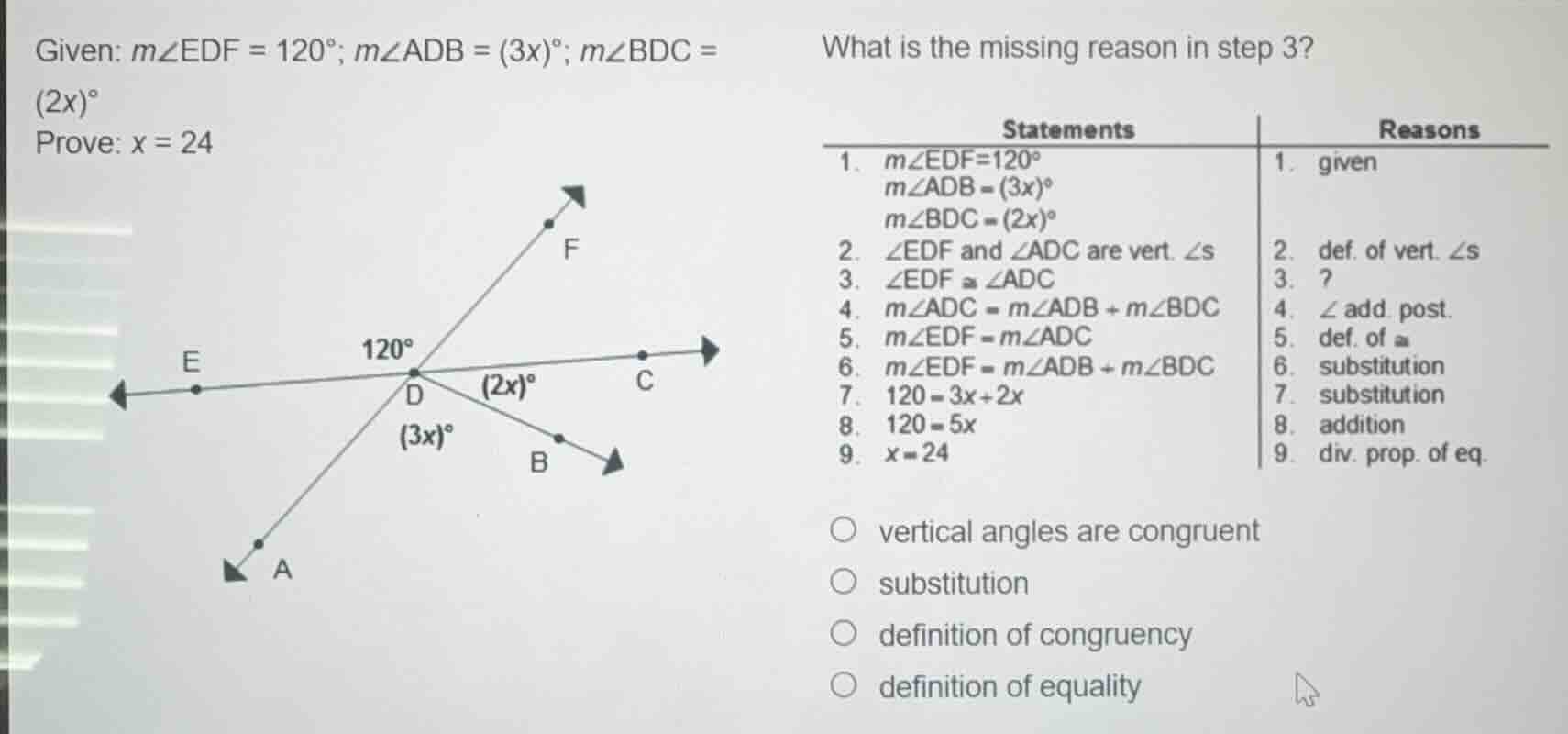
given: $m\angle edf = 120^\circ$; $m\angle adb = (3x)^\circ$; $m\angle bdc = (2x)^\circ$
prove: $x = 24$
what is the missing reason in step 3?
| statements | reasons | ---- | ---- | 1. $m\angle edf=120^\circ$<br>$m\angle adb=(3x)^\circ$<br>$m\angle bdc=(2x)^\circ$ | 1. given | 2. $\angle edf$ and $\angle adc$ are vert. $\angle$s | 2. def. of vert. $\angle$s | 3. $\angle edf \cong \angle adc$ | 3. ? | 4. $m\angle adc = m\angle adb + m\angle bdc$ | 4. $\angle$ add. post. | 5. $m\angle edf = m\angle adc$ | 5. def. of $\cong$ | 6. $m\angle edf = m\angle adb + m\angle bdc$ | 6. substitution | 7. $120 = 3x+2x$ | 7. substitution | 8. $120 = 5x$ | 8. addition | 9. $x=24$ | 9. div. prop. of eq. | - vertical angles are congruent- substitution- definition of congruency- definition of equality |
Brief Explanations
Step 2 states that $\angle EDF$ and $\angle ADC$ are vertical angles. The reason that pairs of vertical angles are congruent is a fundamental geometric theorem, which directly justifies step 3's statement that $\angle EDF \cong \angle ADC$.

Snap & solve any problem in the app
Get step-by-step solutions on Sovi AI
Photo-based solutions with guided steps
Explore more problems and detailed explanations
vertical angles are congruent