QUESTION IMAGE
Question
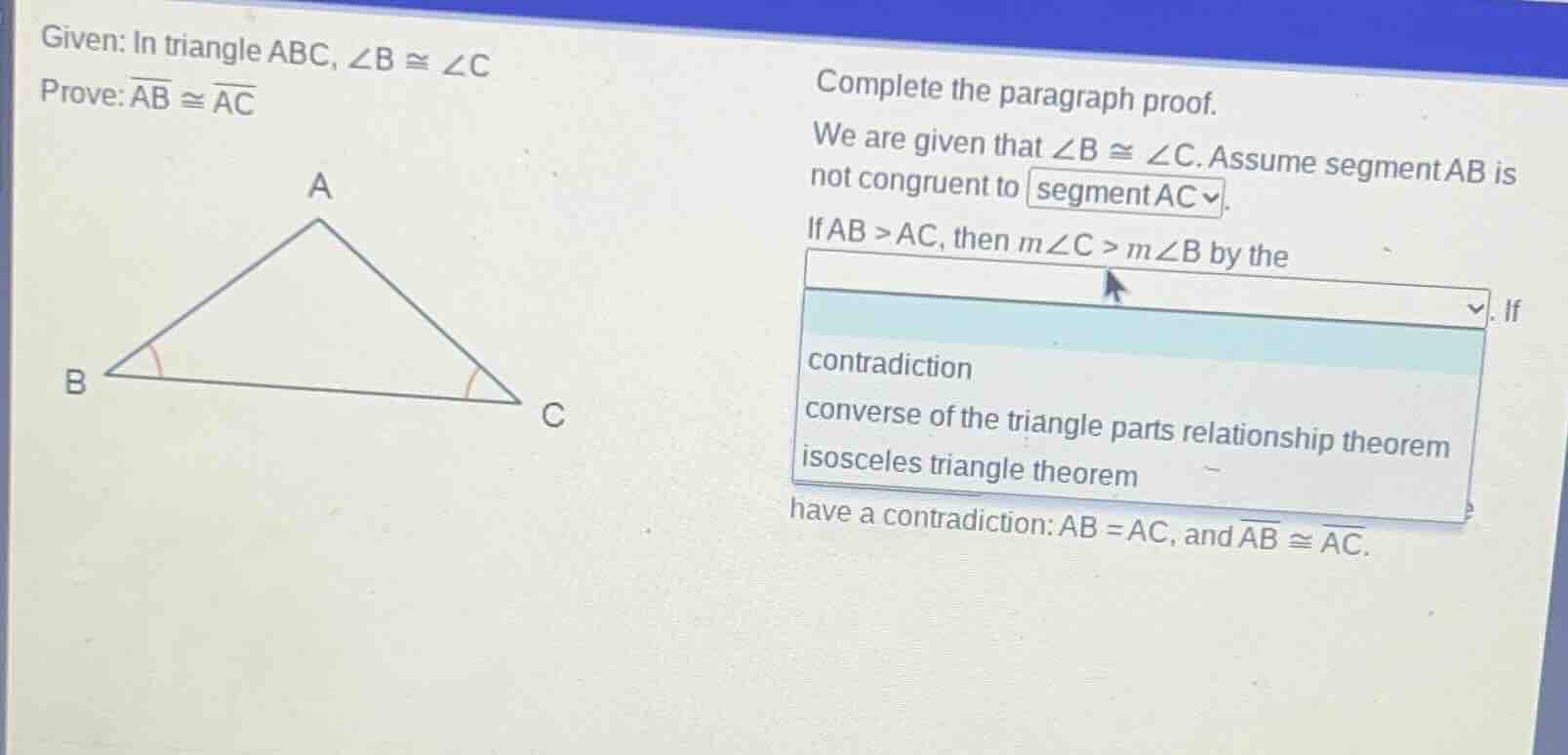
given: in triangle abc, ∠b ≅ ∠c
prove: \overline{ab} ≅ \overline{ac}
complete the paragraph proof.
we are given that ∠b ≅ ∠c. assume segment ab is not congruent to segment ac.
if ab > ac, then m∠c > m∠b by the
dropdown options: contradiction, converse of the triangle parts relationship theorem, isosceles triangle theorem
. if
have a contradiction: ab = ac, and \overline{ab} ≅ \overline{ac}.
To determine the correct theorem, we analyze the relationship between side lengths and angle measures in a triangle. The "converse of the triangle parts relationship theorem" (also known as the converse of the triangle inequality theorem for angle - side relationships) states that if one side of a triangle is longer than another side, then the angle opposite the longer side is larger than the angle opposite the shorter side. Here, we assume \(AB > AC\), and we want to relate this to the measures of \(\angle C\) and \(\angle B\) (where \(\angle C\) is opposite \(AB\) and \(\angle B\) is opposite \(AC\)). The "contradiction" is not a theorem, and the "isosceles triangle theorem" deals with angles opposite equal sides (or vice - versa) in an isosceles triangle, which is not what we need here. So the correct option is the "converse of the triangle parts relationship theorem".

Snap & solve any problem in the app
Get step-by-step solutions on Sovi AI
Photo-based solutions with guided steps
Explore more problems and detailed explanations
converse of the triangle parts relationship theorem