QUESTION IMAGE
Question
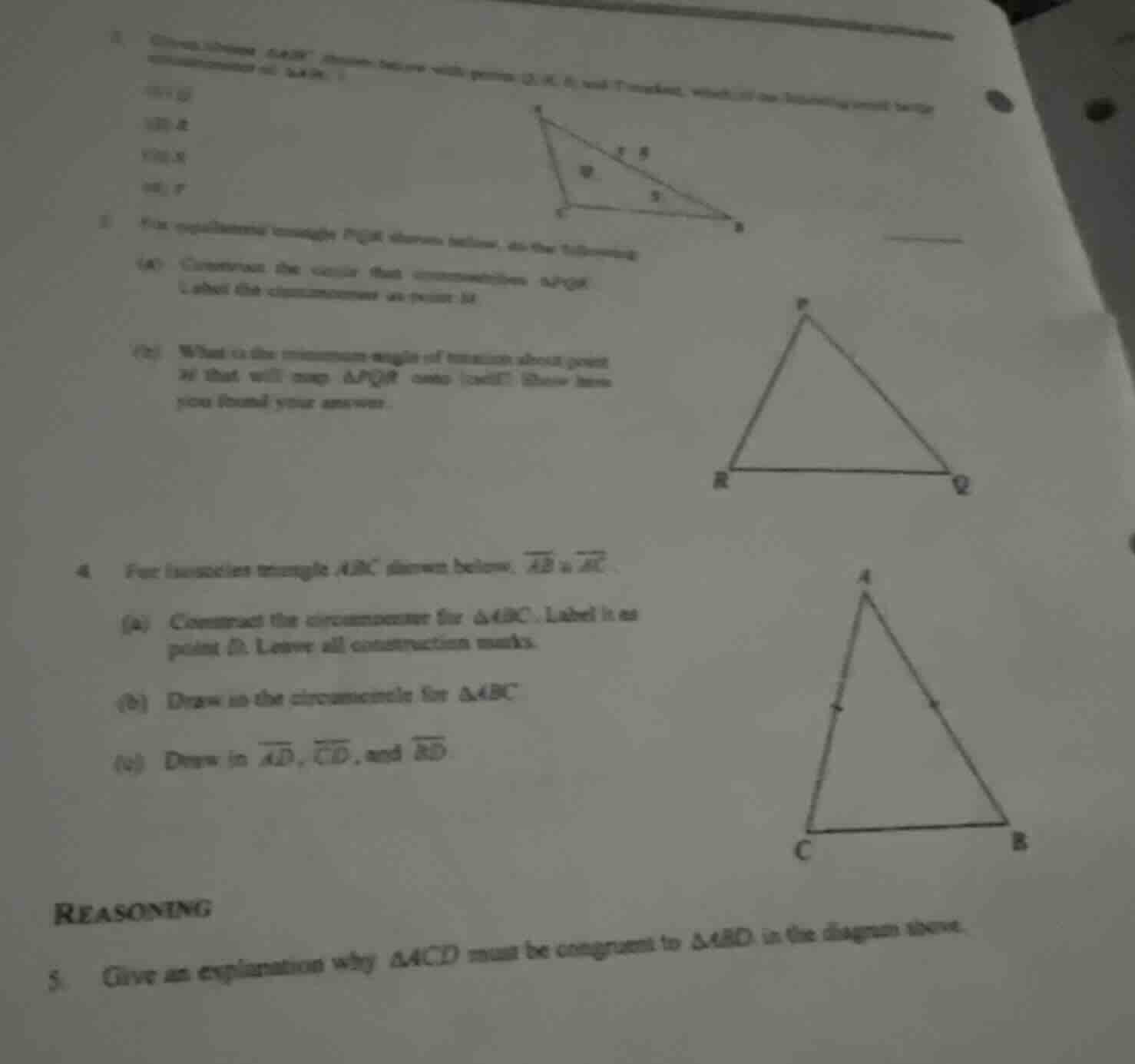
- given triangle oab shown below with points u, r, s, and t marked, which of the following points is the circumcenter of \\( \triangle oab \\)?
(i) u
(ii) r
(iii) s
(iv) t
- for equilateral triangle pqr shown below, do the following:
(a) construct the circle that circumscribes \\( \triangle pqr \\). label the circumcenter as point m.
(b) what is the minimum angle of rotation about point m that will map \\( \triangle pqr \\) onto itself? show how you found your answer.
- for isosceles triangle abc shown below, \\( \overline{ab} \cong \overline{ac} \\).
(a) construct the circumcenter for \\( \triangle abc \\). label it as point d. leave all construction marks.
(b) draw in the circumcircle for \\( \triangle abc \\).
(c) draw in \\( \overline{ad} \\), \\( \overline{cd} \\), and \\( \overline{bd} \\).
reasoning
- give an explanation why \\( \triangle acd \\) must be congruent to \\( \triangle abd \\) in the diagram above.
For Question 5 (Explaining why $\boldsymbol{\triangle ACD \cong \triangle ABD}$):
- Given Information: $\triangle ABC$ is isosceles with $AB = AC$ (from the problem statement: $\overline{AB} \cong \overline{AC}$).
- Circumcenter Property: Point $D$ is the circumcenter of $\triangle ABC$, so $D$ is equidistant from all vertices: $AD = AD$ (common side), $CD = BD$ (radii of the circumcircle), and $AC = AB$ (given).
- SSS Congruence Criterion: By the Side - Side - Side (SSS) congruence rule, if three sides of one triangle are equal to three corresponding sides of another triangle, the triangles are congruent. Here, $AC = AB$, $CD = BD$, and $AD = AD$, so $\triangle ACD \cong \triangle ABD$ by SSS.
- Circumcenter Definition: The circumcenter of a triangle is the intersection of its perpendicular bisectors. For an equilateral triangle, the circumcenter, centroid, incenter, and orthocenter coincide.
- Steps to Construct:
- Draw the perpendicular bisector of one side (e.g., $RQ$):
- Find the midpoint of $RQ$ (let's call it $M$) by measuring the length of $RQ$ and dividing by 2, or by using a compass to draw arcs from $R$ and $Q$ with equal radii and finding their intersection points, then drawing the line through these points (the perpendicular bisector).
- Repeat the process for another side (e.g., $PR$) to find its midpoint $N$ and draw its perpendicular bisector.
- The intersection of these two perpendicular bisectors is the circumcenter $M$ (for an equilateral triangle, this point is also the centroid, incenter, etc.).
- With $M$ as the center and $MR$ (or $MQ$ or $MP$) as the radius, draw the circle. This circle is the circumcircle of $\triangle PQR$.
Part (b): Minimum Angle of Rotation about $\boldsymbol{M}$ to Map $\boldsymbol{\triangle PQR}$ onto Itself
Step 1: Recall Rotational Symmetry of Equilateral Triangle
An equilateral triangle has rotational symmetry of order 3. This means it can be rotated about its center (circumcenter $M$) by angles that are multiples of $\frac{360^{\circ}}{3}=120^{\circ}$ and still map onto itself.
Step 2: Determine Minimum Angle
The smallest positive angle of rotation is the smallest angle in this set of multiples. The multiples are $120^{\circ}, 240^{\circ}, 360^{\circ}$, etc. The smallest positive angle is $120^{\circ}$.

Snap & solve any problem in the app
Get step-by-step solutions on Sovi AI
Photo-based solutions with guided steps
Explore more problems and detailed explanations
$\triangle ACD \cong \triangle ABD$ by the SSS (Side - Side - Side) congruence criterion. This is because:
- $AC = AB$ (given, as $\triangle ABC$ is isosceles with $\overline{AB} \cong \overline{AC}$).
- $CD = BD$ (radii of the circumcircle of $\triangle ABC$, since $D$ is the circumcenter).
- $AD = AD$ (common side to both $\triangle ACD$ and $\triangle ABD$).
Thus, by SSS, $\triangle ACD \cong \triangle ABD$.