QUESTION IMAGE
Question
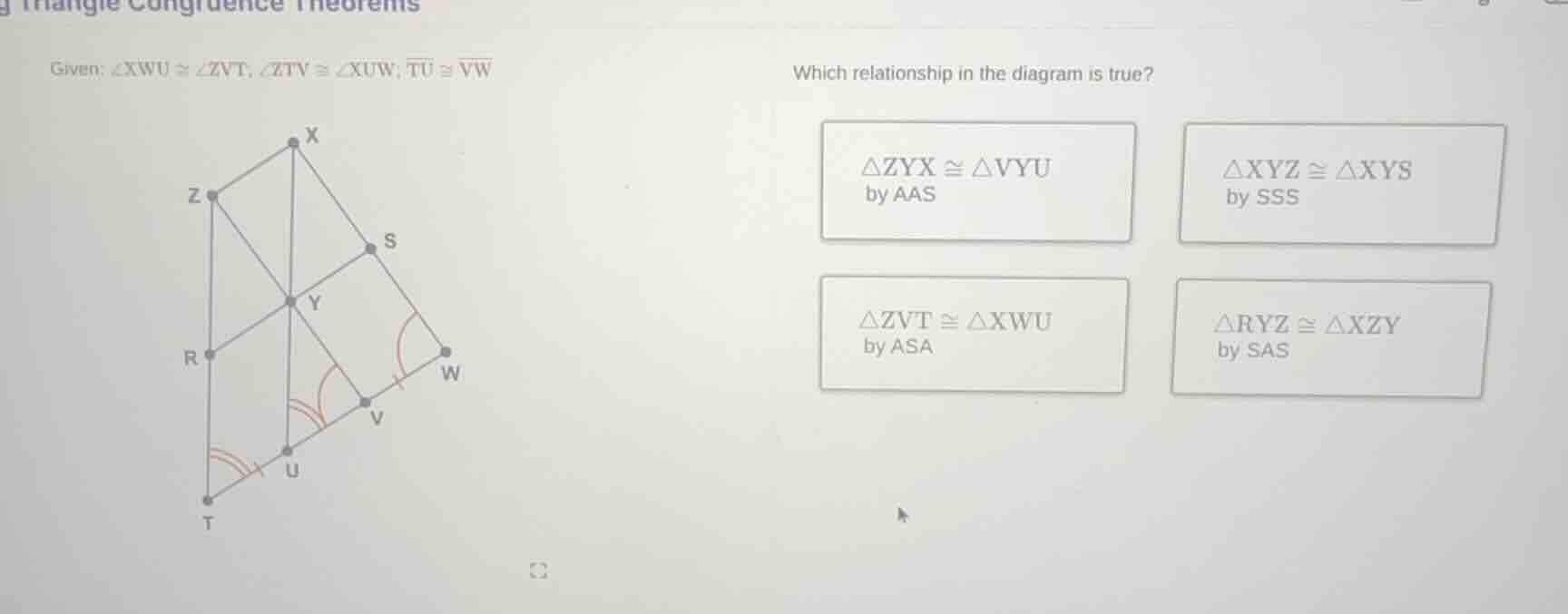
given: $\angle xwu \cong \angle zvt$, $\angle ztv \cong \angle xuw$, $\overline{tu} \cong \overline{vw}$
which relationship in the diagram is true?
$\triangle zyx \cong \triangle vyu$ by aas
$\triangle xyz \cong \triangle xys$ by sss
$\triangle zvt \cong \triangle xwu$ by asa
$\triangle ryz \cong \triangle xzy$ by sas
Step1: Analyze given congruences
We know \( \angle XWU \cong \angle ZVT \), \( \angle ZTV \cong \angle XUW \), and \( \overline{TU} \cong \overline{VW} \). Let's check each option:
Step2: Check \( \triangle ZVT \cong \triangle XWU \)
- \( \angle ZVT \cong \angle XWU \) (given)
- \( \angle ZTV \cong \angle XUW \) (given)
- \( \overline{TV} \cong \overline{WU} \)? Wait, \( TU \cong VW \), and if we look at the segments, \( TV = TU + UV \), \( WU = VW + UV \)? Wait, no, actually, the included side: in ASA, the side between the two angles. For \( \triangle ZVT \) and \( \triangle XWU \), the angles \( \angle ZVT \) and \( \angle ZTV \) have included side \( VT \), and \( \angle XWU \) and \( \angle XUW \) have included side \( WU \)? Wait, no, wait the given \( TU \cong VW \), and if we consider the triangles: \( \angle ZVT \cong \angle XWU \), \( \angle ZTV \cong \angle XUW \), and the side \( VT \) and \( WU \)? Wait, no, actually, the side between \( \angle ZVT \) and \( \angle ZTV \) is \( ZT \) and \( XW \)? No, wait, let's re-express.
Wait, the ASA (Angle-Side-Angle) criterion states that if two angles and the included side of one triangle are congruent to two angles and the included side of another triangle, then the triangles are congruent. For \( \triangle ZVT \) and \( \triangle XWU \):
- \( \angle ZVT \cong \angle XWU \) (given)
- \( \overline{VT} \cong \overline{WU} \)? Wait, \( TU \cong VW \), and if \( UV \) is common, then \( TU + UV = VW + UV \), so \( TV = WU \). Wait, maybe I misread. Alternatively, the given \( TU \cong VW \), and the angles \( \angle ZTV \cong \angle XUW \), \( \angle ZVT \cong \angle XWU \), so the included side between the two angles: for \( \triangle ZVT \), angles at \( V \) and \( T \), included side \( VT \); for \( \triangle XWU \), angles at \( W \) and \( U \), included side \( WU \). But if \( TU \cong VW \), then \( VT = TU + UV \), \( WU = VW + UV \), so \( VT \cong WU \) (since \( TU \cong VW \) and \( UV \) is common). Wait, no, \( TU \cong VW \), so \( TU + UV = VW + UV \implies TV = WU \). So the two angles and the included side: \( \angle ZVT \cong \angle XWU \), \( \overline{TV} \cong \overline{WU} \), \( \angle ZTV \cong \angle XUW \). Wait, that's ASA: two angles and the included side. So \( \triangle ZVT \cong \triangle XWU \) by ASA.
Let's check other options:
- \( \triangle ZYX \cong \triangle VYU \): Not enough info, no given congruences for those sides/angles.
- \( \triangle XYZ \cong \triangle XYS \): SSS? No info on all three sides.
- \( \triangle RYZ \cong \triangle XZY \): No info on those sides/angles.
So the correct one is \( \triangle ZVT \cong \triangle XWU \) by ASA.

Snap & solve any problem in the app
Get step-by-step solutions on Sovi AI
Photo-based solutions with guided steps
Explore more problems and detailed explanations
\( \triangle ZVT \cong \triangle XWU \) by ASA