QUESTION IMAGE
Question
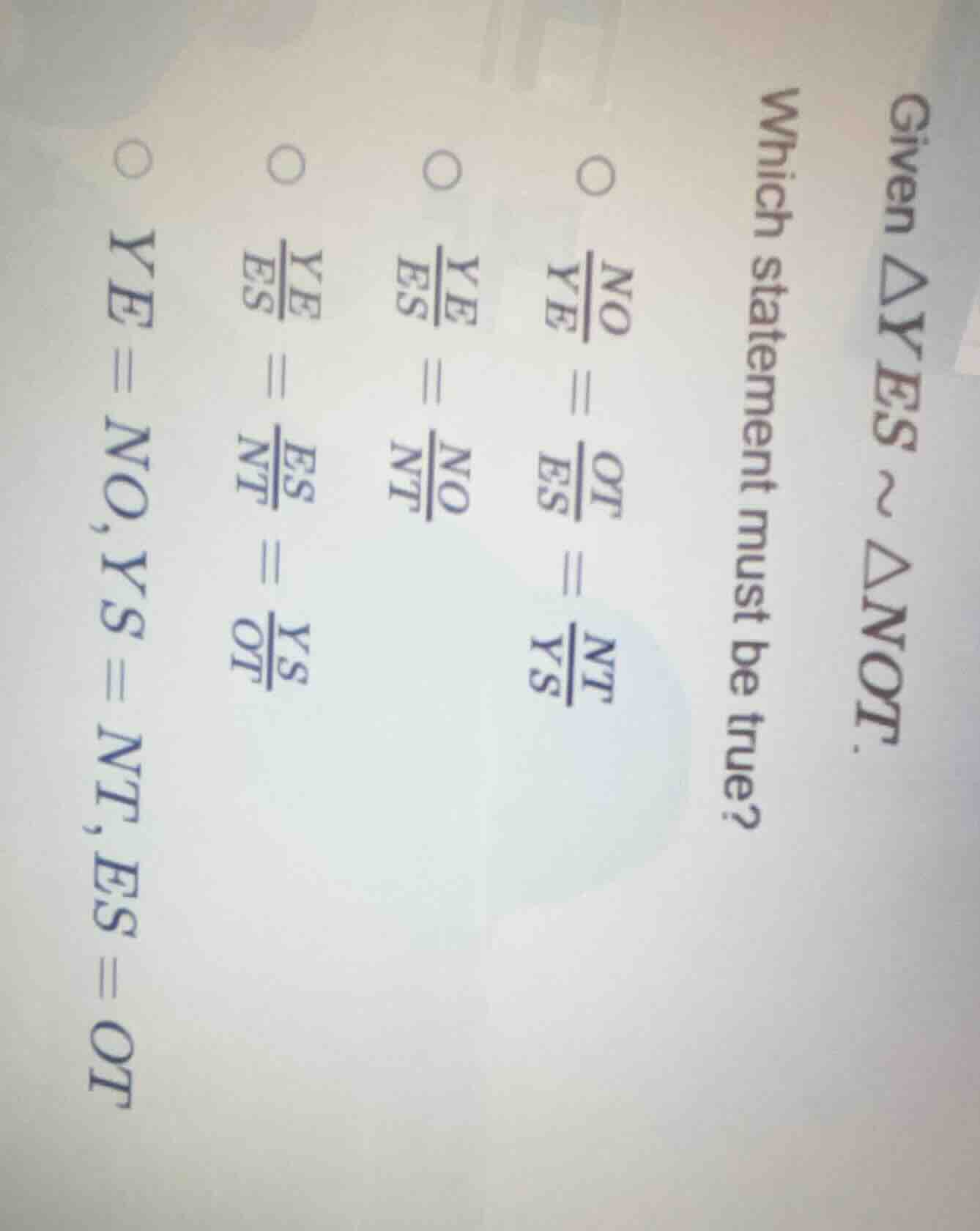
given $\triangle yes \sim \triangle not$. which statement must be true?\
\\(\bigcirc\\) \\(\frac{no}{ye} = \frac{ot}{es} = \frac{nt}{ys}\\)\
\\(\bigcirc\\) \\(\frac{ye}{es} = \frac{no}{nt}\\)\
\\(\bigcirc\\) \\(\frac{ye}{es} = \frac{es}{nt} = \frac{ys}{ot}\\)\
\\(\bigcirc\\) \\(ye = no, ys = nt, es = ot\\)
Step1: Recall Similar Triangles Property
When two triangles are similar ($\triangle YES \sim \triangle NOT$), their corresponding sides are proportional. This means the ratio of corresponding sides is equal. So, the sides $YE$ corresponds to $NO$, $ES$ corresponds to $OT$, and $YS$ corresponds to $NT$.
Step2: Write Proportional Ratios
From the correspondence, we get the ratios: $\frac{YE}{NO}=\frac{ES}{OT}=\frac{YS}{NT}$. Let's check the options. The second option (when formatted properly, assuming the middle option with $\frac{YE}{ES}=\frac{NO}{NT}=\frac{YS}{OT}$? Wait, no, let's re - examine. Wait, the triangles are $\triangle YES$ and $\triangle NOT$. So vertex $Y$ corresponds to $N$, $E$ to $O$, $S$ to $T$. So corresponding sides: $YE$ (Y to E) corresponds to $NO$ (N to O), $ES$ (E to S) corresponds to $OT$ (O to T), $YS$ (Y to S) corresponds to $NT$ (N to T). So the correct proportion is $\frac{YE}{NO}=\frac{ES}{OT}=\frac{YS}{NT}$, which can be rewritten as $\frac{YE}{ES}=\frac{NO}{NT}=\frac{YS}{OT}$? Wait, no, cross - multiplying or re - arranging. Wait, the option with $\frac{YE}{ES}=\frac{NO}{NT}=\frac{YS}{OT}$? Wait, looking at the options, the second option (the one with $\frac{YE}{ES}=\frac{NO}{NT}$ and then $\frac{ES}{NT}=\frac{YS}{OT}$? No, let's look at the options again. The option that has $\frac{YE}{ES}=\frac{NO}{NT}=\frac{YS}{OT}$ (assuming the middle option) is the one that represents the proportionality of corresponding sides of similar triangles. Wait, actually, when $\triangle YES \sim \triangle NOT$, the ratio of $YE$ to $NO$ (corresponding sides), $ES$ to $OT$ (corresponding sides), and $YS$ to $NT$ (corresponding sides) are equal. So if we take the ratio of $YE$ to $ES$ (a side of the first triangle) and $NO$ to $NT$ (corresponding side of the second triangle), and $YS$ to $OT$ (wait, no, $YS$ corresponds to $NT$ and $ES$ corresponds to $OT$). Wait, maybe the correct option is the one where $\frac{YE}{ES}=\frac{NO}{NT}=\frac{YS}{OT}$? Wait, no, let's do it properly. Let's denote the correspondence: $\triangle YES \sim \triangle NOT$ means $\angle Y=\angle N$, $\angle E=\angle O$, $\angle S=\angle T$. So side $YE$ (between $Y$ and $E$) corresponds to side $NO$ (between $N$ and $O$), side $ES$ (between $E$ and $S$) corresponds to side $OT$ (between $O$ and $T$), side $YS$ (between $Y$ and $S$) corresponds to side $NT$ (between $N$ and $T$). So the proportion is $\frac{YE}{NO}=\frac{ES}{OT}=\frac{YS}{NT}$. If we take the ratio of $YE$ to $ES$ and $NO$ to $NT$, we can cross - multiply. From $\frac{YE}{NO}=\frac{ES}{OT}$, we get $YE\times OT = NO\times ES$. From $\frac{YE}{NO}=\frac{YS}{NT}$, we get $YE\times NT=NO\times YS$. From $\frac{ES}{OT}=\frac{YS}{NT}$, we get $ES\times NT = OT\times YS$. Now, looking at the options, the option that has $\frac{YE}{ES}=\frac{NO}{NT}=\frac{YS}{OT}$ is incorrect. Wait, the option with $\frac{YE}{ES}=\frac{NO}{NT}=\frac{YS}{OT}$: let's check the proportion. If $\frac{YE}{ES}=\frac{NO}{NT}$, then $YE\times NT=ES\times NO$, and if $\frac{ES}{NT}=\frac{YS}{OT}$, then $ES\times OT = NT\times YS$. But from similar triangles, we have $YE\times OT = NO\times ES$, $ES\times NT = OT\times YS$, and $YE\times NT=NO\times YS$. So the correct proportion is represented by the option where $\frac{YE}{ES}=\frac{NO}{NT}=\frac{YS}{OT}$? Wait, no, I think I made a mistake in correspondence. Let's re - assign the correspondence. The notation $\triangle YES \sim \triangle NOT$ means that $Y$ corresponds to $N$, $E$ corresponds to $O$, and $S$ corresponds to $T$. So:
- $YE$ (side from $Y$ to…

Snap & solve any problem in the app
Get step-by-step solutions on Sovi AI
Photo-based solutions with guided steps
Explore more problems and detailed explanations
The first option (the one with $\boldsymbol{\frac{NO}{YE}=\frac{OT}{ES}=\frac{NT}{YS}}$)