QUESTION IMAGE
Question
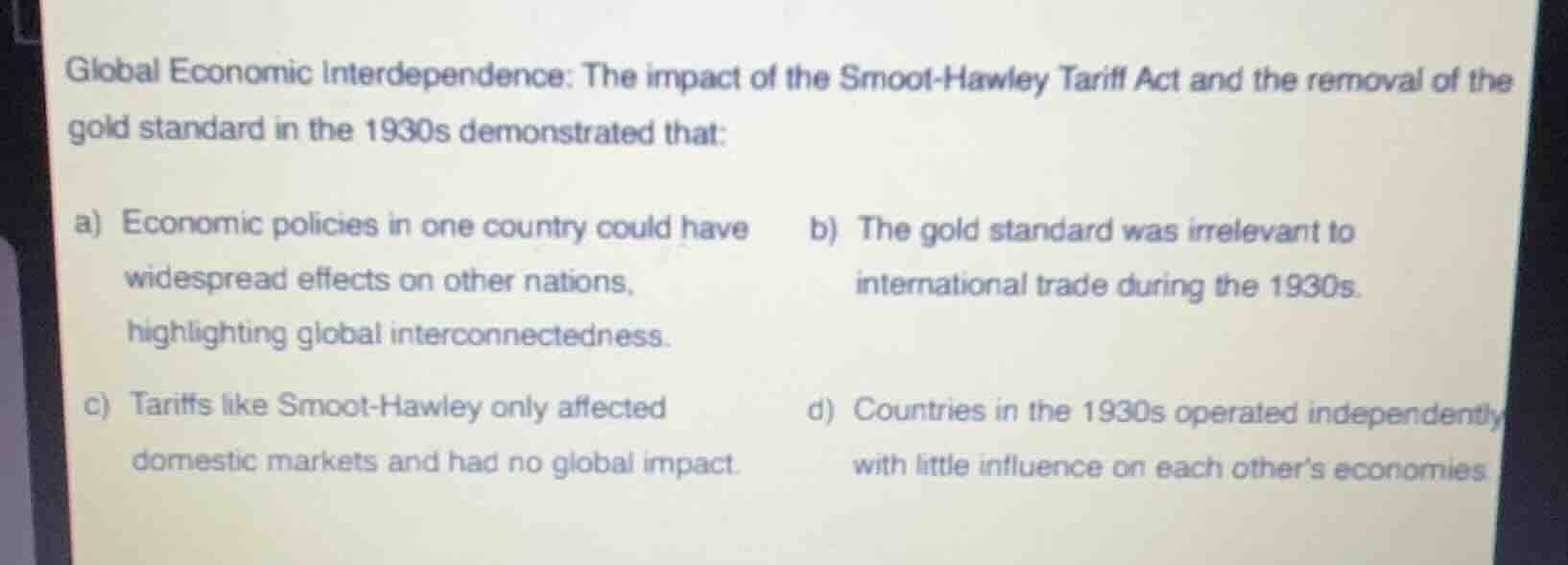
global economic interdependence: the impact of the smoot-hawley tariff act and the removal of the gold standard in the 1930s demonstrated that:
a) economic policies in one country could have widespread effects on other nations, highlighting global interconnectedness.
b) the gold standard was irrelevant to international trade during the 1930s.
c) tariffs like smoot-hawley only affected domestic markets and had no global impact.
d) countries in the 1930s operated independently with little influence on each other’s economies.
To solve this, we analyze each option:
- Option a: The Smoot - Hawley Tariff Act (a U.S. policy) led to retaliatory tariffs worldwide, worsening the Great Depression. The removal of the gold standard also had global economic ripple effects. This shows one country's economic policies impact others, highlighting global interconnectedness.
- Option b: The gold standard was crucial for international trade in the 1930s; its collapse had major effects, so this is wrong.
- Option c: The Smoot - Hawley Tariff had significant global impacts (e.g., other countries imposed tariffs, reducing global trade), so it didn't only affect domestic markets. This is wrong.
- Option d: The 1930s showed countries were highly interdependent (e.g., tariff wars, gold standard collapse), so they didn't operate independently. This is wrong.

Snap & solve any problem in the app
Get step-by-step solutions on Sovi AI
Photo-based solutions with guided steps
Explore more problems and detailed explanations
a) Economic policies in one country could have widespread effects on other nations, highlighting global interconnectedness.