QUESTION IMAGE
Question
from “a good action”
from the gorkey mewspaper and other stories
by sianv antania
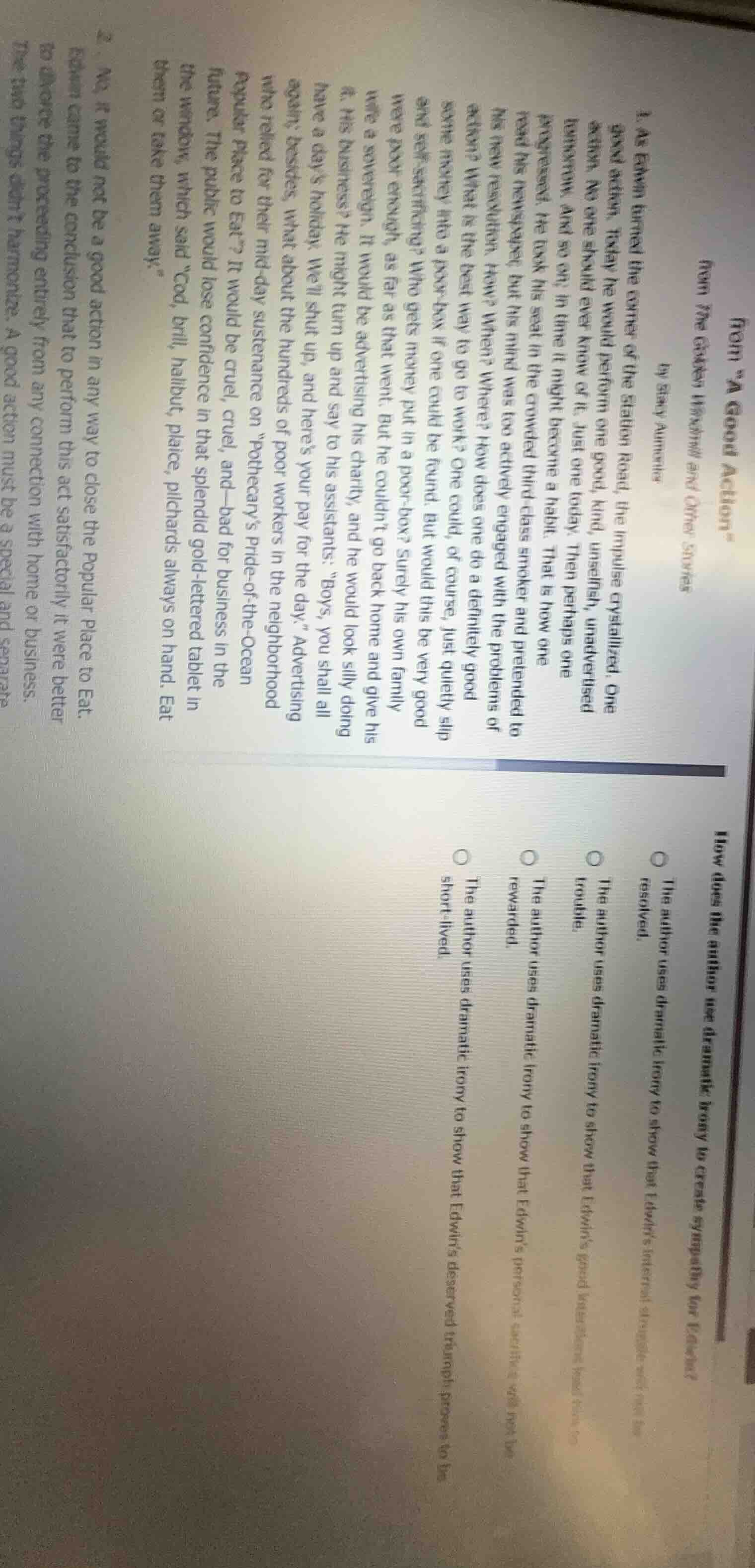
- as edwin turned the corner of the station road, the impulse crystallized. one
sain. no one should ever know of it. just one good, kind, unselfish, unadvertised
toknow. ari so on; in time it might become a habit. that is how one
becomea. he took his seat in the crowded third class smoker and pretended to
read his newspaper, but his mind was too actively engaged with the problems of
his new resolution. how? when? where? how does one do a definitely good
action? what is the best way to go to work? one could, of course, just quietly slip
some money into a poor-box if one could be found; but would this be very good
and self-sacrificing? who gets money put in a poor-box? surely his own family
were poor enough, as far as that went. but he couldn’t go back home and give his
ewife a sovereign. it would be advertising his charity, and he would look silly doing
it. his business? he might turn up and say to his assistants: “boys, you shall all
have a day’s holiday. we’ll shut up, and here’s your pay for the day.” advertising
again; besides, what about the hundreds of poor workers in the neighborhood
who relied for their mid-day sustenance on “pothecary’s pride-of-the-ocean
popular place to eat”? it would be cruel, cruel, and—bad for business in the
future. the public would lose confidence in that splendid gold-lettered tablet in
the window, which said “cod, brill, halibut, plaice, pilchards always on hand. eat
them or take them away.”
- no, it would not be a good action in any way to close the popular place to eat.
edwin came to the conclusion that to perform this act satisfactorily it were better
to divorce the proceeding entirely from any connection with home or business.
the two things didn’t harmonize. a good action must be a special and separate
how does the author use dramatic irony to create sympathy for edwin?
○ the author uses dramatic irony to show that edwin’s interest is quickly resolved.
○ the author uses dramatic irony to show that edwin’s good intentioned hand to trouble.
○ the author uses dramatic irony to show that edwin’s personal is not be rewarded.
○ the author uses dramatic irony to show that edwin’s deserved triumph proves to be short - lived.
Dramatic irony occurs when the audience knows more than the character. Here, Edwin believes his secret good action is self-sacrificing, but the reader sees his concerns about business and family mean his internal struggle to act will not result in a completed good deed. This gap creates sympathy by showing his unfulfilled, earnest intent.

Snap & solve any problem in the app
Get step-by-step solutions on Sovi AI
Photo-based solutions with guided steps
Explore more problems and detailed explanations
The author uses dramatic irony to show that Edwin's internal struggle will not be resolved.