QUESTION IMAGE
Question
grade 11 biology - diagnostic test
- list 3 differences between prokaryotic cells and eukaryotic cells.
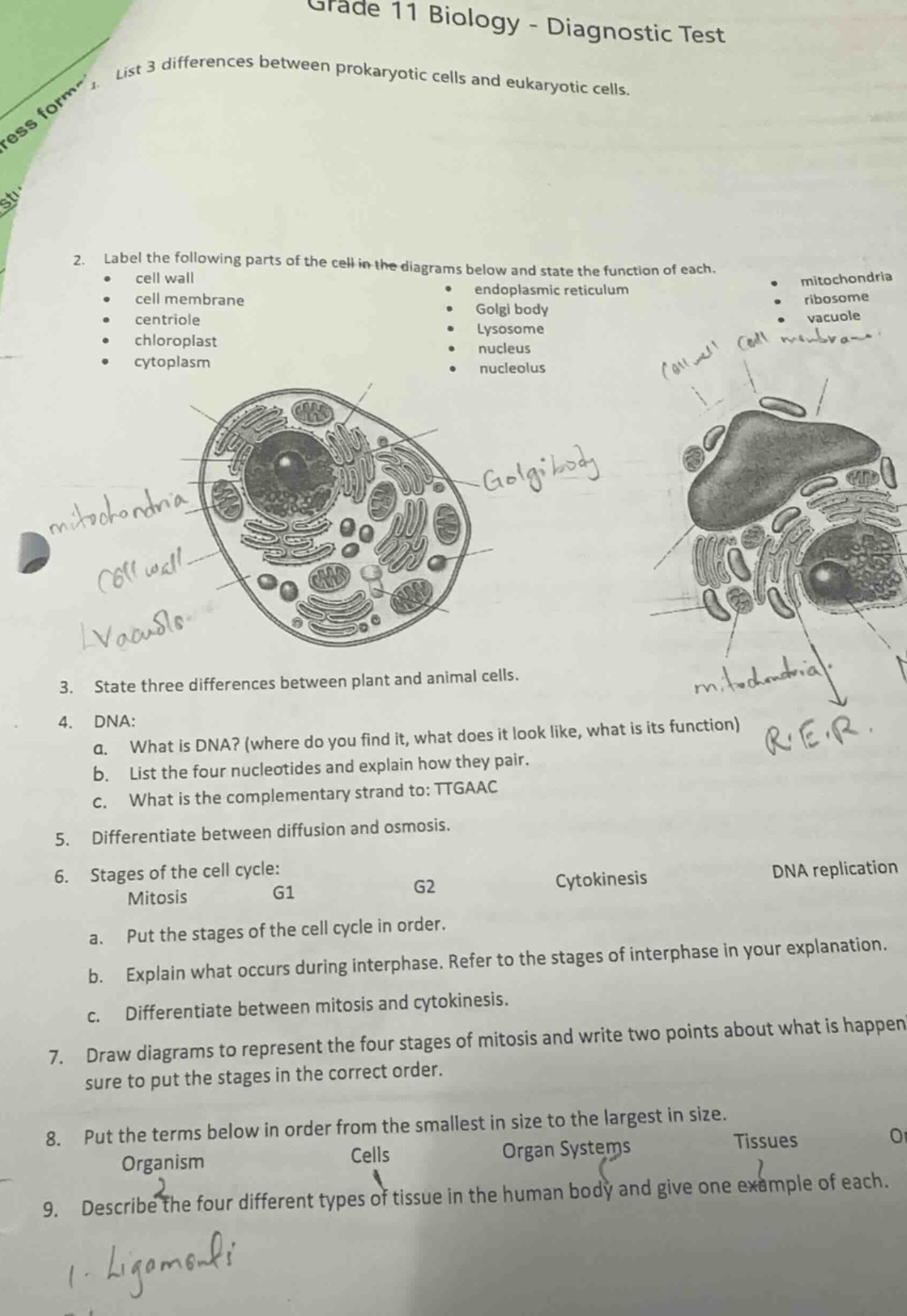
- label the following parts of the cell in the diagrams below and state the function of each.
- cell wall
- cell membrane
- centriole
- chloroplast
- cytoplasm
- endoplasmic reticulum
- golgi body
- lysosome
- nucleus
- nucleolus
- mitochondria
- ribosome
- vacuole
- state three differences between plant and animal cells.
- dna:
a. what is dna? (where do you find it, what does it look like, what is its function)
b. list the four nucleotides and explain how they pair.
c. what is the complementary strand to: ttg aac
- differentiate between diffusion and osmosis.
- stages of the cell cycle:
mitosis g1 g2 cytokinesis dna replication
a. put the stages of the cell cycle in order.
b. explain what occurs during interphase. refer to the stages of interphase in your explanation.
c. differentiate between mitosis and cytokinesis.
- draw diagrams to represent the four stages of mitosis and write two points about what is happen sure to put the stages in the correct order.
- put the terms below in order from the smallest in size to the largest in size.
organism cells organ systems tissues
- describe the four different types of tissue in the human body and give one example of each.
1. Prokaryote vs Eukaryote Differences
Covers core structural and genetic distinctions between the two cell types.
- Nucleus presence: Prokaryotes lack a membrane-bound nucleus; eukaryotes have one.
- Organelles: Prokaryotes have no membrane-bound organelles; eukaryotes have mitochondria, ER, etc.
- DNA structure: Prokaryotes have circular, free-floating DNA; eukaryotes have linear DNA in chromosomes.
2. Cell Part Labels & Functions
Matches each structure to its role in the cell:
- Cell wall: Rigid outer layer; supports/protects plant cells.
- Cell membrane: Phospholipid layer; controls molecule movement in/out.
- Centriole: Cylindrical structure; aids animal cell division.
- Chloroplast: Contains chlorophyll; performs photosynthesis in plants.
- Cytoplasm: Gel-like matrix; holds organelles, enables reactions.
- Endoplasmic Reticulum (ER): Rough ER makes proteins; smooth ER makes lipids.
- Golgi body: Flattened sacs; modifies, sorts, ships proteins.
- Lysosome: Vesicle with enzymes; breaks down waste/debris.
- Nucleus: Membrane-bound organelle; stores genetic material (DNA).
- Nucleolus: Inside nucleus; produces ribosome subunits.
- Mitochondria: Oval organelle; generates ATP (cellular respiration).
- Ribosome: Small particle; synthesizes proteins.
- Vacuole: Fluid-filled sac; stores water/nutrients (large in plants).
Left diagram (plant cell): Cell wall, cell membrane, cytoplasm, nucleus, nucleolus, mitochondria, chloroplast, vacuole, Golgi body, endoplasmic reticulum, ribosomes
Right diagram (animal cell): Cell membrane, cytoplasm, nucleus, nucleolus, mitochondria, centriole, Golgi body, endoplasmic reticulum, ribosomes, lysosomes, small vacuoles
3. Plant vs Animal Cell Differences
Highlights unique structures for each cell type:
- Plant cells have a rigid cell wall; animal cells do not.
- Plant cells contain chloroplasts for photosynthesis; animal cells do not.
- Plant cells have a large central vacuole; animal cells have small, temporary vacuoles.
4. DNA Questions
Covers definition, nucleotide pairing, and complementary strands.
a. DNA (Deoxyribonucleic Acid): Found in the nucleus (eukaryotes) or cytoplasm (prokaryotes); it is a double-stranded helical molecule; its function is to store and transmit genetic information for cell growth, function, and reproduction.
b. Four nucleotides: Adenine (A), Thymine (T), Cytosine (C), Guanine (G). Pairing rule: A bonds with T, C bonds with G (complementary base pairing).
c. Complementary strand uses base pairing rules: A pairs with T, G pairs with C.
5. Diffusion vs Osmosis
Defines each process and their key distinction.
Diffusion: Passive movement of any solute or gas from high to low concentration. Osmosis: Passive movement of water across a semipermeable membrane from high to low water concentration (low to high solute concentration).
6. Cell Cycle Questions
Covers ordering, interphase details, and mitosis vs cytokinesis.
a. Follows the standard sequential stages of the cell cycle.
b. Interphase is the longest cell cycle stage, split into three growth/preparation phases.
c. Distinguishes between nuclear division and cytoplasmic division.
7. Mitosis Stages
Lists the four stages in order with key events for each:
- Prophase: Chromosomes condense, nuclear envelope breaks down, spindle forms.
- Metaphase: Chromosomes line up at the cell's equator (metaphase plate).
- Anaphase: Sister chromatids separate and move to opposite cell poles.
- Telophase: Chromosomes de…

Snap & solve any problem in the app
Get step-by-step solutions on Sovi AI
Photo-based solutions with guided steps
Explore more problems and detailed explanations
1.
- Prokaryotes have no nucleus; eukaryotes have a membrane-bound nucleus.
- Prokaryotes lack membrane-bound organelles; eukaryotes have them (e.g., mitochondria).
- Prokaryotic DNA is circular; eukaryotic DNA is linear (in chromosomes).
2.
Left (Plant Cell) Labels:
- Cell wall: Supports/protects the cell
- Cell membrane: Controls molecule transport
- Cytoplasm: Suspends organelles, hosts reactions
- Nucleus: Stores genetic material
- Nucleolus: Makes ribosome subunits
- Mitochondria: Produces ATP (energy)
- Chloroplast: Carries out photosynthesis
- Large central vacuole: Stores water/nutrients
- Golgi body: Modifies/ships proteins
- Endoplasmic reticulum: Makes proteins/lipids
- Ribosomes: Synthesizes proteins
Right (Animal Cell) Labels:
- Cell membrane: Controls molecule transport
- Cytoplasm: Suspends organelles, hosts reactions
- Nucleus: Stores genetic material
- Nucleolus: Makes ribosome subunits
- Mitochondria: Produces ATP (energy)
- Centriole: Aids in cell division
- Golgi body: Modifies/ships proteins
- Endoplasmic reticulum: Makes proteins/lipids
- Ribosomes: Synthesizes proteins
- Lysosomes: Breaks down waste
- Small vacuoles: Store temporary materials
3.
- Plant cells have a cell wall; animal cells do not.
- Plant cells have chloroplasts; animal cells do not.
- Plant cells have a large central vacuole; animal cells have small vacuoles.
4.
a. DNA is a double-stranded helical molecule. It is found in the nucleus of eukaryotes and the cytoplasm of prokaryotes. Its function is to store and express genetic information for cell structure and function.
b. Nucleotides: Adenine (A), Thymine (T), Cytosine (C), Guanine (G). Pairing: A pairs with T, C pairs with G.
c. AACTTG
5.
Diffusion is the passive movement of any solute/gas down a concentration gradient. Osmosis is the passive movement of water across a semipermeable membrane down its concentration gradient.
6.
a. G1 → DNA replication → G2 → Mitosis → Cytokinesis
b. Interphase includes G1 (cell grows, makes organelles), DNA replication (copies genetic material), and G2 (cell prepares for mitosis).
c. Mitosis is the division of the cell's nucleus; cytokinesis is the division of the cytoplasm to form two new cells.
7.
- Prophase: Chromosomes condense; nuclear envelope dissolves.
- Metaphase: Chromosomes align at the cell equator.
- Anaphase: Sister chromatids split and move to poles.
- Telophase: Nuclear envelopes reform; chromosomes decondense.
8.
Cells → Tissues → Organ Systems → Organism
9.
- Epithelial tissue: Covers body surfaces; example: skin epidermis
- Connective tissue: Supports/connects structures; example: ligaments
- Muscle tissue: Enables movement; example: skeletal bicep muscle
- Nervous tissue: Transmits signals; example: brain neurons