QUESTION IMAGE
Question
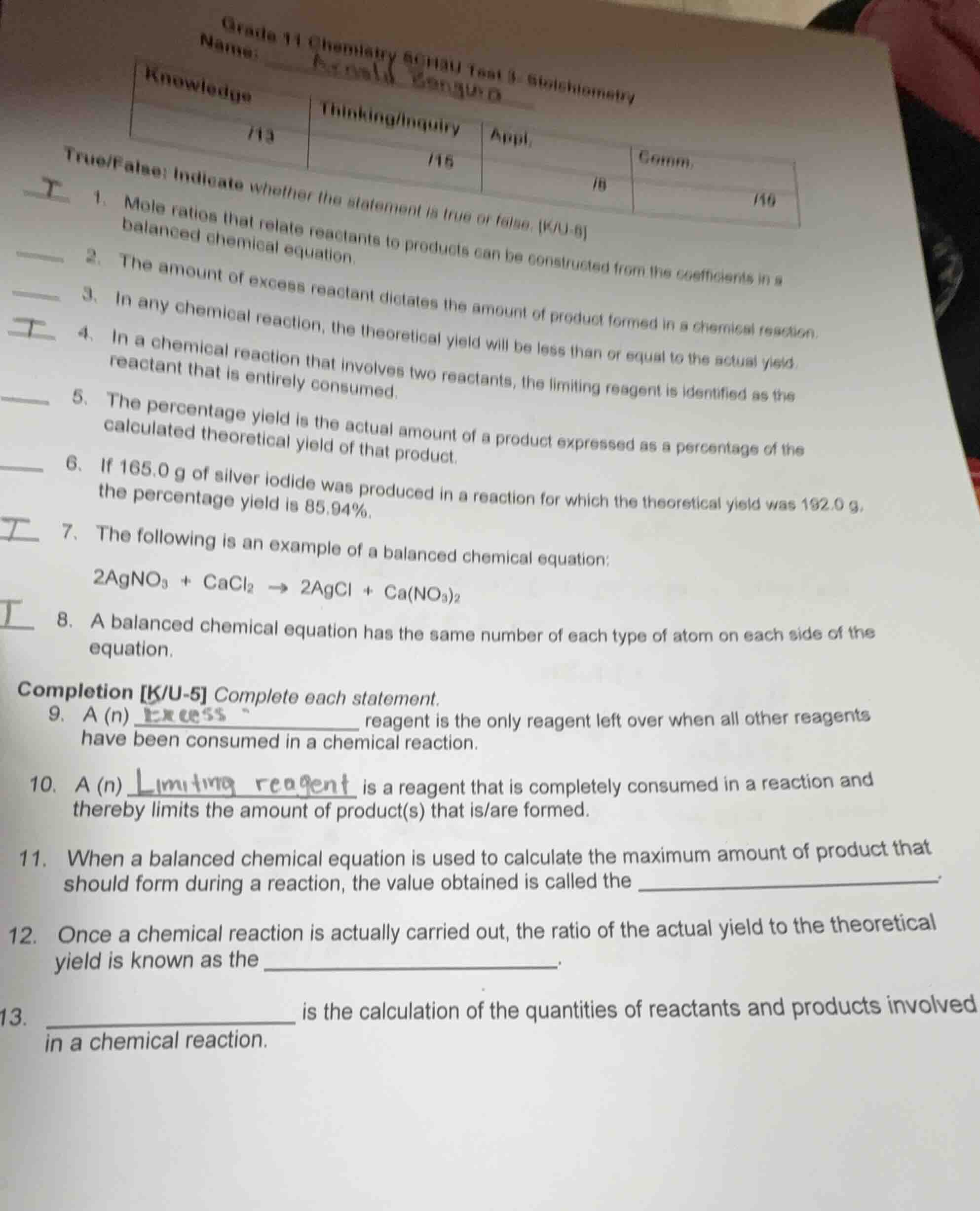
grade 11 chemistry scn3u test 5: stoichiometry
name:
| knowledge /13 | thinking/inquiry /15 | appl. /8 | comm. /10 |
true/false: indicate whether the statement is true or false. k/u-8
- mole ratios that relate reactants to products can be constructed from the coefficients in a balanced chemical equation.
- the amount of excess reactant dictates the amount of product formed in a chemical reaction.
- in any chemical reaction, the theoretical yield will be less than or equal to the actual yield.
- in a chemical reaction that involves two reactants, the limiting reagent is identified as the reactant that is entirely consumed.
- the percentage yield is the actual amount of a product expressed as a percentage of the calculated theoretical yield of that product.
- if 165.0 g of silver iodide was produced in a reaction for which the theoretical yield was 192.0 g, the percentage yield is 85.94%.
- the following is an example of a balanced chemical equation:
2agno₃ + cacl₂ → 2agcl + ca(no₃)₂
- a balanced chemical equation has the same number of each type of atom on each side of the equation.
completion k/u-5 complete each statement.
- a (n) ______ reagent is the only reagent left over when all other reagents have been consumed in a chemical reaction.
- a (n) ______ is a reagent that is completely consumed in a reaction and thereby limits the amount of product(s) that is/are formed.
- when a balanced chemical equation is used to calculate the maximum amount of product that should form during a reaction, the value obtained is called the ______.
- once a chemical reaction is actually carried out, the ratio of the actual yield to the theoretical yield is known as the ______.
- ______ is the calculation of the quantities of reactants and products involved in a chemical reaction.
Response
True/False Questions:
- Explanation: Mole ratios are determined by the coefficients in a balanced chemical equation, relating reactants and products.

Snap & solve any problem in the app
Get step-by-step solutions on Sovi AI
Photo-based solutions with guided steps
Explore more problems and detailed explanations
**: True (T)
- Explanation: The limiting reactant (not excess) determines the amount of product formed.