QUESTION IMAGE
Question
grade 7 unit 4 georgia’s k-12 mathematics standards
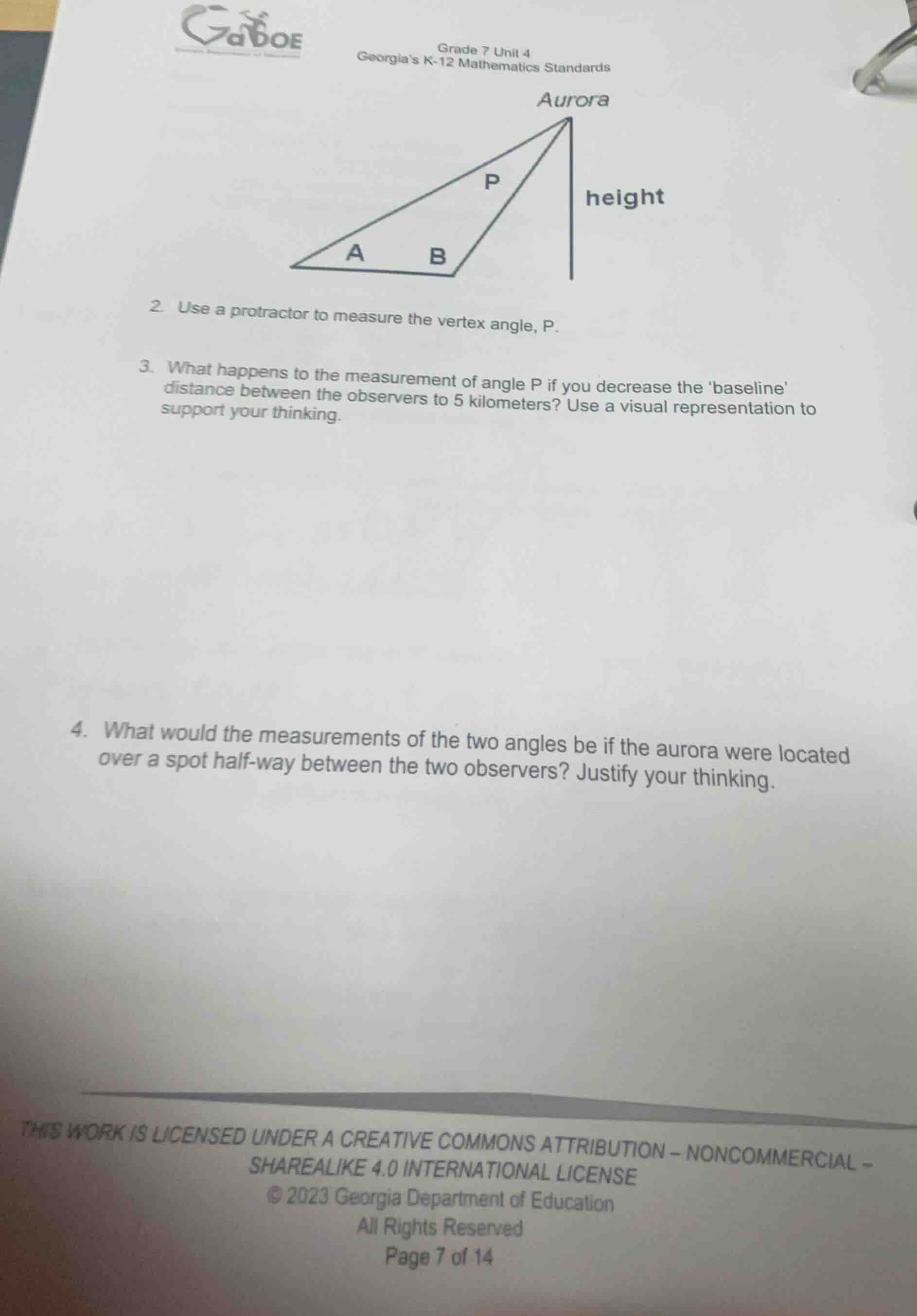
- use a protractor to measure the vertex angle, p.
- what happens to the measurement of angle p if you decrease the baseline distance between the observers to 5 kilometers? use a visual representation to support your thinking.
- what would the measurements of the two angles be if the aurora were located over a spot half-way between the two observers? justify your thinking.
this work is licensed under a creative commons attribution - noncommercial - sharealike 4.0 international license
© 2023 georgia department of education
all rights reserved
page 7 of 14
Question 2 Solution:
Step1: Identify the vertex angle
The vertex angle \( P \) is at the point where the two lines from the observers meet at the aurora. Place the center of the protractor on the vertex (aurora's position) and align one of the sides of angle \( P \) with the zero - degree mark of the protractor.
Step2: Measure the angle
Read the degree measure where the other side of angle \( P \) intersects the protractor scale. (Since this is a practical measurement, the actual value will depend on the diagram's scale. For example, if the diagram is drawn such that angle \( P \) is, say, \( 30^\circ \), but this needs to be measured physically with a protractor.)
Step1: Recall triangle angle - side relationship
In a triangle, when the length of the base (baseline between observers) decreases, while the height (distance from aurora to the baseline) remains constant, we can think in terms of the triangle formed by the two observers and the aurora. Let the height be \( h \), the baseline be \( b \), and the two equal - side lengths (from observers to aurora) be \( l \). Using the tangent function, \( \tan(\theta)=\frac{h}{(b/2)} \) for the base angles, and for angle \( P \), we know that the sum of angles in a triangle is \( 180^\circ \), so \( P = 180^\circ- 2\theta \).
Step2: Analyze the change in angle \( P \)
If the baseline \( b \) decreases, then \( \frac{h}{(b/2)}=\frac{2h}{b} \) increases. So the base angles \( \theta \) increase (since \( \tan(\theta) \) is increasing for \( \theta\in(0,90^\circ) \)). Since \( P = 180^\circ - 2\theta \), as \( \theta \) increases, \( P \) will decrease. For example, if initially \( b = 10 \) km and \( h = 5 \) km, \( \tan(\theta)=\frac{5}{5}=1 \), \( \theta = 45^\circ \), \( P=90^\circ \). If \( b = 5 \) km, \( \tan(\theta)=\frac{5}{2.5} = 2 \), \( \theta\approx63.43^\circ \), \( P=180 - 2\times63.43=53.14^\circ \), which is less than \( 90^\circ \).
Step1: Consider the triangle symmetry
If the aurora is halfway between the two observers, the triangle formed by the two observers and the aurora is an isosceles triangle with the two sides from the observers to the aurora being equal in length (because the distance from each observer to the mid - point is the same).
Step2: Determine the angles
In an isosceles triangle, the base angles (angles at the observers, angles \( A \) and \( B \)) are equal. Let the height of the aurora above the baseline be \( h \) and the distance from each observer to the mid - point be \( x \) (so the baseline length is \( 2x \)). Using the tangent function, \( \tan(A)=\tan(B)=\frac{h}{x} \). Also, since the triangle is isosceles with \( A = B \), and the sum of angles in a triangle is \( 180^\circ \), if we assume the triangle is a right - triangle (since the height is perpendicular to the baseline), then \( A + B+P = 180^\circ \), and \( A = B \), so \( 2A+P = 180^\circ \). If the triangle is a right - triangle (height perpendicular to baseline), then \( P = 90^\circ \) and \( A = B = 45^\circ \) (because \( \tan(A)=\frac{h}{x} \), and if \( h = x \), but more generally, due to the symmetry, the two base angles are equal. For example, if the height is equal to the distance from the observer to the mid - point, the angles are \( 45^\circ \) each, and the vertex angle \( P \) is \( 90^\circ \). In general, the two angles at the observers (angles \( A \) and \( B \)) will be equal, and the vertex angle \( P \) will be \( 180^\circ- 2A \) where \( A = B \).

Snap & solve any problem in the app
Get step-by-step solutions on Sovi AI
Photo-based solutions with guided steps
Explore more problems and detailed explanations
(The answer will be the measured angle value, e.g., if measured as \( 25^\circ \), then the answer is \( 25^\circ \) (actual value depends on protractor measurement))