QUESTION IMAGE
Question
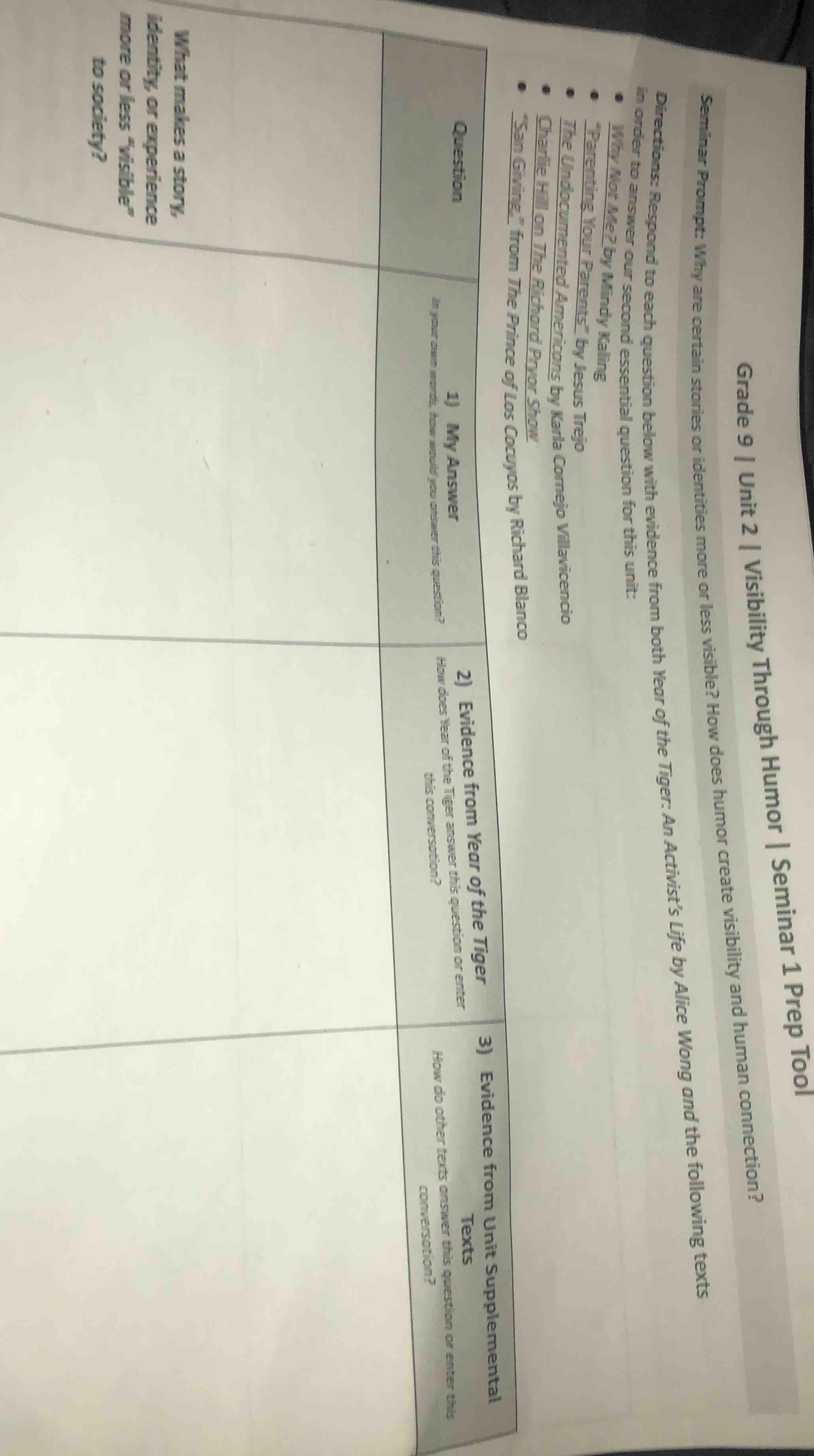
grade 9 | unit 2 | visibility through humor | seminar 1 prep tool
seminar prompt: why are certain stories or identities more or less visible? how does humor create visibility and human connection?
directions: respond to each question below with evidence from both year of the tiger: an activist’s life by alice wong and the following texts
in order to answer our second essential question for this unit:
- why not me? by mindy kaling
- \parenting your parents\ by jesus trejo
- the undocumented americans by karla cornejo villavicencio
- charlie hill on the richard pryor show
- \san giving,\ from the prince of los cocuyos by richard blanco
- my answer
in your own words, how would you answer this question?
- evidence from year of the tiger
how does year of the tiger answer this question or enter this conversation?
- evidence from unit supplemental texts
how do other texts answer this question or enter this conversation?
question
what makes a story, identity, or experience more or less \visible\ to society?
- For the core question, stories/identities gain visibility when they use humor to soften heavy topics, making relatable, shared human experiences accessible to broader audiences. Marginalized identities may be less visible if their stories don't use approachable framing like humor to break societal barriers.
- For Year of the Tiger: An Activist’s Life, Alice Wong uses self-deprecating and dry humor about her disability (e.g., joking about navigating ableist spaces) to make the often-invisible experiences of disabled activists visible. This humor disarms audiences, creating a human connection by showing her personality beyond her disability, inviting others to engage with her advocacy rather than tuning out a "heavy" activist message.
- For the supplemental texts:
- Why Not Me?: Mindy Kaling uses self-deprecating humor about her identity as a South Asian, female Hollywood writer/actor (e.g., joking about being overlooked for roles) to highlight the invisibility of women of color in entertainment. The humor makes her experiences relatable, fostering connection by showing shared feelings of being an outsider, while making her underrepresented identity more visible to mainstream readers.
- Parenting Your Parents: Jesus Trejo uses warm, self-deprecating humor about his experience caring for his immigrant parents (e.g., joking about navigating cultural gaps and caregiving logistics) to make the invisible labor of Latinx adult children caring for aging parents visible. The humor creates connection by framing a stressful, niche experience as universally relatable.
- The Undocumented Americans: Karla Cornejo Villavicencio uses dark, dry humor to humanize undocumented people (e.g., joking about absurd immigration bureaucracy) that society often renders invisible. The humor cuts through dehumanizing narratives, creating connection by showing the mundane, funny, and human side of undocumented life.
- Charlie Hill on The Richard Pryor Show: Charlie Hill uses observational humor about Indigenous identity (e.g., joking about stereotypes of Native Americans in media) to challenge the invisibility and one-dimensional portrayals of Indigenous people. The humor creates connection by making audiences laugh first, then confront their own biases, centering an identity rarely seen in mainstream comedy.
- San Giving: Richard Blanco uses gentle, self-deprecating humor about his Cuban-American, queer identity (e.g., joking about family holiday tensions around his identity) to make the intersectional experiences of queer immigrant people visible. The humor fosters connection by framing personal, specific struggles as relatable family dynamics.

Snap & solve any problem in the app
Get step-by-step solutions on Sovi AI
Photo-based solutions with guided steps
Explore more problems and detailed explanations
- Stories/identities become more visible when they use humor to frame niche, marginalized, or heavy experiences as relatable; they are less visible if they rely on unapproachable, stigmatized framing that pushes audiences away. Humor creates visibility by disarming audiences, and human connection by highlighting shared, universal feelings within specific experiences.
- Alice Wong’s humor about her disabled activist identity disarms audiences, making the invisible experiences of disabled advocates visible, and creates human connection by centering her personality beyond her disability/advocacy, inviting audience engagement rather than defensiveness.
3)
- Why Not Me?: Kaling’s self-deprecating humor highlights the invisibility of women of color in Hollywood, creating connection by framing outsider experiences as relatable.
- Parenting Your Parents: Trejo’s warm humor makes the invisible care labor of Latinx adult children visible, creating connection through relatable family stress.
- The Undocumented Americans: Villavicencio’s dark humor humanizes invisible undocumented people, creating connection by showing their mundane, funny, human lives.
- Charlie Hill on The Richard Pryor Show: Hill’s observational humor challenges invisible, stereotypical Indigenous portrayals, creating connection by making audiences laugh before confronting biases.
- San Giving: Blanco’s gentle humor makes queer Cuban-American intersectional identities visible, creating connection through relatable family holiday tensions.