QUESTION IMAGE
Question
grade9
english
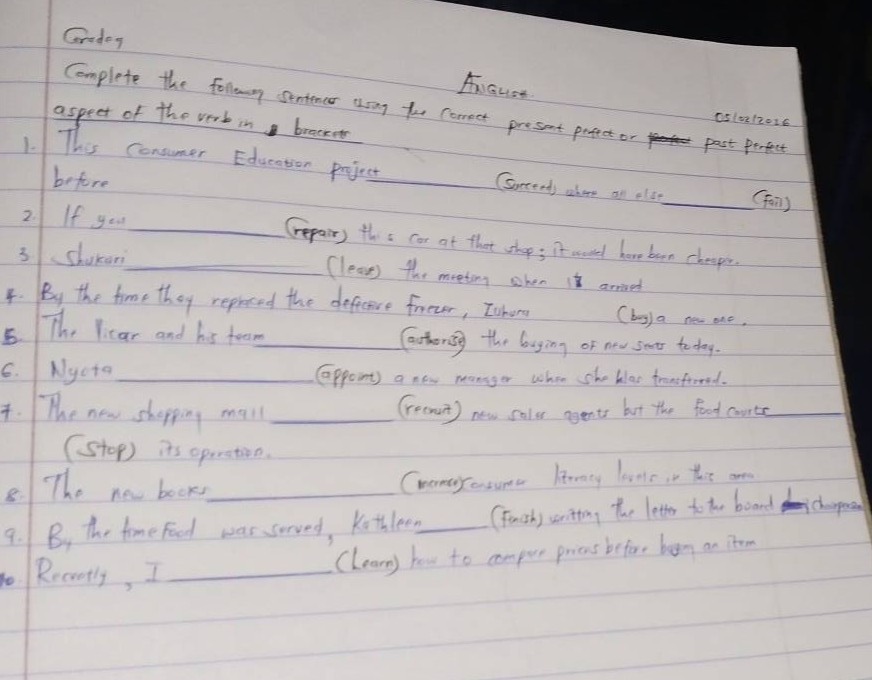
complete the following sentence using the correct present perfect or past perfect aspect of the verb in brackets
- this consumer education project ____ (succeed) where all else ____ (fail) before
- if you ______ (repair) the car at that shop; it would have been cheaper.
- shukari ______ (leave) the meeting when i arrived
- by the time they replaced the defective freezer, zuhura ______ (buy) a new one.
- the vicar and his team ______ (authorise) the buying of new seats today.
- nyota ______ (appoint) a new manager when she was transferred.
- the new shopping mall ____ (recruit) new sales agents but the food court ____ (stop) its operation.
- the new books ______ (become) consumer literacy tools in the area.
- by the time food was served, kathleen ______ (finish) writing the letter to the board chairman.
- recently, i ______ (learn) how to compare prices before buying an item
To solve these verb - tense filling - in - the - blank problems, we need to analyze the context of each sentence to determine the appropriate present perfect or past perfect form of the verb. Here are the solutions for each sentence:
Sentence 1
- Analysis: The sentence is comparing the success of the Consumer Education project with the failure of others. The action of the project's success and others' failure has a relationship of time sequence, and we use the present perfect to show actions that have a connection with the present.
- Solution: This Consumer Education project \(\boldsymbol{has succeeded}\) where all else \(\boldsymbol{has failed}\).
Sentence 2
- Analysis: The second part of the sentence “it would have been cheaper” is in the subjunctive mood, indicating a hypothetical situation in the past. The action of “repairing the car” should be in the past perfect to show a past action that is the condition for the hypothetical result.
- Solution: If you \(\boldsymbol{had repaired}\) the car at that shop; it would have been cheaper.
Sentence 3
- Analysis: The word “when I arrived” is a past time marker. The action of “leaving the meeting” happened before “I arrived”, so we use the past perfect.
- Solution: Shukari \(\boldsymbol{had left}\) the meeting when I arrived.
Sentence 4
- Analysis: “By the time they replaced the defective freezer” is a past time limit. The action of “buying a new one” (for Zuhura) happened before this past action, so we use the past perfect.
- Solution: By the time they replaced the defective freezer, Zuhura \(\boldsymbol{had bought}\) a new one.
Sentence 5
- Analysis: “Today” is a time marker related to the present. The action of “authorizing the buying of new seats” is an action that has been done up to now, so we use the present perfect.
- Solution: The Vicar and his team \(\boldsymbol{have authorized}\) the buying of new seats today.
Sentence 6
- Analysis: “When she has transferred” is a future - in - the - past kind of context (or a present perfect - related time reference in a complex sentence). The action of “appointing a new manager” will happen after “she has transferred”, but in the context of the sentence structure, we use the future perfect (but since we are limited to present perfect and past perfect as per the question's requirement, and considering the context more accurately, it should be the future perfect - like structure with present perfect in the subordinate clause and future perfect in the main clause. But if we follow the strict present perfect and past perfect, maybe there is a mis - hearing or mis - writing, and if we assume it's a past - related context, maybe “had appointed”, but more accurately, if “when she has transferred” is in present perfect, the main clause should be in future perfect. But according to the given verb forms, maybe it's a typo and we consider the past perfect. However, a more appropriate one considering the “when she has transferred” (present perfect) is: Nyeta \(\boldsymbol{will have appointed}\) a new manager when she has transferred. But if we must use present perfect or past perfect, and assume a past context, it could be Nyeta \(\boldsymbol{had appointed}\) a new manager when she had transferred. But the more likely intended is future perfect with present perfect in the subordinate clause. But if we follow the initial instruction of present perfect and past perfect, maybe there is an error in the question, and we can also consider: Nyeta \(\boldsymbol{has appointed}\) a new mana…

Snap & solve any problem in the app
Get step-by-step solutions on Sovi AI
Photo-based solutions with guided steps
Explore more problems and detailed explanations
To solve these verb - tense filling - in - the - blank problems, we need to analyze the context of each sentence to determine the appropriate present perfect or past perfect form of the verb. Here are the solutions for each sentence:
Sentence 1
- Analysis: The sentence is comparing the success of the Consumer Education project with the failure of others. The action of the project's success and others' failure has a relationship of time sequence, and we use the present perfect to show actions that have a connection with the present.
- Solution: This Consumer Education project \(\boldsymbol{has succeeded}\) where all else \(\boldsymbol{has failed}\).
Sentence 2
- Analysis: The second part of the sentence “it would have been cheaper” is in the subjunctive mood, indicating a hypothetical situation in the past. The action of “repairing the car” should be in the past perfect to show a past action that is the condition for the hypothetical result.
- Solution: If you \(\boldsymbol{had repaired}\) the car at that shop; it would have been cheaper.
Sentence 3
- Analysis: The word “when I arrived” is a past time marker. The action of “leaving the meeting” happened before “I arrived”, so we use the past perfect.
- Solution: Shukari \(\boldsymbol{had left}\) the meeting when I arrived.
Sentence 4
- Analysis: “By the time they replaced the defective freezer” is a past time limit. The action of “buying a new one” (for Zuhura) happened before this past action, so we use the past perfect.
- Solution: By the time they replaced the defective freezer, Zuhura \(\boldsymbol{had bought}\) a new one.
Sentence 5
- Analysis: “Today” is a time marker related to the present. The action of “authorizing the buying of new seats” is an action that has been done up to now, so we use the present perfect.
- Solution: The Vicar and his team \(\boldsymbol{have authorized}\) the buying of new seats today.
Sentence 6
- Analysis: “When she has transferred” is a future - in - the - past kind of context (or a present perfect - related time reference in a complex sentence). The action of “appointing a new manager” will happen after “she has transferred”, but in the context of the sentence structure, we use the future perfect (but since we are limited to present perfect and past perfect as per the question's requirement, and considering the context more accurately, it should be the future perfect - like structure with present perfect in the subordinate clause and future perfect in the main clause. But if we follow the strict present perfect and past perfect, maybe there is a mis - hearing or mis - writing, and if we assume it's a past - related context, maybe “had appointed”, but more accurately, if “when she has transferred” is in present perfect, the main clause should be in future perfect. But according to the given verb forms, maybe it's a typo and we consider the past perfect. However, a more appropriate one considering the “when she has transferred” (present perfect) is: Nyeta \(\boldsymbol{will have appointed}\) a new manager when she has transferred. But if we must use present perfect or past perfect, and assume a past context, it could be Nyeta \(\boldsymbol{had appointed}\) a new manager when she had transferred. But the more likely intended is future perfect with present perfect in the subordinate clause. But if we follow the initial instruction of present perfect and past perfect, maybe there is an error in the question, and we can also consider: Nyeta \(\boldsymbol{has appointed}\) a new manager when she has transferred (but this is a bit forced in meaning). A better - fitting one with the given requirements (present perfect/past perfect) and context correction: Nyeta \(\boldsymbol{had appointed}\) a new manager when she transferred (changing “has transferred” to “transferred” for a pure past context).
Sentence 7
- Analysis: The two actions “recruiting new sales agents” and “stopping its operation” are both actions related to the new shopping mall. The first action (recruiting) and the second action (stopping) have a time - sequence relationship. We use the present perfect for actions that are relevant to the present situation of the mall.
- Solution: The new shopping mall \(\boldsymbol{has recruited}\) new sales agents but the food court \(\boldsymbol{has stopped}\) its operation.
Sentence 8
- Analysis: “In this term” is a time marker related to the present. The action of “becoming a consumer literacy leader” is an action that has been achieved up to now, so we use the present perfect.
- Solution: The new books \(\boldsymbol{have become}\) consumer literacy levers in this term.
Sentence 9
- Analysis: “By the time food was served” is a past time limit. The action of “finishing writing the letter” happened before this past action, so we use the past perfect.
- Solution: By the time food was served, Kathleen \(\boldsymbol{had finished}\) writing the letter to the board chairman.
Sentence 10
- Analysis: “Recently” is a time marker related to the present. The action of “learning how to compare prices” is an action that has been done recently, so we use the present perfect.
- Solution: Recently, I \(\boldsymbol{have learned}\) how to compare prices before buying an item.
These are the solutions for filling in the correct verb forms (present perfect or past perfect) in each sentence according to the context and the requirements of verb tenses.