QUESTION IMAGE
Question
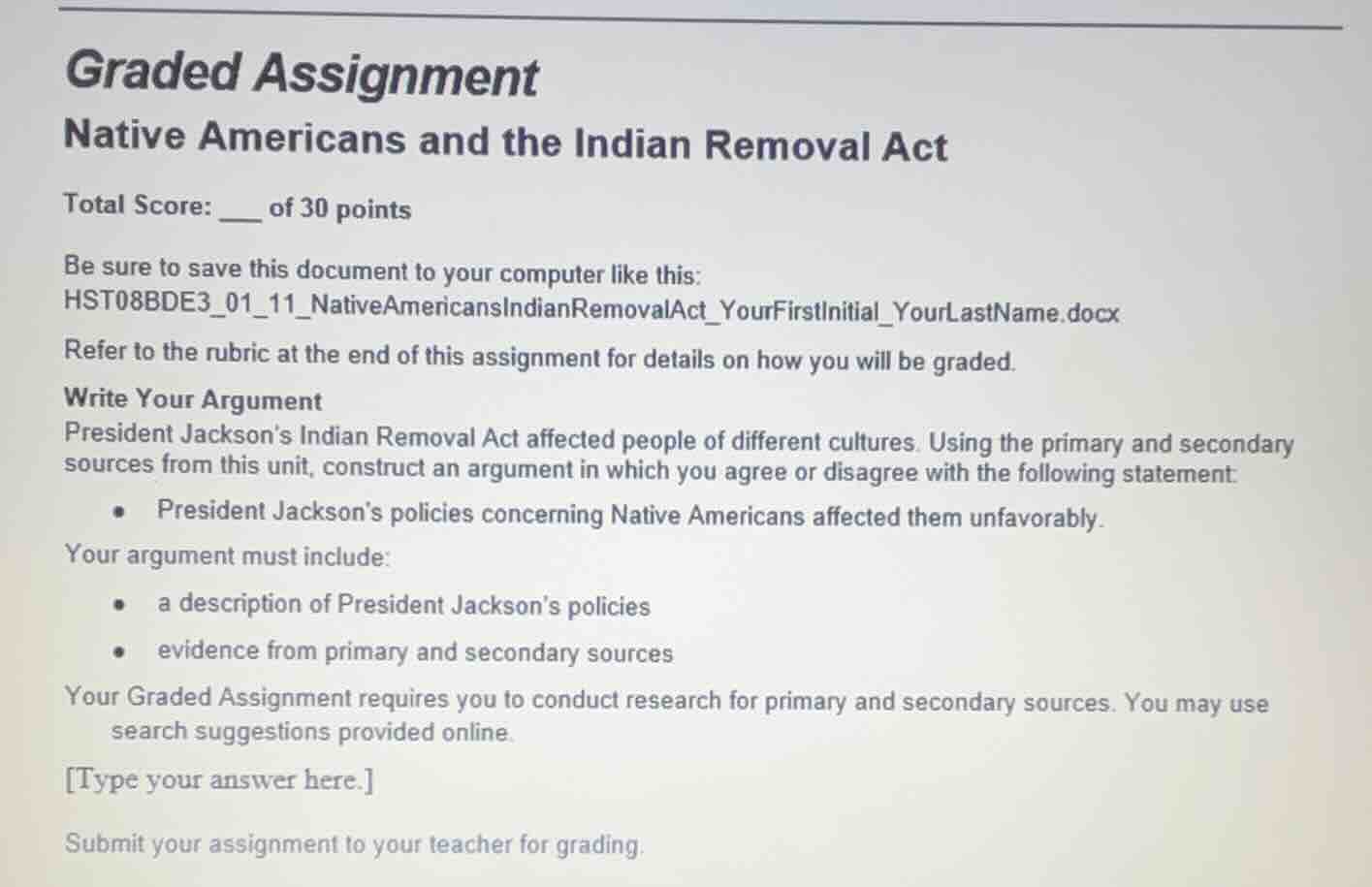
graded assignment
native americans and the indian removal act
total score: ___ of 30 points
be sure to save this document to your computer like this:
hst08bde3_01_11_nativeamericansindianremovalact_yourfirstinitial_yourlastname.docx
refer to the rubric at the end of this assignment for details on how you will be graded.
write your argument
president jackson’s indian removal act affected people of different cultures. using the primary and secondary sources from this unit, construct an argument in which you agree or disagree with the following statement:
- president jackson’s policies concerning native americans affected them unfavorably.
your argument must include:
- a description of president jackson’s policies
- evidence from primary and secondary sources
your graded assignment requires you to conduct research for primary and secondary sources. you may use search suggestions provided online.
type your answer here.
submit your assignment to your teacher for grading.
To address this, we analyze Jackson's Indian Removal Act policies. The Act (1830) forced Native Americans (e.g., Cherokee, Creek) to relocate west of the Mississippi. Primary sources like Cherokee petitions or Jackson’s speeches, and secondary sources (historians’ analyses) show displacement, loss of land, cultural disruption, and suffering (e.g., Trail of Tears). His policies included ignoring tribal sovereignty, using military force, and violating treaties. Evidence: Cherokee Nation v. Georgia (1831) ruling ignored, Trail of Tears deaths/hardship. These policies disrupted Native societies, economies, and cultures, proving unfavorable impacts.

Snap & solve any problem in the app
Get step-by-step solutions on Sovi AI
Photo-based solutions with guided steps
Explore more problems and detailed explanations
President Jackson’s policies concerning Native Americans, centered on the Indian Removal Act of 1830, affected them unfavorably.
Step 1: Describe Jackson’s Policies
Jackson’s policies prioritized white settlement and expansion, disregarding Native American sovereignty. The Indian Removal Act authorized the forced relocation of tribes (e.g., Cherokee, Creek, Choctaw) from their ancestral lands in the Southeast to “Indian Territory” (present - day Oklahoma). He also ignored Supreme Court rulings (e.g., Cherokee Nation v. Georgia, 1831; Worcester v. Georgia, 1832) that affirmed tribal rights to self - governance and land, using military force to enforce removal.
Step 2: Evidence from Sources
- Primary Sources:
- Cherokee petitions to Congress (e.g., 1830s) pleaded for protection of their lands and rights, citing treaties (like the Treaty of Hopewell, 1785) guaranteeing their territory. Jackson’s administration dismissed these, prioritizing white settlers’ demands for fertile land.
- Jackson’s 1830 State of the Union address framed removal as “benevolent” for Native Americans, ignoring the coercion and harm it caused.
- Secondary Sources:
- Historians like Theda Perdue (in Cherokee Women: Gender and Culture Change, 1700 - 1835) document how removal destroyed Cherokee matrilineal social structures, as families were uprooted and traditional roles (e.g., clan leadership, agricultural practices) collapsed.
- The “Trail of Tears” (1838 - 1839, enforced after Jackson left office but rooted in his policies) saw thousands of Cherokee die from disease, starvation, and exposure during forced marches. This directly resulted from Jackson’s refusal to respect tribal sovereignty and his push for territorial expansion.
Step 3: Unfavorable Impacts
Jackson’s policies shattered Native American cultures, economies, and lives. Tribes lost ancestral lands (their spiritual, agricultural, and communal heart), were forced into unfamiliar environments, and endured generational trauma. The disruption of treaties, legal rights, and social systems—combined with the violence of removal—proves these policies had overwhelmingly negative consequences for Native Americans.