QUESTION IMAGE
Question
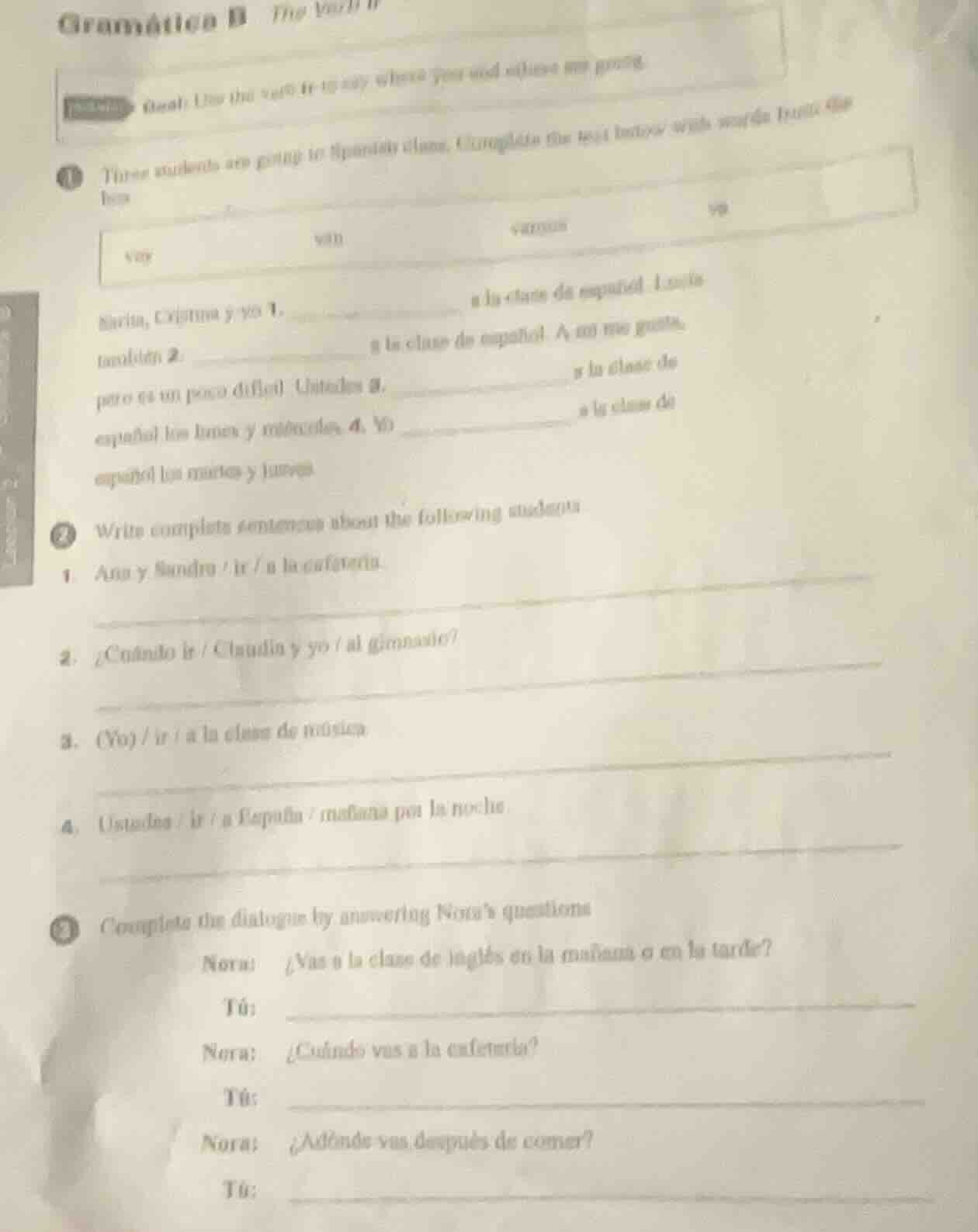
gramática b
goal: use the verb ir to say where you and others are going.
1 three students are going to spanish class. complete the text below with the correct forms of ir.
voy\tvas\tvamos\tvan
maría, cristina y yo 1. ______ a la clase de español. ¡es fácil!
isabel, tú 2. ______ a la clase de español. a mí me gusta,
pero es un poco difícil. ustedes 3. ______ a la clase de
español los lunes y miércoles. 4. yo ______ a la clase de
español los martes y jueves.
2 write complete sentences about the following students.
- ana y sandra / ir / a la cafetería.
_____________________________________
- ¿cuándo ir / claudia y yo / al gimnasio?
_____________________________________
- (yo) / ir / a la clase de música.
_____________________________________
- ustedes / ir / a españa / mañana por la noche.
_____________________________________
3 complete the dialogue by answering nora’s questions.
nora: ¿vas a la clase de inglés en la mañana o en la tarde?
tú: _____________________________________
nora: ¿cuándo vas a la cafetería?
tú: _____________________________________
nora: ¿adónde vas después de comer?
tú: _____________________________________
Part 1: Complete the text (Assuming the verb is "ir" and we need to conjugate it. The options given are "voy", "van", "vas", "va" (maybe a typo, let's correct and use proper conjugations of "ir": yo - voy, tú - vas, él/ella/usted - va, nosotros - vamos, vosotros - vais, ellos/ellas/ustedes - van)
- **Step 1: Analyze the subject "Silvia, Cristina y yo" (we, first person plural? Wait, "yo" is first person singular, so "Silvia, Cristina y yo" is "we" (nosotros). But the options given are "voy", "van", "vas", "va". Wait, maybe the subject is "Silvia, Cristina y yo" as a group, but maybe the original problem has a typo. Wait, let's check the blanks:
Blank 1: Subject "Silvia, Cristina y yo" – if it's "yo" with others? No, "Silvia, Cristina y yo" is "we" (nosotros), but the options are "voy" (yo voy), "van" (ellos van), "vas" (tú vas), "va" (él/ella va). Wait, maybe the subject is "Silvia, Cristina y yo" as three people, so "ellos" (they) – so "van". Wait, maybe the first blank: "Silvia, Cristina y yo 1. ______ a la clase de español" – no, "yo" is first person, so maybe the subject is "Silvia, Cristina y yo" but the verb is for "yo"? No, that doesn't make sense. Wait, maybe the options are conjugations of "ir":
- yo: voy
- tú: vas
- él/ella/usted: va
- nosotros: vamos (not in options)
- vosotros: vais (not in options)
- ellos/ellas/ustedes: van
So the options given are "voy", "van", "vas", "va" (maybe a typo, "vamos" is missing, but let's work with given options).
Wait, maybe the first blank: "Silvia, Cristina y yo" – if it's "yo" with Silvia and Cristina, but the verb is for "yo"? No, "yo" is singular. Wait, maybe the subject is "Silvia, Cristina y yo" as a group, so "ellos" (they) – so "van". Wait, no, "yo" is part of it. This is confusing. Maybe the original problem has a mistake, but let's proceed with the options given.
Wait, maybe the first blank: "Silvia, Cristina y yo" – the subject is "yo" (I) with Silvia and Cristina? No, that's not right. Wait, maybe the first blank is "yo" – "Silvia, Cristina y yo" – no, "yo" is I, so "yo voy" – but "Silvia, Cristina" are with me. Maybe the problem is "Silvia, Cristina y yo" – but the verb is for "yo" – so "voy". But that would mean "Silvia, Cristina and I go to Spanish class" – but "yo voy" is "I go", so "Silvia, Cristina and I, I go to Spanish class" – that doesn't make sense. Wait, maybe the subject is "Silvia, Cristina y yo" as a plural subject, so "van" (they go). So 1. van.
Blank 2: "Isabel 2. ______ a la clase de español" – Isabel is she (ella), so "va".
Blank 3: "Ustedes 3. ______ a la clase de español" – Ustedes is they (formal), so "van".
Blank 4: "Yo 4. ______ a la clase de español" – yo, so "voy".
So:
- van (Silvia, Cristina y yo – they? Maybe the subject is "Silvia, Cristina y yo" as three people, so ellos van)
- va (Isabel is she, so ella va)
- van (Ustedes is they, so ellos van)
- voy (Yo, so yo voy)
Part 2: Write complete sentences (using "ir" to form sentences)
- Ana y Sandra / ir / a la cafetería.
**Step 1: Conjugate "ir" for "Ana y Sandra" (they, ellas) – van.
Sentence: Ana y Sandra van a la cafetería.
- ¿Cuándo ir / Claudia y yo / al gimnasio?
**Step 1: Conjugate "ir" for "Claudia y yo" (we, nosotros) – vamos. But the structure is a question: ¿Cuándo vamos Claudia y yo al gimnasio? Wait, the original is "¿Cuándo ir / Claudia y yo / al gimnasio?" – reorder: ¿Cuándo vamos Claudia y yo al gimnasio?
- Yo / ir / a la clase de música.
**Step 1: Conjugate "ir" for "yo" – voy.
Sentence: Yo voy a la clase de música.
- Ustedes / ir / a Es…

Snap & solve any problem in the app
Get step-by-step solutions on Sovi AI
Photo-based solutions with guided steps
Explore more problems and detailed explanations
Part 1: Complete the text (Assuming the verb is "ir" and we need to conjugate it. The options given are "voy", "van", "vas", "va" (maybe a typo, let's correct and use proper conjugations of "ir": yo - voy, tú - vas, él/ella/usted - va, nosotros - vamos, vosotros - vais, ellos/ellas/ustedes - van)
- **Step 1: Analyze the subject "Silvia, Cristina y yo" (we, first person plural? Wait, "yo" is first person singular, so "Silvia, Cristina y yo" is "we" (nosotros). But the options given are "voy", "van", "vas", "va". Wait, maybe the subject is "Silvia, Cristina y yo" as a group, but maybe the original problem has a typo. Wait, let's check the blanks:
Blank 1: Subject "Silvia, Cristina y yo" – if it's "yo" with others? No, "Silvia, Cristina y yo" is "we" (nosotros), but the options are "voy" (yo voy), "van" (ellos van), "vas" (tú vas), "va" (él/ella va). Wait, maybe the subject is "Silvia, Cristina y yo" as three people, so "ellos" (they) – so "van". Wait, maybe the first blank: "Silvia, Cristina y yo 1. ______ a la clase de español" – no, "yo" is first person, so maybe the subject is "Silvia, Cristina y yo" but the verb is for "yo"? No, that doesn't make sense. Wait, maybe the options are conjugations of "ir":
- yo: voy
- tú: vas
- él/ella/usted: va
- nosotros: vamos (not in options)
- vosotros: vais (not in options)
- ellos/ellas/ustedes: van
So the options given are "voy", "van", "vas", "va" (maybe a typo, "vamos" is missing, but let's work with given options).
Wait, maybe the first blank: "Silvia, Cristina y yo" – if it's "yo" with Silvia and Cristina, but the verb is for "yo"? No, "yo" is singular. Wait, maybe the subject is "Silvia, Cristina y yo" as a group, so "ellos" (they) – so "van". Wait, no, "yo" is part of it. This is confusing. Maybe the original problem has a mistake, but let's proceed with the options given.
Wait, maybe the first blank: "Silvia, Cristina y yo" – the subject is "yo" (I) with Silvia and Cristina? No, that's not right. Wait, maybe the first blank is "yo" – "Silvia, Cristina y yo" – no, "yo" is I, so "yo voy" – but "Silvia, Cristina" are with me. Maybe the problem is "Silvia, Cristina y yo" – but the verb is for "yo" – so "voy". But that would mean "Silvia, Cristina and I go to Spanish class" – but "yo voy" is "I go", so "Silvia, Cristina and I, I go to Spanish class" – that doesn't make sense. Wait, maybe the subject is "Silvia, Cristina y yo" as a plural subject, so "van" (they go). So 1. van.
Blank 2: "Isabel 2. ______ a la clase de español" – Isabel is she (ella), so "va".
Blank 3: "Ustedes 3. ______ a la clase de español" – Ustedes is they (formal), so "van".
Blank 4: "Yo 4. ______ a la clase de español" – yo, so "voy".
So:
- van (Silvia, Cristina y yo – they? Maybe the subject is "Silvia, Cristina y yo" as three people, so ellos van)
- va (Isabel is she, so ella va)
- van (Ustedes is they, so ellos van)
- voy (Yo, so yo voy)
Part 2: Write complete sentences (using "ir" to form sentences)
- Ana y Sandra / ir / a la cafetería.
**Step 1: Conjugate "ir" for "Ana y Sandra" (they, ellas) – van.
Sentence: Ana y Sandra van a la cafetería.
- ¿Cuándo ir / Claudia y yo / al gimnasio?
**Step 1: Conjugate "ir" for "Claudia y yo" (we, nosotros) – vamos. But the structure is a question: ¿Cuándo vamos Claudia y yo al gimnasio? Wait, the original is "¿Cuándo ir / Claudia y yo / al gimnasio?" – reorder: ¿Cuándo vamos Claudia y yo al gimnasio?
- Yo / ir / a la clase de música.
**Step 1: Conjugate "ir" for "yo" – voy.
Sentence: Yo voy a la clase de música.
- Ustedes / ir / a España / mañana por la noche.
**Step 1: Conjugate "ir" for "ustedes" – van.
Sentence: Ustedes van a España mañana por la noche.
Part 3: Complete the dialogue (using "ir" and answering the questions)
- Nora: ¿Vas a la clase de inglés en la mañana o en la tarde?
Tú: Voy a la clase de inglés en la mañana. (or en la tarde, choose one)
- Nora: ¿Cuándo vas a la cafetería?
Tú: Voy a la cafetería después de la clase. (or any time, e.g., Voy a la cafetería a las doce.)
- Nora: ¿Adónde vas después de comer?
Tú: Voy a la biblioteca después de comer. (or any place, e.g., Voy a mi casa después de comer.)
Final Answers (Part 1, assuming the options are as given and we correct):
- van
- va
- van
- voy
(Part 2 sentences):
- Ana y Sandra van a la cafetería.
- ¿Cuándo vamos Claudia y yo al gimnasio?
- Yo voy a la clase de música.
- Ustedes van a España mañana por la noche.
(Part 3 dialogue answers – examples):
- Voy a la clase de inglés en la mañana.
- Voy a la cafetería a las doce.
- Voy a la biblioteca después de comer.