QUESTION IMAGE
Question
grammar passage
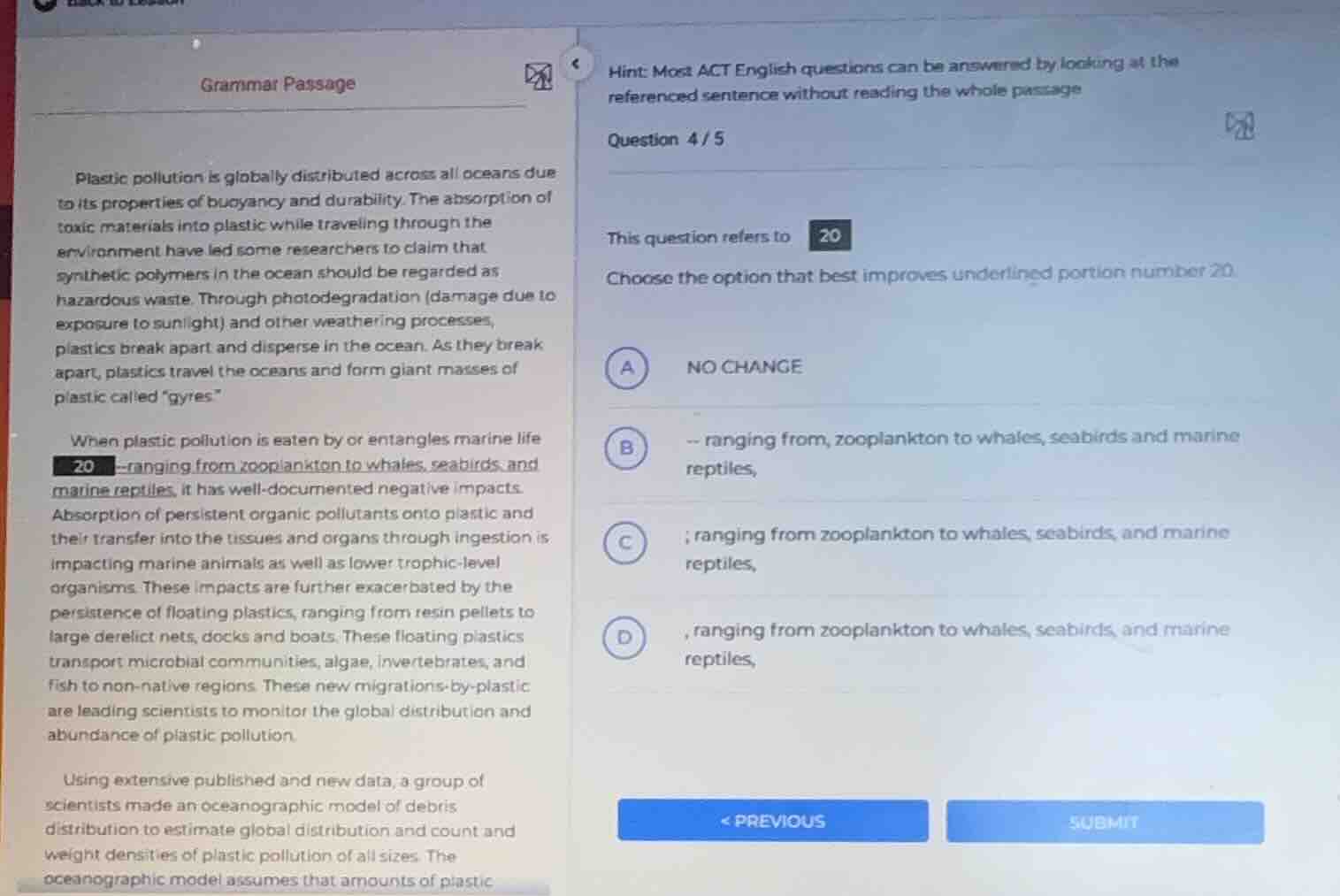
plastic pollution is globally distributed across all oceans due to its properties of buoyancy and durability. the absorption of toxic materials into plastic while traveling through the environment have led some researchers to claim that synthetic polymers in the ocean should be regarded as hazardous waste. through photodegradation (damage due to exposure to sunlight) and other weathering processes, plastics break apart and disperse in the ocean. as they break apart, plastics travel the oceans and form giant masses of plastic called “gyres.”
when plastic pollution is eaten by or entangles marine life 20 --ranging from zooplankton to whales, seabirds, and marine reptiles, it has well - documented negative impacts. absorption of persistent organic pollutants onto plastic and their transfer into the tissues and organs through ingestion is impacting marine animals as well as lower trophic - level organisms. these impacts are further exacerbated by the persistence of floating plastics, ranging from resin pellets to large derelict nets, docks and boats. these floating plastics transport microbial communities, algae, invertebrates, and fish to non - native regions. these new migrations - by - plastic are leading scientists to monitor the global distribution and abundance of plastic pollution.
using extensive published and new data, a group of scientists made an oceanographic model of debris distribution to estimate global distribution and count and weight densities of plastic pollution of all sizes. the oceanographic model assumes that amounts of plastic
hint: most act english questions can be answered by looking at the referenced sentence without reading the whole passage
question 4 / 5
this question refers to 20
choose the option that best improves underlined portion number 20.
a no change
b -- ranging from, zooplankton to whales, seabirds and marine reptiles,
c ; ranging from zooplankton to whales, seabirds, and marine reptiles,
d, ranging from zooplankton to whales, seabirds, and marine reptiles,
To determine the correct option, we analyze the punctuation and the function of the phrase "ranging from zooplankton to whales, seabirds, and marine reptiles". This phrase is a non - restrictive modifier that provides additional information about "marine life". In English, a non - restrictive modifier should be set off by a comma.
- Option A: The double hyphen (--) is incorrect punctuation for this type of modifier.
- Option B: The comma after "from" is incorrect as it disrupts the phrase "ranging from...", and the double hyphen is also wrong.
- Option C: A semicolon is used to separate two independent clauses, but the phrase here is not an independent clause, so a semicolon is inappropriate.
- Option D: A comma is used to set off the non - restrictive modifier, which is the correct punctuation for this context.

Snap & solve any problem in the app
Get step-by-step solutions on Sovi AI
Photo-based solutions with guided steps
Explore more problems and detailed explanations
D. , ranging from zooplankton to whales, seabirds, and marine reptiles,