QUESTION IMAGE
Question
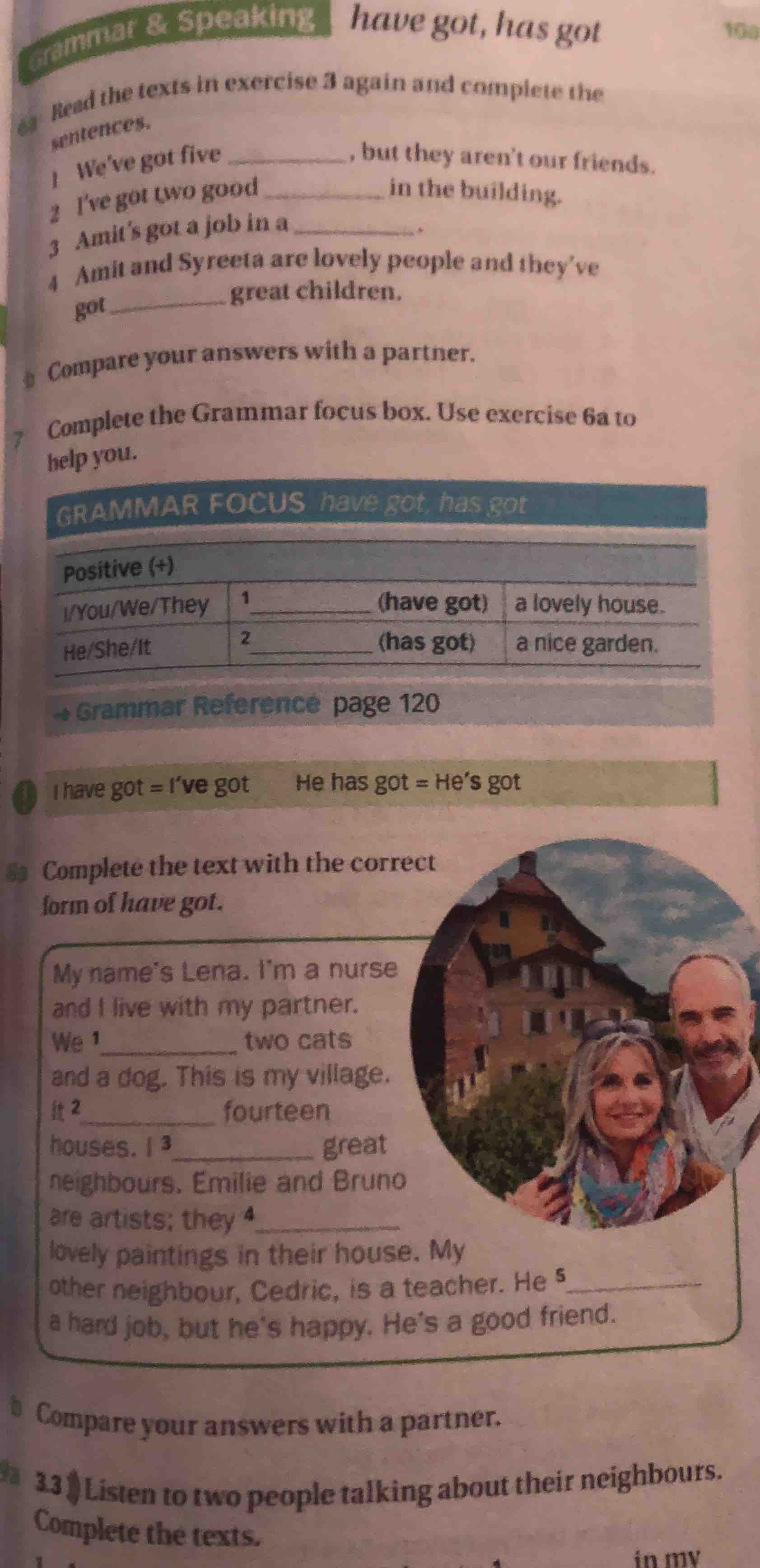
grammar & speaking have got, has got
read the texts in exercise 3 again and complete the sentences.
1 weve got five ______, but they arent our friends.
2 ive got two good ______ in the building.
3 amits got a job in a ______.
4 amit and syreeta are lovely people and theyve got ______ great children.
b compare your answers with a partner.
complete the grammar focus box. use exercise 6a to help you.
grammar focus have got, has got
positive (+)
i/you/we/they 1 ______ (have got) a lovely house.
he/she/it 2 ______ (has got) a nice garden.
grammar reference page 120
i have got = ive got he has got = hes got
complete the text with the correct form of have got.
my names lena. im a nurse and i live with my partner.
we 1 ______ two cats and a dog. this is my village.
it 2 ____ fourteen houses. i 3 __ great neighbours. emilie and bruno are artists; they 4 __ lovely paintings in their house. my other neighbour, cedric, is a teacher. he 5 ____ a hard job, but hes happy. hes a good friend.
b compare your answers with a partner.
13 listen to two people talking about their neighbours. complete the texts.
in my
Part 6a (assuming the texts from exercise 3 have common noun contexts, typical for such exercises, e.g., "neighbours", "friends", "jobs", "colleagues", "children" etc. But since the original texts of exercise 3 aren't shown, here are sample answers based on common scenarios):
- We've got five neighbours (but they aren't our friends).
- I've got two good friends (in the building).
- Amit's got a job in a company (or "hospital", "school" etc., but common job - related noun).
- Amit and Syreeta are lovely people and they've got two (or "some") great children.
Part 7 (Grammar Focus):
- For "I/You/We/They", the form is $\boldsymbol{\text{have}}$ (have got). So the blank is filled with "have".
- For "He/She/It", the form is $\boldsymbol{\text{has}}$ (has got). So the blank is filled with "has".
Part 8a (Completing the text with "have got/has got"):
- Step 1: Analyze subject "We"
"We" is a plural subject (first - person plural). The correct form of "have got" for "We" is "have got" (or contracted "We've got").
So, "We $\boldsymbol{\text{have got}}$ two cats and a dog."
- Step 2: Analyze subject "It"
"It" is a singular third - person subject. The correct form of "have got" for "It" is "has got" (or contracted "It's got").
So, "It $\boldsymbol{\text{has got}}$ fourteen houses."
- Step 3: Analyze subject "I"
"I" is a first - person singular subject. The correct form of "have got" for "I" is "have got" (or contracted "I've got").
So, "I $\boldsymbol{\text{have got}}$ great neighbours."
- Step 4: Analyze subject "they"
"They" is a plural third - person subject. The correct form of "have got" for "They" is "have got" (or contracted "They've got").
So, "they $\boldsymbol{\text{have got}}$ lovely paintings in their house."
- Step 5: Analyze subject "He"
"He" is a singular third - person subject. The correct form of "have got" for "He" is "has got" (or contracted "He's got").
So, "He $\boldsymbol{\text{has got}}$ a hard job, but he's happy."
Final Answers (for each part):
Part 6a (Sample Answers):
- neighbours (or other appropriate plural noun)
- friends (or other appropriate plural noun)
- company (or other appropriate singular noun)
- two (or other appropriate quantifier/noun)
Part 7:
- have
- has
Part 8a:
- have got
- has got
- have got
- have got
- has got

Snap & solve any problem in the app
Get step-by-step solutions on Sovi AI
Photo-based solutions with guided steps
Explore more problems and detailed explanations
Part 6a (assuming the texts from exercise 3 have common noun contexts, typical for such exercises, e.g., "neighbours", "friends", "jobs", "colleagues", "children" etc. But since the original texts of exercise 3 aren't shown, here are sample answers based on common scenarios):
- We've got five neighbours (but they aren't our friends).
- I've got two good friends (in the building).
- Amit's got a job in a company (or "hospital", "school" etc., but common job - related noun).
- Amit and Syreeta are lovely people and they've got two (or "some") great children.
Part 7 (Grammar Focus):
- For "I/You/We/They", the form is $\boldsymbol{\text{have}}$ (have got). So the blank is filled with "have".
- For "He/She/It", the form is $\boldsymbol{\text{has}}$ (has got). So the blank is filled with "has".
Part 8a (Completing the text with "have got/has got"):
- Step 1: Analyze subject "We"
"We" is a plural subject (first - person plural). The correct form of "have got" for "We" is "have got" (or contracted "We've got").
So, "We $\boldsymbol{\text{have got}}$ two cats and a dog."
- Step 2: Analyze subject "It"
"It" is a singular third - person subject. The correct form of "have got" for "It" is "has got" (or contracted "It's got").
So, "It $\boldsymbol{\text{has got}}$ fourteen houses."
- Step 3: Analyze subject "I"
"I" is a first - person singular subject. The correct form of "have got" for "I" is "have got" (or contracted "I've got").
So, "I $\boldsymbol{\text{have got}}$ great neighbours."
- Step 4: Analyze subject "they"
"They" is a plural third - person subject. The correct form of "have got" for "They" is "have got" (or contracted "They've got").
So, "they $\boldsymbol{\text{have got}}$ lovely paintings in their house."
- Step 5: Analyze subject "He"
"He" is a singular third - person subject. The correct form of "have got" for "He" is "has got" (or contracted "He's got").
So, "He $\boldsymbol{\text{has got}}$ a hard job, but he's happy."
Final Answers (for each part):
Part 6a (Sample Answers):
- neighbours (or other appropriate plural noun)
- friends (or other appropriate plural noun)
- company (or other appropriate singular noun)
- two (or other appropriate quantifier/noun)
Part 7:
- have
- has
Part 8a:
- have got
- has got
- have got
- have got
- has got