QUESTION IMAGE
Question
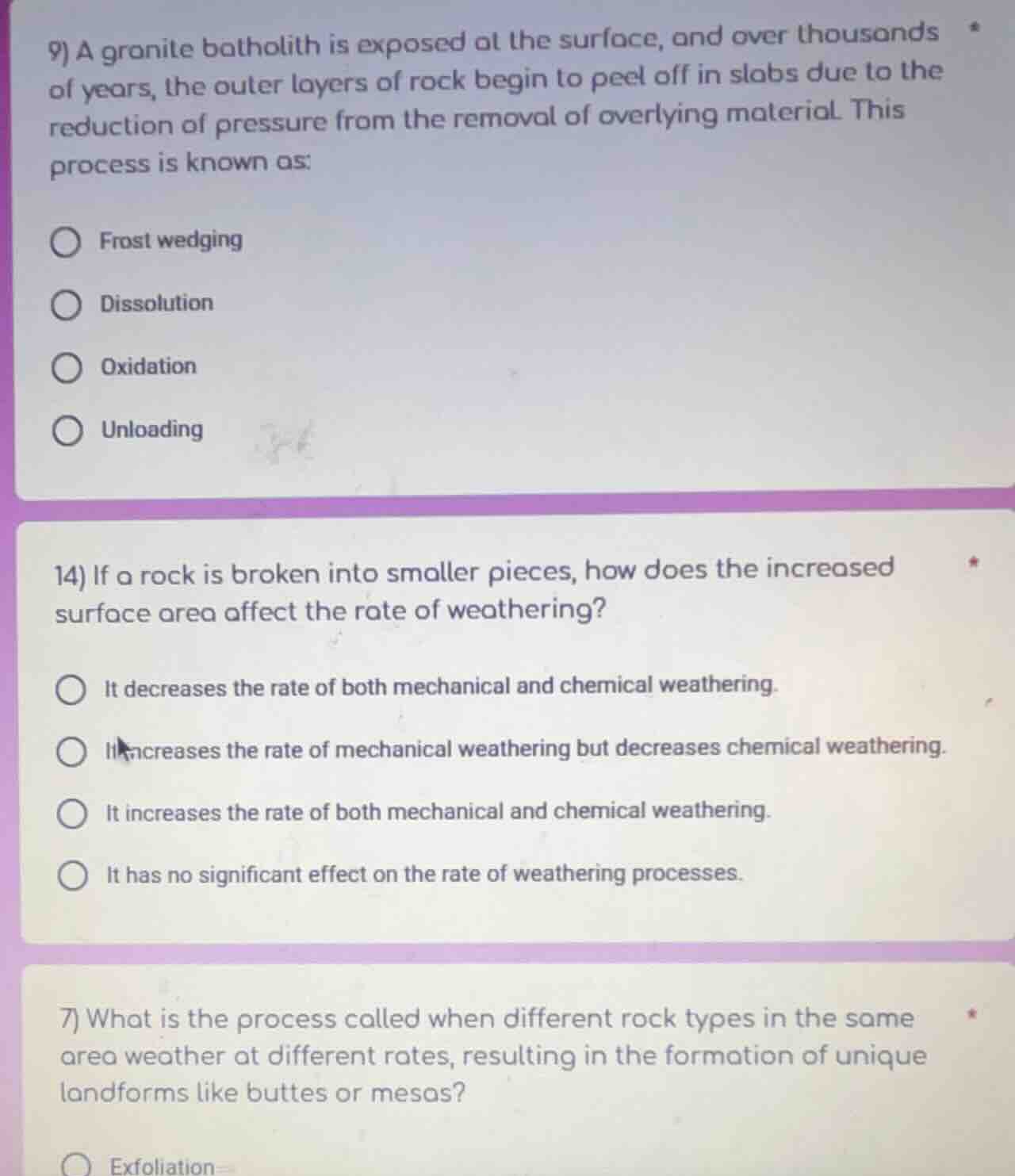
- a granite batholith is exposed at the surface, and over thousands of years, the outer layers of rock begin to peel off in slabs due to the reduction of pressure from the removal of overlying material. this process is known as:◯ frost wedging◯ dissolution◯ oxidation◯ unloading14) if a rock is broken into smaller pieces, how does the increased surface area affect the rate of weathering?◯ it decreases the rate of both mechanical and chemical weathering.◯ it increases the rate of mechanical weathering but decreases chemical weathering.◯ it increases the rate of both mechanical and chemical weathering.◯ it has no significant effect on the rate of weathering processes.7) what is the process called when different rock types in the same area weather at different rates, resulting in the formation of unique landforms like buttes or mesas?◯ exfoliation
For Question 9:
The described process of rock layers peeling off due to reduced overlying pressure is defined as unloading (also called exfoliation, which is a type of unloading). Frost wedging uses ice expansion, dissolution dissolves rock, and oxidation is a chemical reaction with oxygen, none match the given description.
For Question 14:
Increased surface area exposes more of the rock to weathering agents. For mechanical weathering, more surface area gives more points for physical forces to act on; for chemical weathering, more surface area allows more contact with chemical agents like water or acids, speeding up both processes.
For Question 7:
The process where different rock types weather at different rates, creating landforms like buttes or mesas, is differential weathering. Exfoliation is the peeling of rock layers from unloading, which does not match this description.

Snap & solve any problem in the app
Get step-by-step solutions on Sovi AI
Photo-based solutions with guided steps
Explore more problems and detailed explanations
- D. Unloading
- C. It increases the rate of both mechanical and chemical weathering.
- (Correct option not shown in the image, but the process is differential weathering)