QUESTION IMAGE
Question
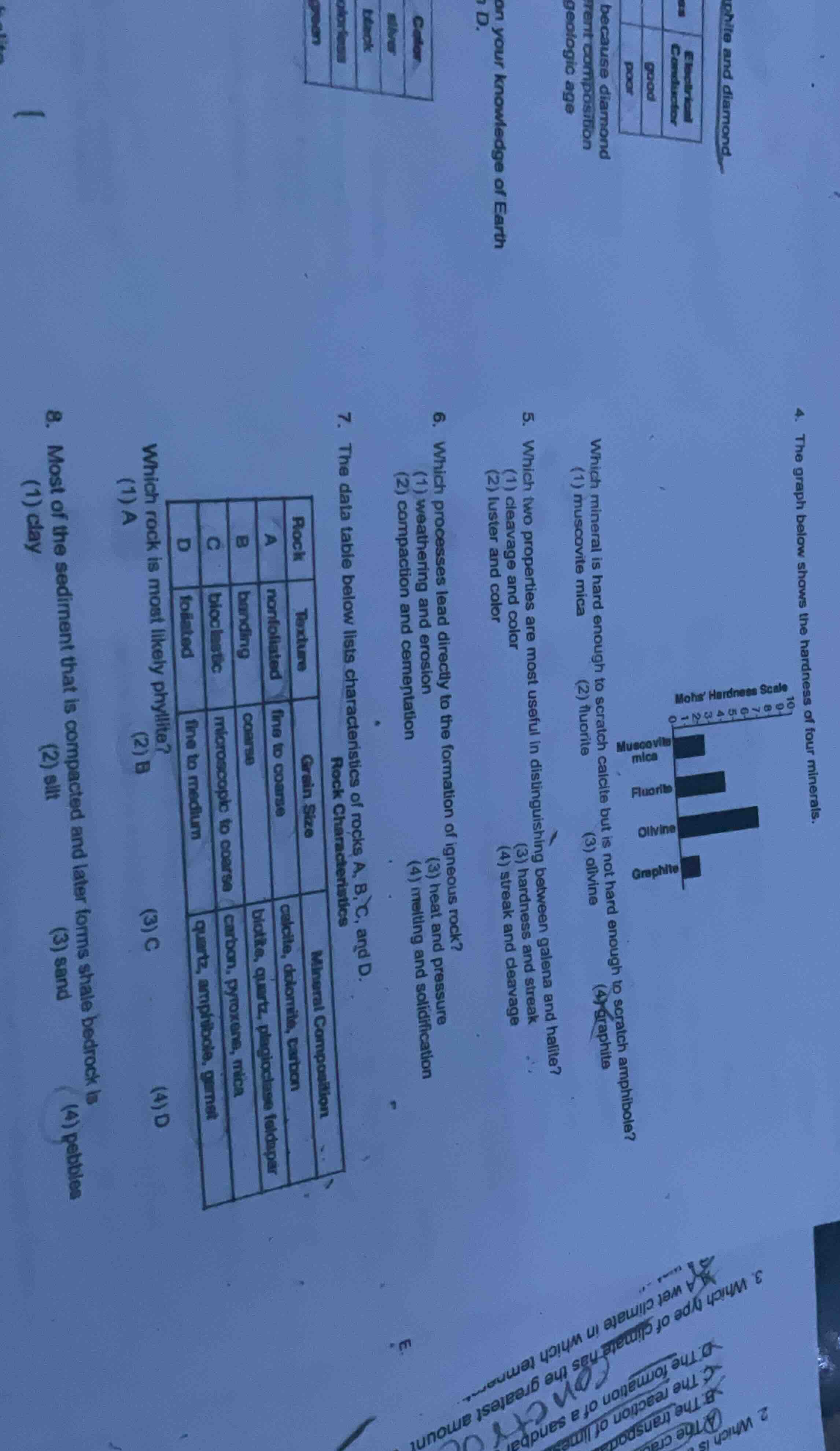
- the graph below shows the hardness of four minerals.
which mineral is hard enough to scratch calcite but is not hard enough to scratch amphibole?
(1) muscovite mica
(2) fluorite
(3) olivine
(4) graphite
- which two properties are most useful in distinguishing between galena and halite?
(1) cleavage and color
(2) luster and color
(3) hardness and streak
(4) streak and cleavage
- which processes lead directly to the formation of igneous rock?
(1) weathering and erosion
(2) compaction and cementation
(3) heat and pressure
(4) melting and solidification
- the data table below lists characteristics of rocks a, b, c, and d.
rock characteristics
rock | texture | grain size | mineral composition
a | nonfoliated | fine to coarse | calcite, dolomite, carbon
b | banding | coarse | biotite, quartz, plagioclase feldspar
c | bioclastic | microscopic to coarse | carbon, pyroxene, mica
d | foliated | fine to medium | quartz, amphibole, garnet
which rock is most likely phyllite?
(1) a
(2) b
(3) c
(4) d
- most of the sediment that is compacted and later forms shale bedrock is
(1) clay
(2) silt
(3) sand
(4) pebbles
- Pregunta 4: Se usa la escala de dureza de Mohs: la calcita tiene dureza 3, el anfíbol tiene 5-6. La olivina tiene dureza 6.5-7, que raya a la calcita pero no al anfíbol; la moscovita tiene 2-2.5, la fluorita 4, el grafito 1-2.
- Pregunta 5: La galena y la halita tienen colores similares, pero la galena tiene rayo gris metálico y escisión perfecta en tres direcciones, mientras que la halita tiene rayo blanco y escisión perfecta en tres direcciones cubicas. La dureza y el rayo no son diferenciadores claros, el color y el brillo no sirven, la escisión y el rayo sí permiten distinguirlas.
- Pregunta 6: Las rocas ígneas se forman por fusión de roca (derretimiento) y posterior solidificación. La meteorización y erosión forman sedimentos, la compactación y cementación forman rocas sedimentarias, el calor y la presión forman rocas metamórficas.
- Pregunta 7: La filita es una roca metamórfica foliada, con tamaño de grano fino a medio, compuesta por cuarzo, anfíbol y granate (características de la roca D). La roca A es no foliada, la B tiene bandas y grano grueso, la C es bioclástica.
- Pregunta 8: La pizarra (shale) es una roca sedimentaria formada por la compactación de limos finos (arcilla, clay), que son los sedimentos más finos que se compactan y cementan.

Snap & solve any problem in the app
Get step-by-step solutions on Sovi AI
Photo-based solutions with guided steps
Explore more problems and detailed explanations
- Pregunta 4: (3) olivine
- Pregunta 5: (4) streak and cleavage
- Pregunta 6: (4) melting and solidification
- Pregunta 7: (4) D
- Pregunta 8: (1) clay