QUESTION IMAGE
Question
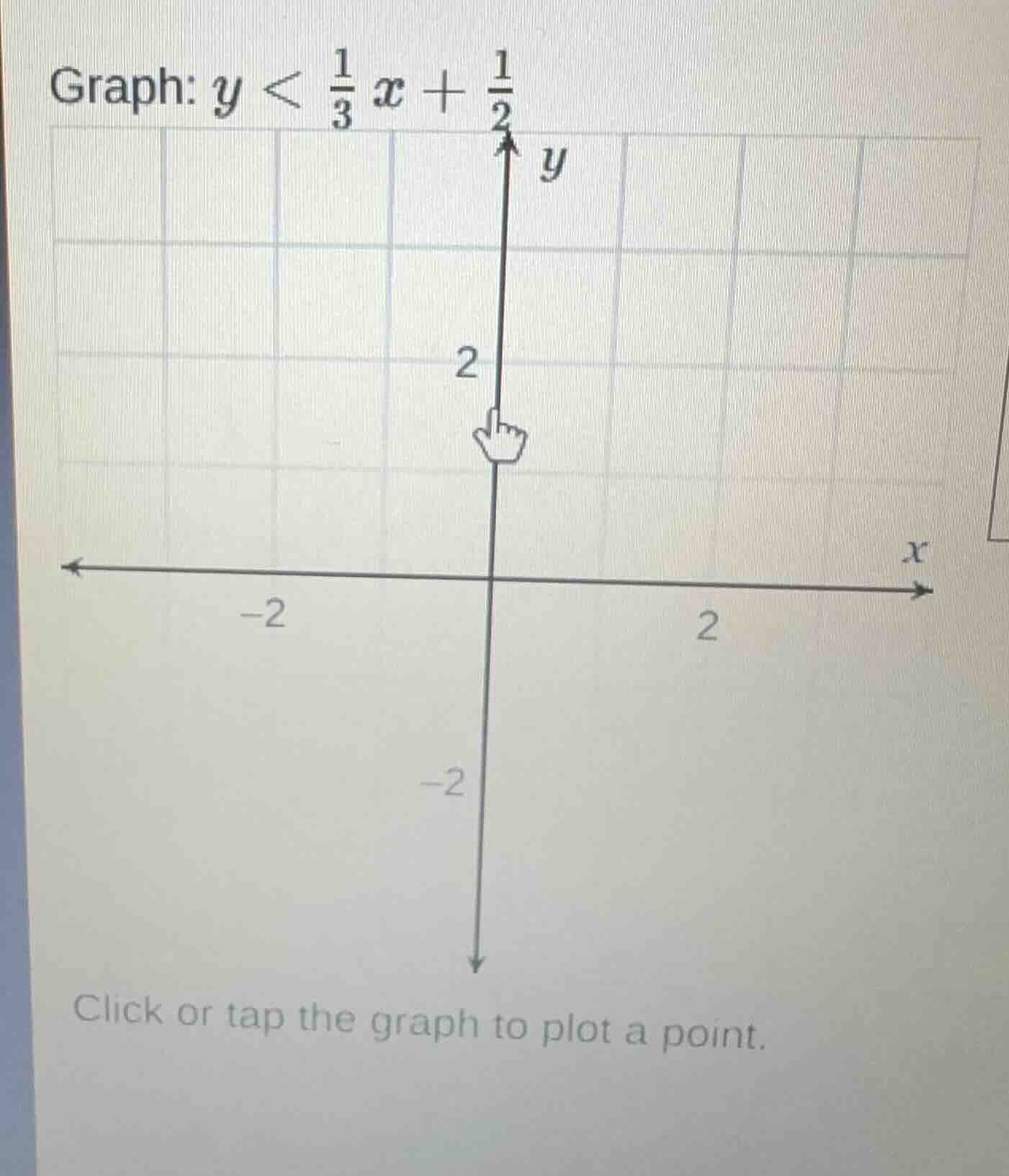
graph: $y < \frac{1}{3}x + \frac{1}{2}$
click or tap the graph to plot a point.
Step1: Identify the boundary line
The inequality is \( y < \frac{1}{3}x+\frac{1}{2} \). First, graph the boundary line \( y=\frac{1}{3}x + \frac{1}{2} \). The slope \( m=\frac{1}{3} \) and the y - intercept \( b = \frac{1}{2}\) (or 0.5). Since the inequality is \( y<\frac{1}{3}x+\frac{1}{2} \), the boundary line should be dashed (because the inequality is strict, \( y\) is not equal to \( \frac{1}{3}x+\frac{1}{2} \)).
Step2: Determine the shading region
To find which side of the line to shade, we can use a test point. A common test point is \( (0,0) \). Substitute \( x = 0\) and \( y=0\) into the inequality:
\( 0<\frac{1}{3}(0)+\frac{1}{2}\)
\( 0 < \frac{1}{2}\), which is true. So we shade the region that contains the point \( (0,0) \), which is below the dashed line \( y=\frac{1}{3}x+\frac{1}{2} \).
Step3: Plot the boundary line (key points)
- Y - intercept: When \( x = 0\), \( y=\frac{1}{2}\), so the point is \( (0,\frac{1}{2}) \).
- Another point: Using the slope \( \frac{1}{3} \) (rise 1, run 3), from \( (0,\frac{1}{2}) \), moving 3 units to the right (run = 3) and 1 unit up (rise = 1), we get the point \( (3,\frac{1}{2}+ 1)=(3,\frac{3}{2})\) or \( (3,1.5) \). We can also use \( x=- 3\), then \( y=\frac{1}{3}(-3)+\frac{1}{2}=-1 + 0.5=-0.5\), so the point \( (-3,-0.5) \).
Step4: Draw the dashed line and shade
Draw the dashed line through the points \( (0,0.5) \), \( (3,1.5) \), \( (-3,-0.5) \) (or other points on the line \( y = \frac{1}{3}x+\frac{1}{2}\)). Then shade the region below the dashed line (since the test point \( (0,0) \) is in that region and satisfies the inequality \( y<\frac{1}{3}x+\frac{1}{2}\)).

Snap & solve any problem in the app
Get step-by-step solutions on Sovi AI
Photo-based solutions with guided steps
Explore more problems and detailed explanations
To graph \( y<\frac{1}{3}x+\frac{1}{2} \):
- Draw a dashed line for \( y = \frac{1}{3}x+\frac{1}{2} \) (using slope \( \frac{1}{3} \) and y - intercept \( \frac{1}{2} \)).
- Shade the region below the dashed line (tested with \( (0,0) \) which satisfies \( 0<\frac{1}{2} \)).