QUESTION IMAGE
Question
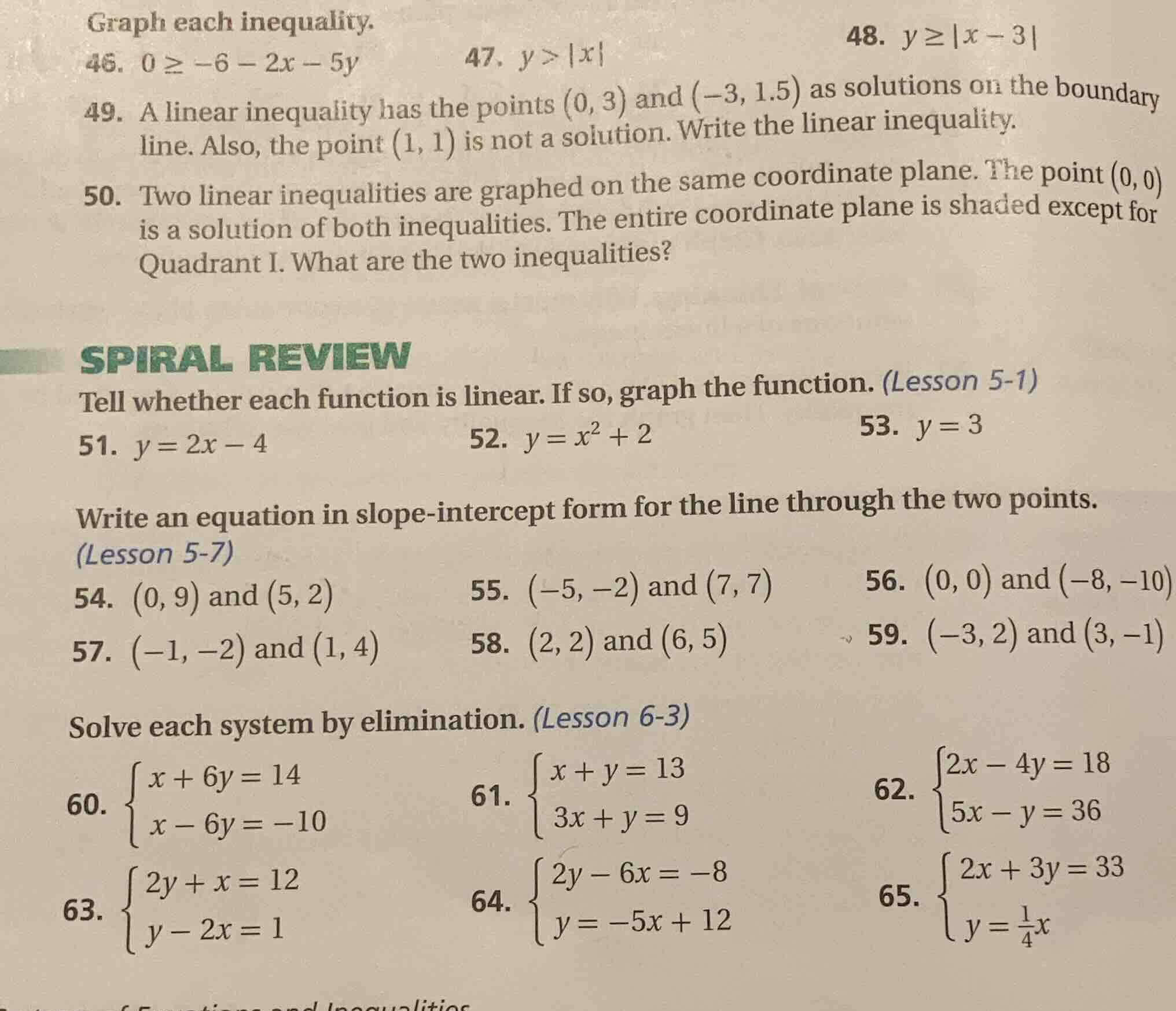
graph each inequality.
- ( 0 geq -6 - 2x - 5y ) 47. ( y > |x| ) 48. ( y geq |x - 3| )
- a linear inequality has the points ( (0, 3) ) and ( (-3, 1.5) ) as solutions on the boundary line. also, the point ( (1, 1) ) is not a solution. write the linear inequality.
- two linear inequalities are graphed on the same coordinate plane. the point ( (0, 0) ) is a solution of both inequalities. the entire coordinate plane is shaded except for quadrant i. what are the two inequalities?
spiral review
tell whether each function is linear. if so, graph the function. (lesson 5 - 1)
- ( y = 2x - 4 ) 52. ( y = x^2 + 2 ) 53. ( y = 3 )
write an equation in slope - intercept form for the line through the two points. (lesson 5 - 7)
- ( (0, 9) ) and ( (5, 2) ) 55. ( (-5, -2) ) and ( (7, 7) ) 56. ( (0, 0) ) and ( (-8, -10) )
- ( (-1, -2) ) and ( (1, 4) ) 58. ( (2, 2) ) and ( (6, 5) ) 59. ( (-3, 2) ) and ( (3, -1) )
solve each system by elimination. (lesson 6 - 3)
- ( \begin{cases}x + 6y = 14\\x - 6y = -10end{cases} ) 61. ( \begin{cases}x + y = 13\\3x + y = 9end{cases} ) 62. ( \begin{cases}2x - 4y = 18\\5x - y = 36end{cases} )
- ( \begin{cases}2y + x = 12\\y - 2x = 1end{cases} ) 64. ( \begin{cases}2y - 6x = -8\\y = -5x + 12end{cases} ) 65. ( \begin{cases}2x + 3y = 33\\y = \frac{1}{4}xend{cases} )
For Questions 46-50 (Inequalities)
---
Question 46: $0 \geq -6 - 2x - 5y$
Step1: Rearrange to slope-intercept form
$0 +6 +2x \geq -5y \implies 2x +6 \geq -5y \implies y \geq -\frac{2}{5}x - \frac{6}{5}$
Step2: Graph the boundary line
Boundary line: $y = -\frac{2}{5}x - \frac{6}{5}$ (solid, since $\geq$). Shade above the line.
---
Question 47: $y > |x|$
Step1: Identify the boundary graph
Boundary graph: $y=|x|$ (V-shaped, vertex at (0,0), dashed since $>$)
Step2: Determine shaded region
Shade all areas above the V-shaped graph.
---
Question 48: $y \geq |x-3|$
Step1: Identify the boundary graph
Boundary graph: $y=|x-3|$ (V-shaped, vertex at (3,0), solid since $\geq$)
Step2: Determine shaded region
Shade all areas above the V-shaped graph.
---
Question 49
Step1: Calculate slope of boundary line
Slope $m = \frac{1.5-3}{-3-0} = \frac{-1.5}{-3} = 0.5 = \frac{1}{2}$
Step2: Write boundary line equation
Using $(0,3)$: $y = \frac{1}{2}x + 3$
Step3: Test point to find inequality sign
Substitute $(1,1)$: $1 \stackrel{?}{\leq} \frac{1}{2}(1)+3 = 3.5$ (true, but (1,1) is not a solution, so reverse the sign)
Inequality: $y \geq \frac{1}{2}x + 3$
---
Question 50
Step1: Identify Quadrant I constraints
Quadrant I is where $x>0$ and $y>0$. To exclude it, the inequalities must shade everywhere else, with (0,0) as a solution.
Step2: Determine valid inequalities
$x \leq 0$ (shades left of y-axis, includes (0,0)) and $y \leq 0$ (shades below x-axis, includes (0,0)). Together they shade all except Quadrant I.
---
Question 51: $y=2x-4$
Step1: Check linearity
Follows $y=mx+b$ (degree 1), so linear.
Step2: Graph key points
Y-intercept: $(0,-4)$; X-intercept: $0=2x-4 \implies x=2$, so $(2,0)$. Draw solid line through points.
---
Question 52: $y=x^2+2$
Step1: Check linearity
Has $x^2$ term (degree 2), so not linear.
---
Question 53: $y=3$
Step1: Check linearity
Follows $y=mx+b$ ($m=0$, $b=3$), so linear.
Step2: Graph the line
Horizontal solid line at $y=3$, parallel to x-axis.
---
Question 54: $(0,9)$ and $(5,2)$
Step1: Calculate slope
$m = \frac{2-9}{5-0} = -\frac{7}{5}$
Step2: Write slope-intercept form
Y-intercept is $(0,9)$, so $y = -\frac{7}{5}x + 9$
---
Question 55: $(-5,-2)$ and $(7,7)$
Step1: Calculate slope
$m = \frac{7-(-2)}{7-(-5)} = \frac{9}{12} = \frac{3}{4}$
Step2: Solve for b
Substitute $(-5,-2)$: $-2 = \frac{3}{4}(-5)+b \implies -2 = -\frac{15}{4}+b \implies b = -2 + \frac{15}{4} = \frac{7}{4}$
Equation: $y = \frac{3}{4}x + \frac{7}{4}$
---
Question 56: $(0,0)$ and $(-8,-10)$
Step1: Calculate slope
$m = \frac{-10-0}{-8-0} = \frac{10}{8} = \frac{5}{4}$
Step2: Write slope-intercept form
Y-intercept is $(0,0)$, so $y = \frac{5}{4}x$
---
Question 57: $(-1,-2)$ and $(1,4)$
Step1: Calculate slope
$m = \frac{4-(-2)}{1-(-1)} = \frac{6}{2} = 3$
Step2: Solve for b
Substitute $(1,4)$: $4 = 3(1)+b \implies b=1$
Equation: $y=3x+1$
---
Question 58: $(2,2)$ and $(6,5)$
Step1: Calculate slope
$m = \frac{5-2}{6-2} = \frac{3}{4}$
Step2: Solve for b
Substitute $(2,2)$: $2 = \frac{3}{4}(2)+b \implies 2 = \frac{3}{2}+b \implies b = \frac{1}{2}$
Equation: $y = \frac{3}{4}x + \frac{1}{2}$
---
Question 59: $(-3,2)$ and $(3,-1)$
Step1: Calculate slope
$m = \frac{-1-2}{3-(-3)} = \frac{-3}{6} = -\frac{1}{2}$
Step2: Solve for b
Substitute $(3,-1)$: $-1 = -\frac{1}{2}(3)+b \implies -1 = -\frac{3}{2}+b \implies b = \frac{1}{2}$
Equation: $y = -\frac{1}{2}x + \frac{1}{2}$

Snap & solve any problem in the app
Get step-by-step solutions on Sovi AI
Photo-based solutions with guided steps
Explore more problems and detailed explanations
- Boundary line: $y = -\frac{2}{5}x - \frac{6}{5}$ (solid), shade above the line
- Boundary graph: $y=|x|$ (dashed), shade above the graph
- Boundary graph: $y=|x-3|$ (solid), shade above the graph
- $\boldsymbol{y \geq \frac{1}{2}x + 3}$
- $\boldsymbol{x \leq 0}$ and $\boldsymbol{y \leq 0}$
---