QUESTION IMAGE
Question
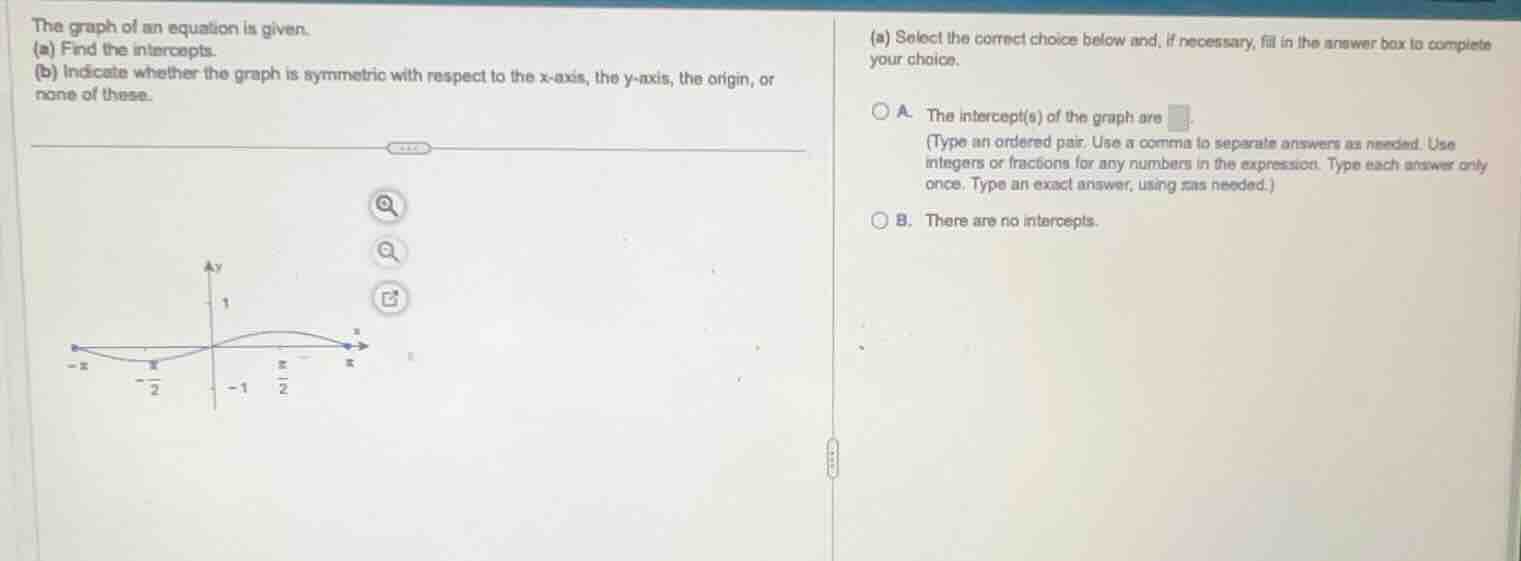
the graph of an equation is given.
(a) find the intercepts.
(b) indicate whether the graph is symmetric with respect to the x - axis, the y - axis, the origin, or none of these.
(a) select the correct choice below and, if necessary, fill in the answer box to complete your choice.
○ a. the intercept(s) of the graph are
(type an ordered pair. use a comma to separate answers as needed. use integers or fractions for any numbers in the expression. type each answer only once. type an exact answer, using (pi) as needed.)
○ b. there are no intercepts.
Step1: Identify x-intercepts
The graph crosses the x-axis at $(-\pi, 0)$, $(0, 0)$, and $(\pi, 0)$.
Step2: Identify y-intercept
The graph crosses the y-axis at $(0, 0)$.
Step3: Check x-axis symmetry
A graph symmetric over x-axis has $(x,y)$ and $(x,-y)$. Here, points like $(-\pi,0)$ satisfy, but $(-\frac{\pi}{2}, -1)$ has no $(-\frac{\pi}{2}, 1)$, so no x-axis symmetry.
Step4: Check y-axis symmetry
A graph symmetric over y-axis has $(x,y)$ and $(-x,y)$. Here, $(\frac{\pi}{2}, 1)$ and $(-\frac{\pi}{2}, -1)$ do not match, so no y-axis symmetry.
Step5: Check origin symmetry
A graph symmetric over origin has $(x,y)$ and $(-x,-y)$. For all points: $(\frac{\pi}{2}, 1)$ pairs with $(-\frac{\pi}{2}, -1)$, $(\pi, 0)$ pairs with $(-\pi, 0)$, $(0,0)$ pairs with itself. So origin symmetry holds.
---
(a) Answer:
A. The intercept(s) of the graph are $(-\pi, 0)$, $(0, 0)$, $(\pi, 0)$
(b) Answer:
The graph is symmetric with respect to the origin.

Snap & solve any problem in the app
Get step-by-step solutions on Sovi AI
Photo-based solutions with guided steps
Explore more problems and detailed explanations
Step1: Identify x-intercepts
The graph crosses the x-axis at $(-\pi, 0)$, $(0, 0)$, and $(\pi, 0)$.
Step2: Identify y-intercept
The graph crosses the y-axis at $(0, 0)$.
Step3: Check x-axis symmetry
A graph symmetric over x-axis has $(x,y)$ and $(x,-y)$. Here, points like $(-\pi,0)$ satisfy, but $(-\frac{\pi}{2}, -1)$ has no $(-\frac{\pi}{2}, 1)$, so no x-axis symmetry.
Step4: Check y-axis symmetry
A graph symmetric over y-axis has $(x,y)$ and $(-x,y)$. Here, $(\frac{\pi}{2}, 1)$ and $(-\frac{\pi}{2}, -1)$ do not match, so no y-axis symmetry.
Step5: Check origin symmetry
A graph symmetric over origin has $(x,y)$ and $(-x,-y)$. For all points: $(\frac{\pi}{2}, 1)$ pairs with $(-\frac{\pi}{2}, -1)$, $(\pi, 0)$ pairs with $(-\pi, 0)$, $(0,0)$ pairs with itself. So origin symmetry holds.
---
(a) Answer:
A. The intercept(s) of the graph are $(-\pi, 0)$, $(0, 0)$, $(\pi, 0)$
(b) Answer:
The graph is symmetric with respect to the origin.