QUESTION IMAGE
Question
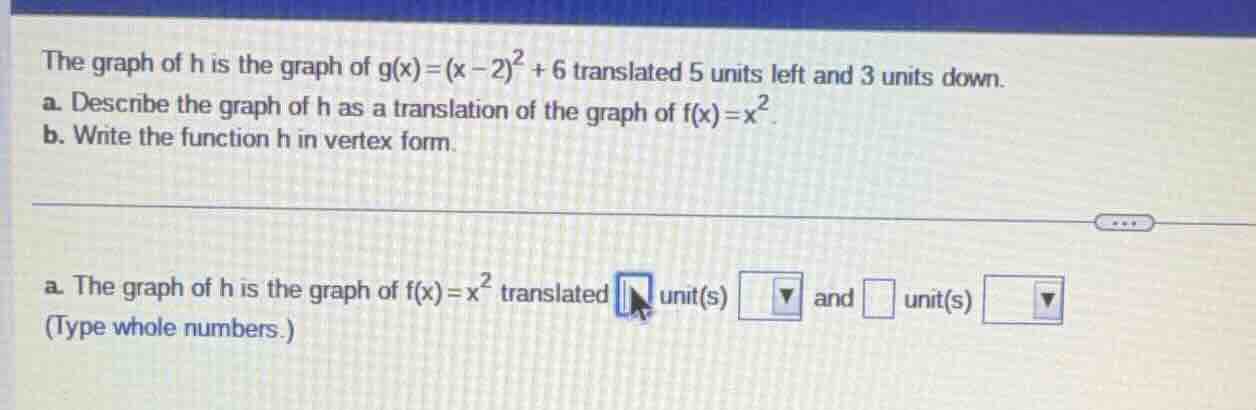
the graph of h is the graph of ( g(x)=(x - 2)^2 + 6 ) translated 5 units left and 3 units down.
a. describe the graph of h as a translation of the graph of ( f(x)=x^2 ).
b. write the function h in vertex form.
a. the graph of h is the graph of ( f(x)=x^2 ) translated (\boxed{}) unit(s) (\boldsymbol{
abla}) and (\boxed{}) unit(s) (\boldsymbol{
abla})
(type whole numbers.)
Part a
To determine the translation from \( f(x) = x^2 \) to \( h(x) \), we first analyze the translation from \( f(x) \) to \( g(x) \), then from \( g(x) \) to \( h(x) \).
- The function \( g(x) = (x - 2)^2 + 6 \) is a translation of \( f(x) = x^2 \). The vertex form of a parabola is \( f(x) = a(x - h)^2 + k \), where \( (h, k) \) is the vertex. For \( g(x) \), the vertex is \( (2, 6) \), so \( f(x) = x^2 \) (vertex at \( (0, 0) \)) is translated 2 units right and 6 units up to get \( g(x) \).
- Now, we translate \( g(x) \) 5 units left and 3 units down to get \( h(x) \). To find the total translation from \( f(x) \) to \( h(x) \):
- Horizontal translation: The original horizontal translation from \( f \) to \( g \) is 2 units right. Then we translate 5 units left. So total horizontal translation: \( 2 - 5=-3 \) (which means 3 units left, since left is negative direction in horizontal translation for \( (x - h) \) form).
- Vertical translation: The original vertical translation from \( f \) to \( g \) is 6 units up. Then we translate 3 units down. So total vertical translation: \( 6 - 3 = 3 \) units down.
Wait, actually, let's re - express the translation rules properly. The rule for horizontal translation: if we have \( y=a(x - h)^2+k \), a change in \( h \) by \( \Delta h \) and \( k \) by \( \Delta k \).
For \( f(x)=x^2=(x - 0)^2+0 \), \( g(x)=(x - 2)^2+6 \): \( h = 2,k = 6 \), so translation from \( f \) to \( g \): 2 units right (\( h\) increases by 2) and 6 units up (\( k\) increases by 6).
Then translating \( g(x) \) 5 units left: for the horizontal shift, if we have \( y=(x - h)^2 + k\), moving left by 5 units means we replace \( x \) with \( x+5 \) in \( g(x) \). So \( g(x + 5)=(x + 5-2)^2+6=(x + 3)^2+6 \). Then moving down 3 units: we subtract 3 from the function, so \( h(x)=(x + 3)^2+6 - 3=(x+3)^2+3 \).
Now, comparing \( h(x)=(x + 3)^2+3 \) with \( f(x)=x^2=(x-0)^2 + 0 \):
- Horizontal translation: The vertex of \( f(x) \) is \( (0,0) \), the vertex of \( h(x) \) is \( (- 3,3) \). So from \( (0,0) \) to \( (-3,3) \), we move 3 units left (since \( 0-3=-3 \)) and 3 units up? Wait, no, wait the vertex form is \( y=a(x - h)^2+k \), so for \( h(x)=(x+3)^2+3=(x-(-3))^2+3 \), the vertex is \( (-3,3) \). So from \( f(x)=x^2 \) (vertex \( (0,0) \)) to \( h(x) \) (vertex \( (-3,3) \)):
Horizontal translation: \( 0\to - 3 \), so we move 3 units left (because to get from \( x = 0 \) to \( x=-3 \), we subtract 3, which is a leftward movement).
Vertical translation: \( 0\to3 \), so we move 3 units up? Wait, no, earlier when we translated \( g(x) \) 5 units left and 3 units down. Let's do it step by step:
- Start with \( f(x)=x^2 \), vertex \( (0,0) \).
- Translate to \( g(x)=(x - 2)^2+6 \): vertex \( (2,6) \) (2 right, 6 up).
- Translate \( g(x) \) 5 units left: new \( x \) - coordinate of vertex: \( 2-5=-3 \); new \( y \) - coordinate of vertex: \( 6 \) (before moving down). Then translate 3 units down: new \( y \) - coordinate: \( 6 - 3=3 \). So vertex of \( h(x) \) is \( (-3,3) \).
So from \( f(x) \) (vertex \( (0,0) \)) to \( h(x) \) (vertex \( (-3,3) \)):
- Horizontal: \( 0\) to \( - 3 \): 3 units left.
- Vertical: \( 0\) to \( 3 \): 3 units up? Wait, no, the problem says "translated 5 units left and 3 units down" from \( g(x) \) to \( h(x) \). Let's re - calculate the total translation from \( f(x) \) to \( h(x) \):
The translation from \( f \) to \( g \): 2 units right, 6 units up.
The translation from \( g \) to \( h \): 5 units left, 3 units down.
Total horizontal translation: \( 2\) units right \( + 5\)…
- We know that \( g(x)=(x - 2)^2+6 \)
- To translate \( g(x) \) 5 units left, we replace \( x \) with \( x + 5 \) in \( g(x) \):
\( g(x + 5)=( (x + 5)-2)^2+6=(x + 3)^2+6 \)
- Then we translate this result 3 units down by subtracting 3 from the function:
\( h(x)=(x + 3)^2+6-3=(x + 3)^2+3 \)
The vertex form of a quadratic function is \( y=a(x - h)^2+k \), where \( (h,k) \) is the vertex. For \( h(x)=(x + 3)^2+3 \), \( a = 1 \), \( h=-3 \), \( k = 3 \), so it is in vertex form.
Final Answers
Part a
The graph of \( h \) is the graph of \( f(x)=x^2 \) translated \(\boldsymbol{3}\) unit(s) left and \(\boldsymbol{3}\) unit(s) up.
Part b
The function \( h \) in vertex form is \( \boldsymbol{h(x)=(x + 3)^2+3} \)
Part a Answer
3 units left and 3 units up (so the blanks should be filled with 3, left, 3, up)
Part b Answer
\( h(x)=(x + 3)^2+3 \)

Snap & solve any problem in the app
Get step-by-step solutions on Sovi AI
Photo-based solutions with guided steps
Explore more problems and detailed explanations
- We know that \( g(x)=(x - 2)^2+6 \)
- To translate \( g(x) \) 5 units left, we replace \( x \) with \( x + 5 \) in \( g(x) \):
\( g(x + 5)=( (x + 5)-2)^2+6=(x + 3)^2+6 \)
- Then we translate this result 3 units down by subtracting 3 from the function:
\( h(x)=(x + 3)^2+6-3=(x + 3)^2+3 \)
The vertex form of a quadratic function is \( y=a(x - h)^2+k \), where \( (h,k) \) is the vertex. For \( h(x)=(x + 3)^2+3 \), \( a = 1 \), \( h=-3 \), \( k = 3 \), so it is in vertex form.
Final Answers
Part a
The graph of \( h \) is the graph of \( f(x)=x^2 \) translated \(\boldsymbol{3}\) unit(s) left and \(\boldsymbol{3}\) unit(s) up.
Part b
The function \( h \) in vertex form is \( \boldsymbol{h(x)=(x + 3)^2+3} \)
Part a Answer
3 units left and 3 units up (so the blanks should be filled with 3, left, 3, up)
Part b Answer
\( h(x)=(x + 3)^2+3 \)