QUESTION IMAGE
Question
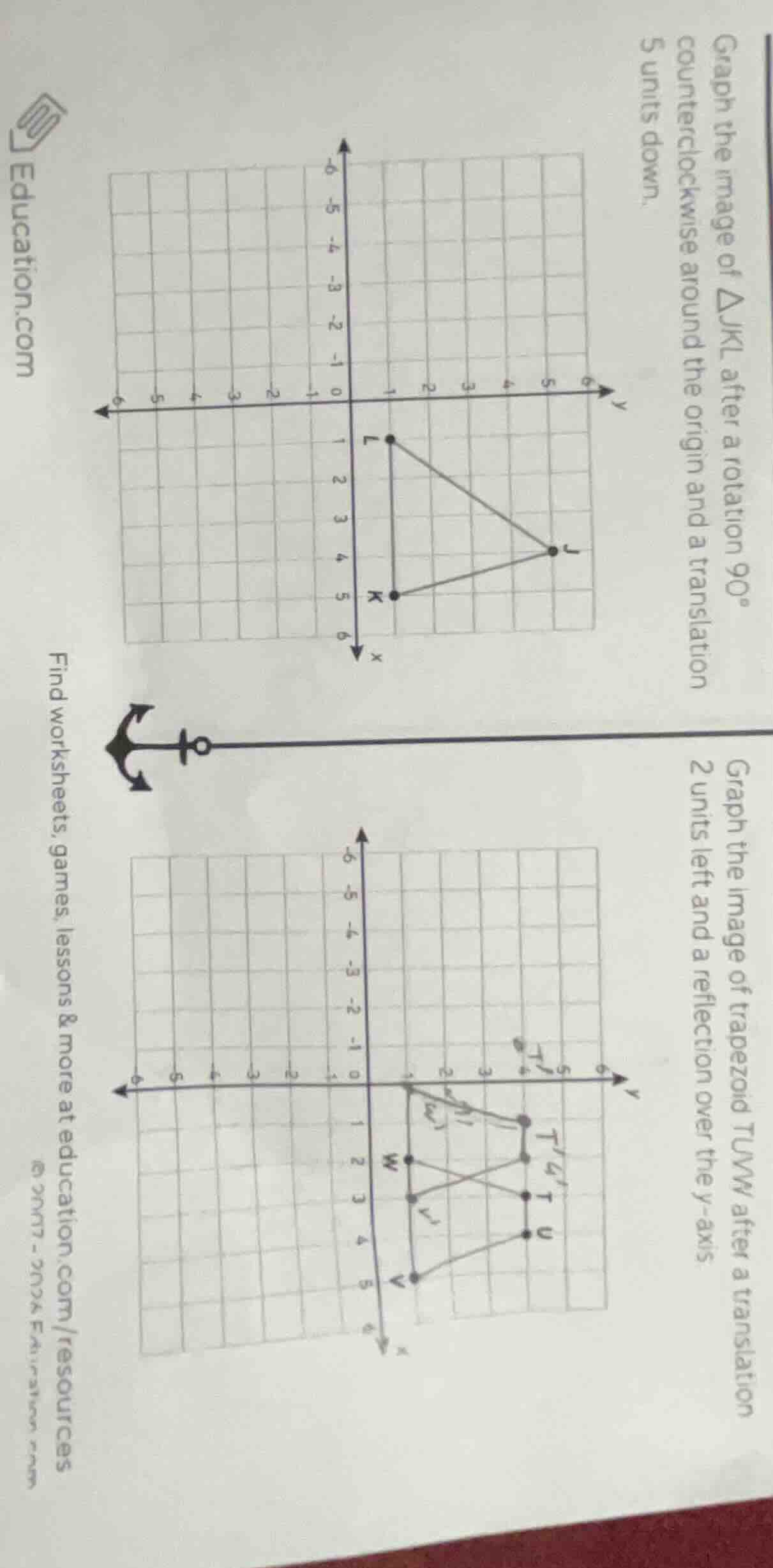
graph the image of $\triangle jkl$ after a rotation $90^\circ$ counterclockwise around the origin and a translation 5 units down.
graph the image of trapezoid tuw after a translation 2 units left and a reflection over the $y$-axis
First Problem (Triangle \( \triangle JKL \)):
Step 1: Identify Coordinates of \( \triangle JKL \)
From the graph:
- \( J \): Let's assume grid coordinates. Looking at the graph, \( J \) seems to be at \( (4, 5) \)? Wait, no, the axes: x-axis (horizontal) and y-axis (vertical). Wait, the graph has x from 0 to 6 (downward? Wait, maybe the axes are labeled with x as vertical? Wait, no, standard coordinate system: x is horizontal (right), y is vertical (up). Wait, the first graph: L is at (1,1)? Wait, no, the grid: let's re-express. Let's take the first triangle \( \triangle JKL \):
Looking at the first graph:
- Point \( L \): Let's see, x (vertical) and y (horizontal)? Wait, maybe the axes are swapped. Wait, the first graph: the x-axis is vertical (downward), y-axis is horizontal (right). So:
- \( L \): x=1, y=1 (so coordinates \( (1, 1) \) if x is vertical, y is horizontal? Wait, no, standard is (x, y) with x horizontal, y vertical. Maybe the graph is rotated. Alternatively, let's use the standard rotation rule: 90° counterclockwise rotation around origin: \( (x, y) \to (-y, x) \).
Wait, let's find the coordinates correctly. Let's assume the first triangle \( \triangle JKL \):
- \( L \): Let's see, in the first graph, the vertical axis (x) and horizontal (y). So \( L \) is at (x=1, y=1) (x down, y right). \( K \) is at (x=5, y=1). \( J \) is at (x=4, y=5). Wait, no, maybe better to list coordinates:
Assuming standard (x, y) where x is horizontal (right), y is vertical (up). Wait, the first graph: the vertical axis is labeled x (from 0 to 6 downward), horizontal is y (from 0 to 6 right). So:
- \( L \): x=1 (down), y=1 (right) → (1, 1)
- \( K \): x=5 (down), y=1 (right) → (5, 1)
- \( J \): x=4 (down), y=5 (right) → (4, 5)
Now, 90° counterclockwise rotation around origin: the rule is \( (x, y) \to (-y, x) \) (if original is (x, y) with x horizontal, y vertical). Wait, no: 90° counterclockwise rotation: \( (x, y) \) becomes \( (-y, x) \).
Wait, let's confirm: for a point \( (a, b) \), 90° counterclockwise rotation around (0,0) is \( (-b, a) \).
Then, translation 5 units down: subtract 5 from the y-coordinate (if y is vertical). Wait, but first, rotation, then translation.
Wait, maybe the coordinates are:
- \( L \): (1, 1) [x=1 (vertical), y=1 (horizontal)] → standard (x, y) = (1, 1)
- \( K \): (5, 1)
- \( J \): (4, 5)
First, rotate 90° counterclockwise:
For \( L(1, 1) \): \( (-1, 1) \) (wait, no: 90° counterclockwise: \( (x, y) \to (-y, x) \). So \( (1, 1) \to (-1, 1) \)? Wait, no: if (x, y) is (horizontal, vertical), then 90° counterclockwise rotation: the new x is -y, new y is x. So (1, 1) → (-1, 1)? Wait, no, let's take (2, 3): 90° counterclockwise is (-3, 2). Yes, so (x, y) → (-y, x).
So:
- \( L(1, 1) \): rotate 90° CCW: \( (-1, 1) \)
- \( K(5, 1) \): rotate 90° CCW: \( (-1, 5) \)
- \( J(4, 5) \): rotate 90° CCW: \( (-5, 4) \)
Then, translation 5 units down: subtract 5 from the y-coordinate (since down is negative y direction).
So:
- \( L' \): \( (-1, 1 - 5) = (-1, -4) \)
- \( K' \): \( (-1, 5 - 5) = (-1, 0) \)
- \( J' \): \( (-5, 4 - 5) = (-5, -1) \)
Now, plot these points: \( L'(-1, -4) \), \( K'(-1, 0) \), \( J'(-5, -1) \).
Second Problem (Trapezoid \( TUVW \)):
Step 1: Identify Coordinates of \( TUVW \)
From the second graph:
Assuming standard (x, y) (x horizontal, y vertical):
- \( T \): Let's see, the trapezoid has points: \( T \), \( U \), \( V \), \( W \). Let's find coordinates:
Looking at the graph:
- \( T \): x=1, y=4 (wait, no, the y-axis is horizontal? Wait, the second graph: y-ax…

Snap & solve any problem in the app
Get step-by-step solutions on Sovi AI
Photo-based solutions with guided steps
Explore more problems and detailed explanations
First Problem (Triangle \( \triangle JKL \)):
Step 1: Identify Coordinates of \( \triangle JKL \)
From the graph:
- \( J \): Let's assume grid coordinates. Looking at the graph, \( J \) seems to be at \( (4, 5) \)? Wait, no, the axes: x-axis (horizontal) and y-axis (vertical). Wait, the graph has x from 0 to 6 (downward? Wait, maybe the axes are labeled with x as vertical? Wait, no, standard coordinate system: x is horizontal (right), y is vertical (up). Wait, the first graph: L is at (1,1)? Wait, no, the grid: let's re-express. Let's take the first triangle \( \triangle JKL \):
Looking at the first graph:
- Point \( L \): Let's see, x (vertical) and y (horizontal)? Wait, maybe the axes are swapped. Wait, the first graph: the x-axis is vertical (downward), y-axis is horizontal (right). So:
- \( L \): x=1, y=1 (so coordinates \( (1, 1) \) if x is vertical, y is horizontal? Wait, no, standard is (x, y) with x horizontal, y vertical. Maybe the graph is rotated. Alternatively, let's use the standard rotation rule: 90° counterclockwise rotation around origin: \( (x, y) \to (-y, x) \).
Wait, let's find the coordinates correctly. Let's assume the first triangle \( \triangle JKL \):
- \( L \): Let's see, in the first graph, the vertical axis (x) and horizontal (y). So \( L \) is at (x=1, y=1) (x down, y right). \( K \) is at (x=5, y=1). \( J \) is at (x=4, y=5). Wait, no, maybe better to list coordinates:
Assuming standard (x, y) where x is horizontal (right), y is vertical (up). Wait, the first graph: the vertical axis is labeled x (from 0 to 6 downward), horizontal is y (from 0 to 6 right). So:
- \( L \): x=1 (down), y=1 (right) → (1, 1)
- \( K \): x=5 (down), y=1 (right) → (5, 1)
- \( J \): x=4 (down), y=5 (right) → (4, 5)
Now, 90° counterclockwise rotation around origin: the rule is \( (x, y) \to (-y, x) \) (if original is (x, y) with x horizontal, y vertical). Wait, no: 90° counterclockwise rotation: \( (x, y) \) becomes \( (-y, x) \).
Wait, let's confirm: for a point \( (a, b) \), 90° counterclockwise rotation around (0,0) is \( (-b, a) \).
Then, translation 5 units down: subtract 5 from the y-coordinate (if y is vertical). Wait, but first, rotation, then translation.
Wait, maybe the coordinates are:
- \( L \): (1, 1) [x=1 (vertical), y=1 (horizontal)] → standard (x, y) = (1, 1)
- \( K \): (5, 1)
- \( J \): (4, 5)
First, rotate 90° counterclockwise:
For \( L(1, 1) \): \( (-1, 1) \) (wait, no: 90° counterclockwise: \( (x, y) \to (-y, x) \). So \( (1, 1) \to (-1, 1) \)? Wait, no: if (x, y) is (horizontal, vertical), then 90° counterclockwise rotation: the new x is -y, new y is x. So (1, 1) → (-1, 1)? Wait, no, let's take (2, 3): 90° counterclockwise is (-3, 2). Yes, so (x, y) → (-y, x).
So:
- \( L(1, 1) \): rotate 90° CCW: \( (-1, 1) \)
- \( K(5, 1) \): rotate 90° CCW: \( (-1, 5) \)
- \( J(4, 5) \): rotate 90° CCW: \( (-5, 4) \)
Then, translation 5 units down: subtract 5 from the y-coordinate (since down is negative y direction).
So:
- \( L' \): \( (-1, 1 - 5) = (-1, -4) \)
- \( K' \): \( (-1, 5 - 5) = (-1, 0) \)
- \( J' \): \( (-5, 4 - 5) = (-5, -1) \)
Now, plot these points: \( L'(-1, -4) \), \( K'(-1, 0) \), \( J'(-5, -1) \).
Second Problem (Trapezoid \( TUVW \)):
Step 1: Identify Coordinates of \( TUVW \)
From the second graph:
Assuming standard (x, y) (x horizontal, y vertical):
- \( T \): Let's see, the trapezoid has points: \( T \), \( U \), \( V \), \( W \). Let's find coordinates:
Looking at the graph:
- \( T \): x=1, y=4 (wait, no, the y-axis is horizontal? Wait, the second graph: y-axis is horizontal (right), x-axis is vertical (down). So:
- \( T \): x=1 (down), y=4 (right) → (1, 4)
- \( U \): x=1 (down), y=5 (right) → (1, 5)
- \( V \): x=5 (down), y=5 (right) → (5, 5)
- \( W \): x=2 (down), y=2 (right) → (2, 2)
First, translation 2 units left: subtract 2 from the y-coordinate (since y is horizontal, left is negative y).
So:
- \( T \): (1, 4 - 2) = (1, 2)
- \( U \): (1, 5 - 2) = (1, 3)
- \( V \): (5, 5 - 2) = (5, 3)
- \( W \): (2, 2 - 2) = (2, 0)
Then, reflection over the y-axis: reflection over y-axis (x=0) changes (x, y) to (-x, y) (if x is vertical, y is horizontal? Wait, no, standard reflection over y-axis: (x, y) → (-x, y) where x is horizontal, y is vertical. Wait, in our case, x is vertical (down), y is horizontal (right). So reflection over y-axis (vertical line x=0? No, y-axis is horizontal. Wait, maybe the axes are swapped. Let's re-express with standard (x, y) where x is horizontal (right), y is vertical (up). Then the second graph's y-axis is horizontal (right), x-axis is vertical (down). So:
- \( T \): (y=4, x=1) → (4, 1) (standard: (x, y) = (horizontal, vertical))
- \( U \): (y=5, x=1) → (5, 1)
- \( V \): (y=5, x=5) → (5, 5)
- \( W \): (y=2, x=2) → (2, 2)
Now, translation 2 units left: subtract 2 from the x-coordinate (horizontal left is negative x).
So:
- \( T \): (4 - 2, 1) = (2, 1)
- \( U \): (5 - 2, 1) = (3, 1)
- \( V \): (5 - 2, 5) = (3, 5)
- \( W \): (2 - 2, 2) = (0, 2)
Then, reflection over the y-axis: reflection over y-axis (x=0) changes (x, y) to (-x, y).
So:
- \( T' \): (-2, 1)
- \( U' \): (-3, 1)
- \( V' \): (-3, 5)
- \( W' \): (0, 2)
Now, plot these points: \( T'(-2, 1) \), \( U'(-3, 1) \), \( V'(-3, 5) \), \( W'(0, 2) \).
Final Answer (Graphing Instructions):
For \( \triangle JKL \):
- Rotate each vertex 90° counterclockwise: \( (x, y) \to (-y, x) \).
- Translate 5 units down: subtract 5 from y-coordinate.
- Plot the new vertices and connect.
For trapezoid \( TUVW \):
- Translate 2 units left: subtract 2 from x-coordinate.
- Reflect over y-axis: \( (x, y) \to (-x, y) \).
- Plot the new vertices and connect.
(Note: The actual graphing requires plotting the calculated coordinates on the grid, which is a visual task. The key is applying the transformation rules correctly.)