QUESTION IMAGE
Question
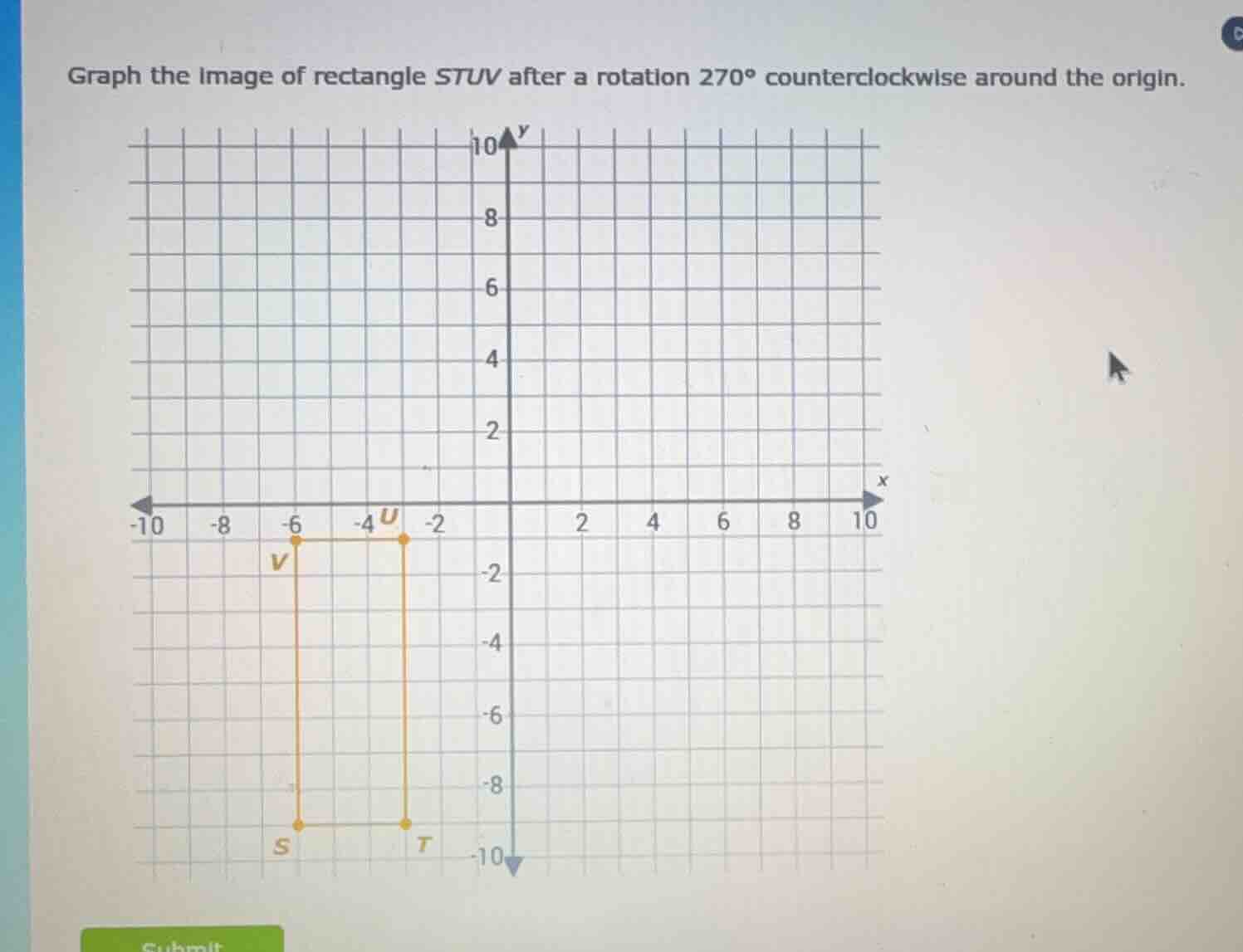
graph the image of rectangle stuv after a rotation 270° counterclockwise around the origin.
First, we need to find the coordinates of the vertices of rectangle \( STUV \). From the graph:
- \( S(-6, -9) \) (assuming the bottom vertex S is at y=-9, since it's a rectangle and V is at (-6, -1), wait, no, looking at the grid, V is at (-6, -1)? Wait, no, the grid: V is at (-6, -1)? Wait, the y-axis: the orange points. Let's recheck:
Looking at the graph, the coordinates:
- \( V(-6, -1) \)? Wait, no, the vertical lines: V is at (-6, -1)? Wait, no, the y-coordinate: the orange segment from V to S: V is at (-6, -1), S is at (-6, -9)? Wait, no, the grid lines: each grid is 1 unit. Let's see:
Point \( V \): x=-6, y=-1? Wait, no, the point V is at (-6, -1)? Wait, the U is at (-3, -1)? Wait, no, the original rectangle: V is at (-6, -1), U is at (-3, -1), T is at (-3, -9), S is at (-6, -9)? Wait, no, the graph shows:
Wait, the orange points: V is at (-6, -1) (since it's on the horizontal line y=-1, x=-6), U is at (-3, -1) (x=-3, y=-1), T is at (-3, -9) (x=-3, y=-9), S is at (-6, -9) (x=-6, y=-9). Yes, that makes a rectangle.
Now, the rule for a \( 270^\circ \) counterclockwise rotation around the origin is \( (x, y)
ightarrow (y, -x) \).
Step 1: Find coordinates of each vertex
- \( S(-6, -9) \)
- \( T(-3, -9) \)
- \( U(-3, -1) \)
- \( V(-6, -1) \)
Step 2: Apply rotation rule \( (x, y)
ightarrow (y, -x) \) to each vertex
- For \( S(-6, -9) \):
New x = -9, New y = -(-6) = 6. So \( S'(-9, 6) \)? Wait, no, wait the rotation rule: \( 270^\circ \) counterclockwise is equivalent to \( 90^\circ \) clockwise, and the rule is \( (x, y)
ightarrow (y, -x) \). Wait, let's confirm:
The rotation rules:
- \( 90^\circ \) counterclockwise: \( (x, y)
ightarrow (-y, x) \)
- \( 180^\circ \) counterclockwise: \( (x, y)
ightarrow (-x, -y) \)
- \( 270^\circ \) counterclockwise: \( (x, y)
ightarrow (y, -x) \)
Yes, so:
- \( S(-6, -9) \): \( (x, y) = (-6, -9) \), so new \( (y, -x) = (-9, -(-6)) = (-9, 6) \)? Wait, no, \( -x \) when x=-6 is -(-6)=6. So \( S'(-9, 6) \)?
Wait, no, let's take a point (a, b). After \( 270^\circ \) counterclockwise rotation, the new coordinates are (b, -a). So for (x, y) = (a, b), new (b, -a).
So:
- \( S(-6, -9) \): a=-6, b=-9. New (b, -a) = (-9, -(-6)) = (-9, 6)
- \( T(-3, -9) \): a=-3, b=-9. New (b, -a) = (-9, -(-3)) = (-9, 3)
- \( U(-3, -1) \): a=-3, b=-1. New (b, -a) = (-1, -(-3)) = (-1, 3)
- \( V(-6, -1) \): a=-6, b=-1. New (b, -a) = (-1, -(-6)) = (-1, 6)
Wait, but let's check with a simple point. For example, a point (1, 0) rotated \( 270^\circ \) counterclockwise: it should go to (0, -1)? Wait, no, \( 270^\circ \) counterclockwise from (1,0) is (0, -1)? Wait, no, \( 90^\circ \) counterclockwise: (0,1); \( 180^\circ \): (-1,0); \( 270^\circ \): (0, -1). Using the rule (x,y)→(y, -x): (1,0)→(0, -1). Correct. So the rule is correct.
Now, let's re-express the original coordinates correctly. Wait, maybe I misread the coordinates. Let's look again:
The rectangle: V is at (-6, -1), U is at (-3, -1), T is at (-3, -9), S is at (-6, -9). So:
- \( V(-6, -1) \)
- \( U(-3, -1) \)
- \( T(-3, -9) \)
- \( S(-6, -9) \)
Now apply the rotation:
- \( S(-6, -9) \): (x,y)=(-6,-9) → (y, -x)=(-9, -(-6))=(-9, 6)
- \( T(-3, -9) \): (x,y)=(-3,-9) → (y, -x)=(-9, -(-3))=(-9, 3)
- \( U(-3, -1) \): (x,y)=(-3,-1) → (y, -x)=(-1, -(-3))=(-1, 3)
- \( V(-6, -1) \): (x,y)=(-6,-1) → (y, -x)=(-1, -(-6))=(-1, 6)
Now, we need to plot these new points:
- \( S'(-9, 6) \)
- \( T'(-9, 3) \) Wait, no, wait T was (-3, -9), so (y, -x) is (-9, 3). Wait, no, T is (-3, -9), so x=-3, y=-9. So (y, -x) = (-9, 3). Correct.
Wait, no, U is (-3, -1): x=-3, y…

Snap & solve any problem in the app
Get step-by-step solutions on Sovi AI
Photo-based solutions with guided steps
Explore more problems and detailed explanations
The image of rectangle \( STUV \) after a \( 270^\circ \) counterclockwise rotation around the origin has vertices at \( S'(-9, 6) \), \( T'(-9, 3) \), \( U'(-1, 3) \), and \( V'(-1, 6) \). (To graph, plot these points and connect them in order.)