QUESTION IMAGE
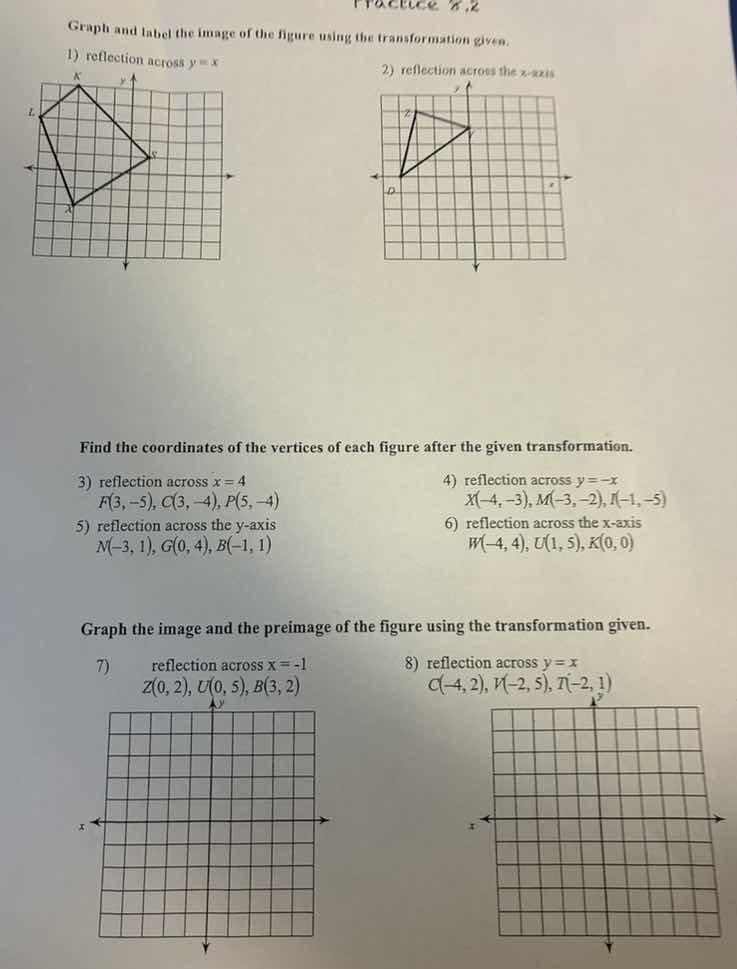
Question
graph and label the image of the figure using the transformation given.
- reflection across $y = x$
- reflection across the x-axis
find the coordinates of the vertices of each figure after the given transformation.
- reflection across $x = 4$
$f(3, -5), c(3, -4), p(5, -4)$
- reflection across $y = -x$
$x(-4, -3), m(-3, -2), i(-1, -5)$
- reflection across the y-axis
$n(-3, 1), g(0, 4), b(-1, 1)$
- reflection across the x-axis
$w(-4, 4), u(1, 5), k(0, 0)$
graph the image and the preimage of the figure using the transformation given.
- reflection across $x = -1$
$z(0, 2), u(0, 5), b(3, 2)$
- reflection across $y = x$
$c(-4, 2), v(-2, 5), t(-2, 1)$
Step1: Identify reflection rule for $y=x$
For a point $(x,y)$, reflection over $y=x$ is $(y,x)$.
Step2: Identify original vertices (1)
Assume vertices: $L(-4,1), K(-2,3), S(2,1), X(-2,-2)$
Step3: Apply rule to (1)
$L'(1,-4), K'(3,-2), S'(1,2), X'(-2,-2)$
Step4: Identify reflection rule for x-axis
For a point $(x,y)$, reflection over x-axis is $(x,-y)$.
Step5: Identify original vertices (2)
Assume vertices: $D(-2,-1), Z(-1,2), S(1,2)$
Step6: Apply rule to (2)
$D'(-2,1), Z'(-1,-2), S'(1,-2)$
Step7: Reflection over $x=4$ formula
For $(x,y)$, new $x=2*4-x=8-x$, $y$ stays.
Step8: Apply to (3) points
$F(3,-5)\to(8-3,-5)=(5,-5)$
$C(3,-4)\to(8-3,-4)=(5,-4)$
$P(5,-4)\to(8-5,-4)=(3,-4)$
Step9: Reflection over $y=-x$ formula
For $(x,y)$, new point is $(-y,-x)$.
Step10: Apply to (4) points
$X(-4,-3)\to(3,4)$
$M(-3,-2)\to(2,3)$
$I(-1,-5)\to(5,1)$
Step11: Reflection over y-axis formula
For $(x,y)$, new point is $(-x,y)$.
Step12: Apply to (5) points
$N(-3,1)\to(3,1)$
$G(0,4)\to(0,4)$
$B(-1,1)\to(1,1)$
Step13: Apply x-axis rule to (6)
$W(-4,4)\to(-4,-4)$
$U(1,5)\to(1,-5)$
$K(0,0)\to(0,0)$
Step14: Reflection over $x=-1$ formula
For $(x,y)$, new $x=2*(-1)-x=-2-x$, $y$ stays.
Step15: Apply to (7) points
$Z(0,2)\to(-2-0,2)=(-2,2)$
$U(0,5)\to(-2-0,5)=(-2,5)$
$B(3,2)\to(-2-3,2)=(-5,2)$
Step16: Apply $y=x$ rule to (8)
$C(-4,2)\to(2,-4)$
$V(-2,5)\to(5,-2)$
$T(-2,1)\to(1,-2)$

Snap & solve any problem in the app
Get step-by-step solutions on Sovi AI
Photo-based solutions with guided steps
Explore more problems and detailed explanations
- Reflected vertices over $y=x$: $L'(1,-4), K'(3,-2), S'(1,2), X'(-2,-2)$ (graph by plotting these points)
- Reflected vertices over x-axis: $D'(-2,1), Z'(-1,-2), S'(1,-2)$ (graph by plotting these points)
- $F'(5,-5), C'(5,-4), P'(3,-4)$
- $X'(3,4), M'(2,3), I'(5,1)$
- $N'(3,1), G'(0,4), B'(1,1)$
- $W'(-4,-4), U'(1,-5), K'(0,0)$
- Reflected vertices over $x=-1$: $Z'(-2,2), U'(-2,5), B'(-5,2)$ (graph preimage and image)
- Reflected vertices over $y=x$: $C'(2,-4), V'(5,-2), T'(1,-2)$ (graph preimage and image)