QUESTION IMAGE
Question
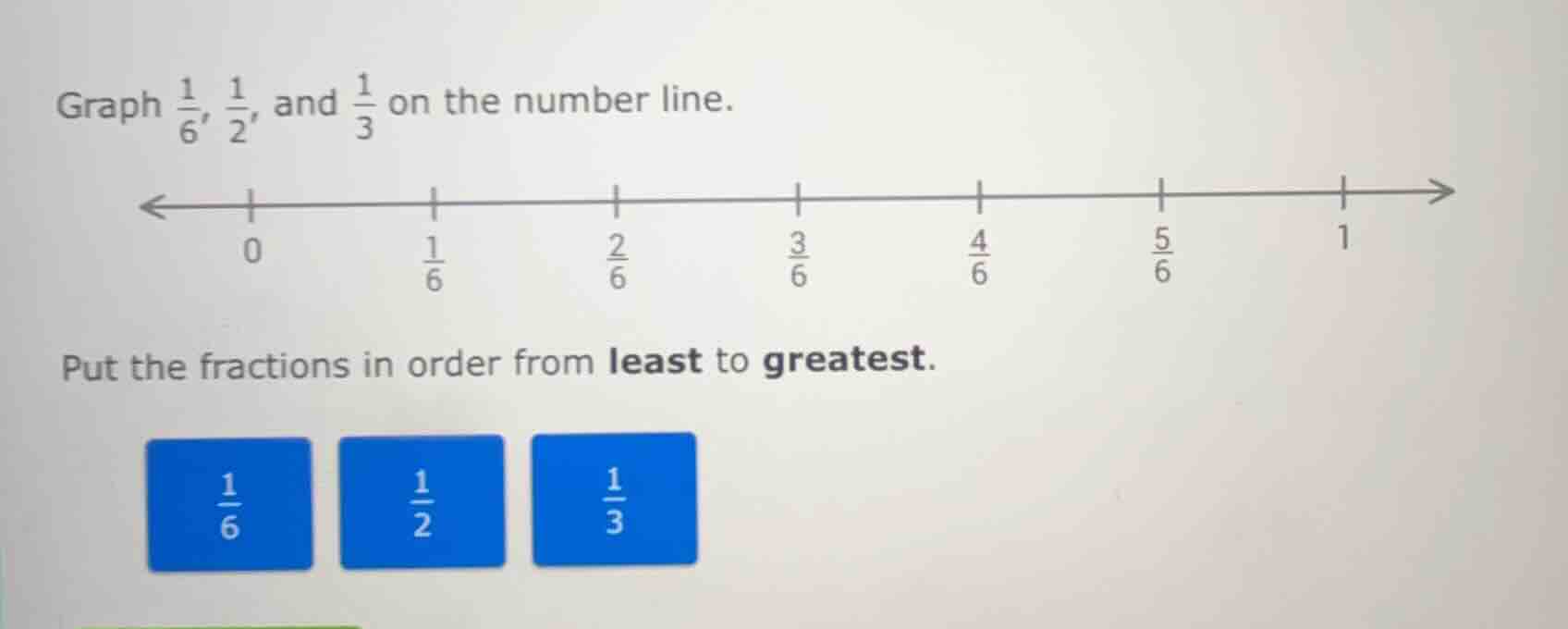
graph \\(\frac{1}{6}\\), \\(\frac{1}{2}\\), and \\(\frac{1}{3}\\) on the number line.
\\(\leftarrow\\) \\(\frac{0}{}\\) \\(\frac{}{}\\) \\(\frac{1}{6}\\) \\(\frac{2}{6}\\) \\(\frac{3}{6}\\) \\(\frac{4}{6}\\) \\(\frac{5}{6}\\) \\(\frac{1}{}\\) \\(\
ightarrow\\)
put the fractions in order from least to greatest.
\\(\frac{1}{6}\\) \\(\frac{1}{2}\\) \\(\frac{1}{3}\\)
Step1: Find common denominator
To compare \(\frac{1}{6}\), \(\frac{1}{2}\), and \(\frac{1}{3}\), we find a common denominator. The least common denominator of 6, 2, and 3 is 6.
Convert \(\frac{1}{2}\) to sixths: \(\frac{1}{2}=\frac{1\times3}{2\times3}=\frac{3}{6}\)
Convert \(\frac{1}{3}\) to sixths: \(\frac{1}{3}=\frac{1\times2}{3\times2}=\frac{2}{6}\)
\(\frac{1}{6}\) remains \(\frac{1}{6}\).
Step2: Compare numerators
Now we have \(\frac{1}{6}\), \(\frac{2}{6}\), and \(\frac{3}{6}\). Since the denominators are the same, we compare the numerators. \(1 < 2 < 3\), so \(\frac{1}{6} < \frac{2}{6} < \frac{3}{6}\).
Step3: Convert back to original fractions
Substituting back, we get \(\frac{1}{6} < \frac{1}{3} < \frac{1}{2}\).

Snap & solve any problem in the app
Get step-by-step solutions on Sovi AI
Photo-based solutions with guided steps
Explore more problems and detailed explanations
\(\frac{1}{6}\), \(\frac{1}{3}\), \(\frac{1}{2}\)