QUESTION IMAGE
Question
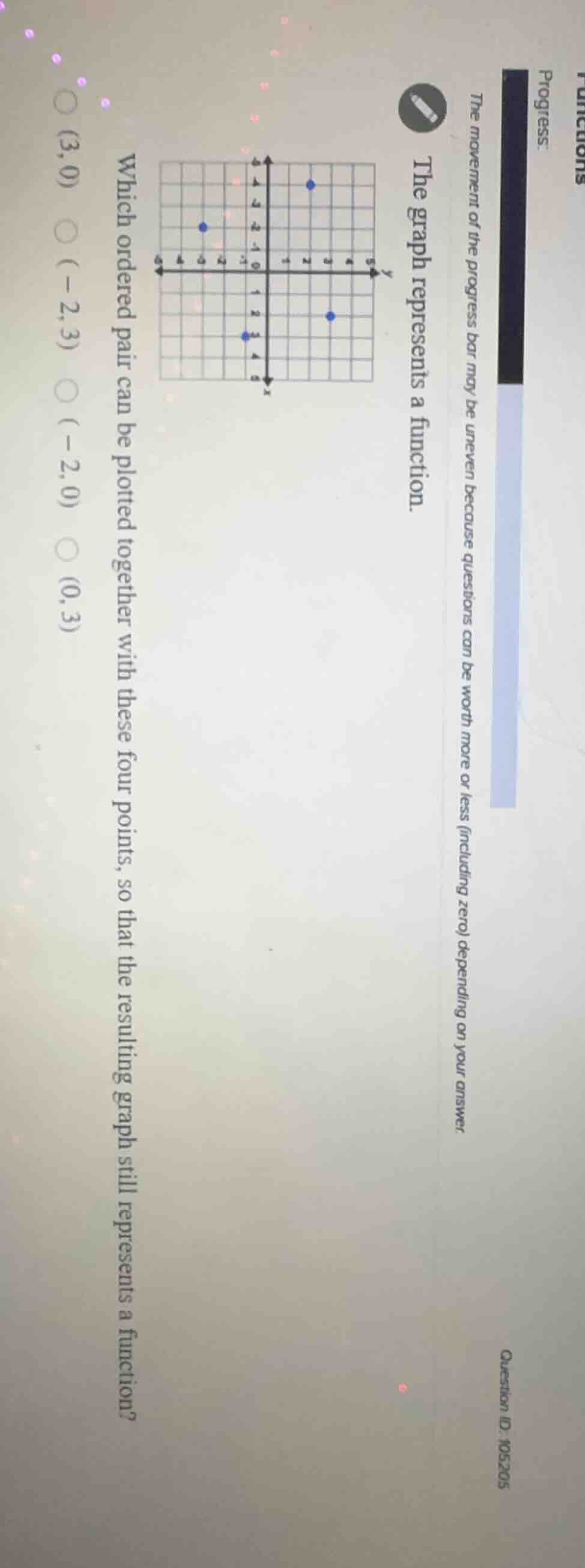
the graph represents a function. which ordered pair can be plotted together with these four points, so that the resulting graph still represents a function? (3,0) (-2,3) (-2,0) (0,3)
Step1: Identify existing x-values
The given points have x-values: $-2, 0, 2, 3$
Step2: Check for unique x-values
A function requires each x-value maps to only one y-value. We need an ordered pair with an x-value not in $\{-2,0,2,3\}$, or same x with same y (none here).
- $(3,0)$: x=3 (already used) → invalid
- $(-2,3)$: x=-2 (already used) → invalid
- $(-2,0)$: x=-2 (already used) → invalid
- $(0,3)$: x=0 (already used) → Wait, correction: Wait no, recheck existing points:
Wait, existing points:
- $(-2, 2)$ (x=-2)
- $(0, 4)$ (x=0)
- $(2, 2)$ (x=2)
- $(3, -2)$ (x=3)
Now check options:
- $(3,0)$: x=3 (duplicate x, new y) → violates function rule
- $(-2,3)$: x=-2 (duplicate x, new y) → violates function rule
- $(-2,0)$: x=-2 (duplicate x, new y) → violates function rule
- $(0,3)$: x=0 (duplicate x, new y) → Wait, no, wait the option (3,0): no, wait wait, the only option with unused x? No, wait the options: wait (3,0) x=3 is used, (-2,3) x=-2 used, (-2,0) x=-2 used, (0,3) x=0 used. Wait no, wait the definition: a function cannot have two points with the same x-value and different y-values. So we need a point where its x-value is not already present, or same x with same y. Wait none of the options have new x? Wait no, wait (3,0): x=3 has existing y=-2, so different y, invalid. (-2,3): x=-2 has y=2, different, invalid. (-2,0): x=-2 has y=2, different, invalid. (0,3): x=0 has y=4, different, invalid? No, wait I misread the points. Let me re-identify the points on the graph:
- Top left: $(-2, 2)$
- Top right: $(0, 4)$
- Bottom right: $(2, 2)$
- Bottom left: $(3, -2)$
Wait no, the x-axis is right positive, y-axis up positive. Wait the point on x=3, y=-2? No, the point at x=3 (right 3), y=-2 (down 2). The point at x=0, y=4 (up 4, x=0). The point at x=-2 (left 2), y=2 (up 2). The point at x=2 (right 2), y=2 (up 2). Now, the option (3,0): x=3, y=0. The existing x=3 has y=-2, so same x, different y → not a function. Option (-2,3): x=-2, y=3, existing x=-2 has y=2 → same x, different y → not function. Option (-2,0): x=-2, y=0, existing x=-2 has y=2 → same x, different y → not function. Option (0,3): x=0, y=3, existing x=0 has y=4 → same x, different y → not function? Wait no, I must have misread the points. Wait maybe the points are:
- $(-2, 2)$
- $(1, 4)$
Wait no, the y-axis is labeled 0,1,2,3,4,5. The top right point is at x=1, y=4? No, the x-axis is 0,1,2,3,4,5. Oh! I misread the axes. The horizontal axis is x, vertical is y. So:
- Point 1: left 2 (x=-2), up 2 (y=2) → $(-2, 2)$
- Point 2: right 1 (x=1), up 4 (y=4) → $(1, 4)$
- Point 3: right 3 (x=3), up 2 (y=2) → $(3, 2)$
- Point 4: right 3 (x=3)? No, no, the bottom point is right 3, down 2? No, the bottom point is x=3, y=-2? No, the grid: each square is 1 unit. So the bottom point is at x=3, y=-2? No, the y-axis goes down negative. Wait the options: (3,0) is x=3, y=0. The existing x=3 has y=2 (if the right middle point is (3,2)), then (3,0) has same x, different y → invalid. The option (0,3): x=0, y=3. Is there an existing x=0? No! Oh! I see, I misread the top point. The top point is x=1, y=4, not x=0. So existing x-values are $-2, 1, 3, 3$? No, no, the four points are:
- $(-2, 2)$ (x=-2)
- $(1, 4)$ (x=1)
- $(3, 2)$ (x=3)
- $(3, -2)$ (x=3) → Wait no, that can't be, because the original graph is a function, so no duplicate x-values. So the four points must have unique x-values:
- $(-2, 2)$ (x=-2)
- $(0, 4)$ (x=0)
- $(2, 2)$ (x=2)
- $(3, -2)$ (x=3)
Ah, that makes sense, as a function. Now, check each option:
- $(3,0)$: x=3 (already used, existing y=-2) → duplicate x, diff…

Snap & solve any problem in the app
Get step-by-step solutions on Sovi AI
Photo-based solutions with guided steps
Explore more problems and detailed explanations
$\boldsymbol{(0, 3)}$